
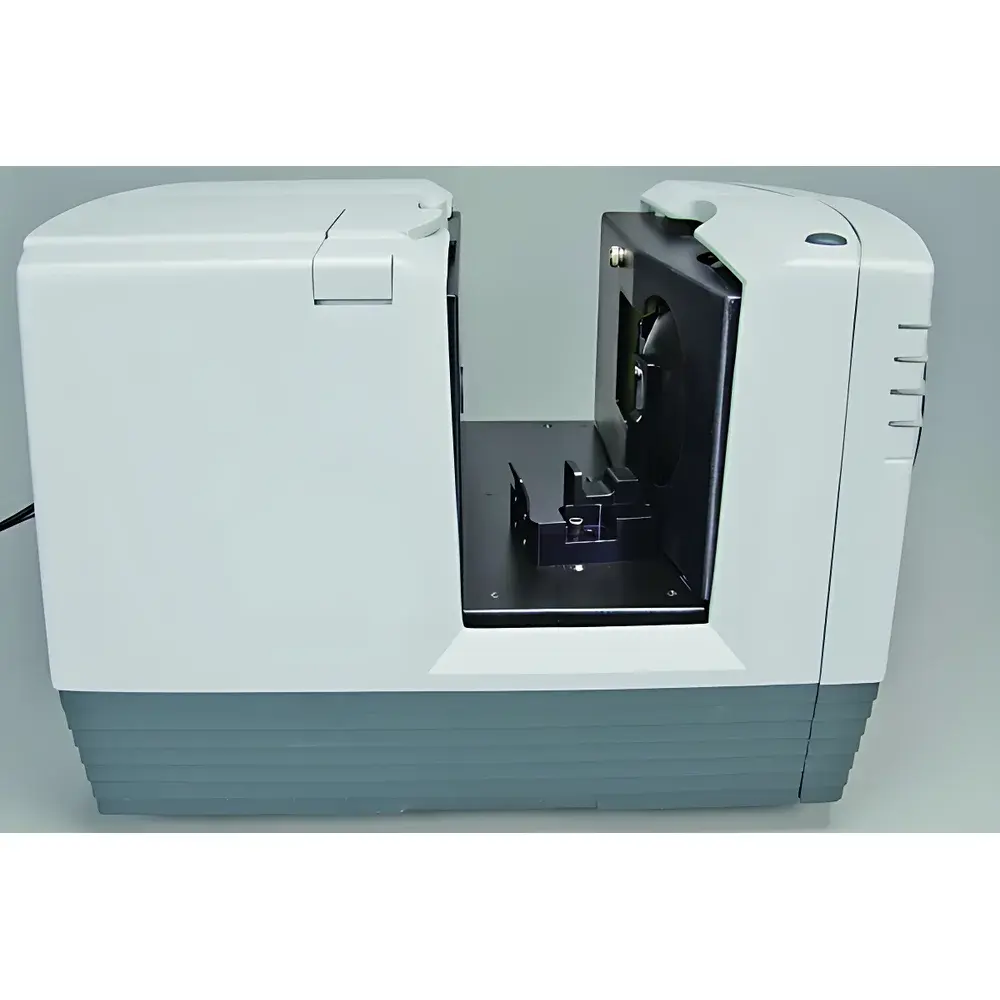
HunterLab UltraScan VIS Benchtop Spectrophotometric Colorimeter
| Brand | HunterLab |
|---|---|
| Origin | USA |
| Model | UltraScan VIS |
| Instrument Type | Benchtop |
| Optical Geometry | d/8° Integrating Sphere |
| Light Source | D65 Illuminant with Automatic UV Correction via Fluorescent Standard & Removable UV Filter |
| Spectral Range | 360–780 nm |
| Measurement Modes | Reflectance (SCI/SCE), Transmittance (Directional d/0° and Total d/8°), Haze (Transmittance Turbidity) |
| Compliance | ASTM E308, ASTM D2244, ISO 7724, CIE No. 15, USP <631> |
| Repeatability | ≤0.02 ΔE*ab (White Tile, 10 readings) |
| Detector | Dual Photodiode Array (10 nm Effective Bandwidth) |
| Aperture Options | Large Area View (LAV): 25 mm (19 mm optical), Small Area View (SAV): 9.5 mm (6.3 mm optical) |
| Interface | USB 2.0 & RS-232C |
| Sample Handling | Ergonomic Spring-Loaded Clamp (180° articulation, dual quick-release), Oversized Transmittance Chamber (3-sided access, accommodates cuvettes up to 80 mm) |
Overview
The HunterLab UltraScan VIS is a high-precision benchtop spectrophotometric colorimeter engineered for pharmaceutical, cosmetic, and regulatory-compliant quality control laboratories requiring traceable, repeatable, and metrologically robust color measurement across the full visible spectrum—and beyond. Operating on the CIE-recommended d/8° integrating sphere geometry for reflectance and both d/0° (directional) and d/8° (total) configurations for transmittance, the UltraScan VIS delivers spectrophotometric data from 360 nm to 780 nm at 10 nm intervals. This extended spectral range enables quantification of UV-excited fluorescence—critical for detecting optical brighteners in excipients, coatings, or active pharmaceutical ingredients (APIs)—while maintaining strict adherence to USP , ASTM E308, ISO 7724-1, and CIE Publication 15:2018. Its dual photodiode array architecture eliminates mechanical moving parts in the optical path, ensuring long-term photometric stability and inter-instrument agreement within ±0.02 ΔE*ab (10 readings on CR-300 white tile), a performance benchmark essential for multi-site QC harmonization and raw material release decisions.
Key Features
- Regulatory-Ready Optical Design: Complies with FDA-referenced standards including USP for colorimetric assay validation and ASTM D2244 for color difference tolerancing—supporting GLP/GMP documentation workflows.
- Automated SCI/SCE Switching: Software-controlled specular component inclusion/exclusion eliminates manual port cover manipulation, reducing operator error and enabling consistent gloss-inclusive (SCE) and gloss-excluded (SCI) reporting per ISO 2813 and ASTM D523.
- Dual-Aperture System: Motor-driven LAV (25 mm physical / 19 mm optical) and SAV (9.5 mm / 6.3 mm) apertures auto-align lens position and validate sample placement—ensuring geometric conformity per CIE 15:2018 Annex D.
- UV-Managed Fluorescence Measurement: Integrated D65 illuminant paired with NIST-traceable fluorescent standard and motorized UV filter allows automatic UV energy calibration or complete UV blocking—enabling compliant measurement of optically brightened films, capsules, and liquid formulations.
- Oversized Transmittance Chamber: Three-sided open architecture accommodates cuvettes up to 80 mm pathlength, PET films, and irregularly shaped transparent solids—supporting both directional (d/0°) and total (d/8°) transmittance per ASTM D1003 for haze-corrected color assessment.
- Thermally Neutral Pulsed Xenon Source: Microsecond-duration flash eliminates thermal loading on light-sensitive samples (e.g., photosensitive APIs, gelatin capsules), mitigating triplet-state artifacts and preserving sample integrity during repeated measurements.
Sample Compatibility & Compliance
The UltraScan VIS supports solid, liquid, and semi-solid pharmaceutical forms—including tablets, coated pellets, suspensions, solutions, gels, and blister packaging—without modification. Its ergonomic spring-loaded clamp accommodates irregular geometries and thicknesses up to 40 mm; the transmittance chamber accepts ISO-standard 10 mm, 20 mm, and 50 mm cuvettes as well as custom 80 mm cells. All measurement protocols align with ICH Q5C (stability-indicating color methods), USP (colorimetric assays), and ASTM E2849 (pharmaceutical color tolerance specification). Instrument qualification documentation (IQ/OQ/PQ templates), electronic audit trail (21 CFR Part 11–compliant software optional), and NIST-traceable calibration certificates are provided to support regulatory submissions and internal quality audits.
Software & Data Management
Controlled via HunterLab’s Universal Software Suite (v5.0+), the UltraScan VIS supports automated method execution, statistical process control (SPC) charting, and multivariate trend analysis. Raw spectral data (360–780 nm @ 10 nm steps) is exportable in CSV, XML, and ASTM E2534-compliant formats. The software enforces user-level permissions, electronic signatures, and full audit trail logging—including parameter changes, calibration events, and result modifications—to satisfy FDA 21 CFR Part 11 and EU Annex 11 requirements. Optional IQ/OQ/PQ packages include test scripts, acceptance criteria, and documented evidence for installation, operational, and performance qualification under GAMP 5 guidelines.
Applications
- Quantitative color release testing of tablets and capsules per USP monographs
- Optical brightener detection in cellulose-based excipients and film coatings
- Haze-corrected transmittance analysis of ophthalmic solutions and parenteral preparations
- Batch-to-batch consistency monitoring of liquid suspensions and emulsions
- Stability-indicating color change tracking during accelerated and real-time stability studies (ICH Q1A)
- Raw material identity verification using spectral fingerprint matching (PCA or Mahalanobis distance)
FAQ
Does the UltraScan VIS meet USP requirements for colorimetric assay validation?
Yes—the instrument’s spectral range (360–780 nm), D65 illumination, and compliance with ASTM E308 calculation methods fulfill all technical criteria specified in USP . Validation kits and protocol templates are included.
Can it measure turbid pharmaceutical suspensions accurately?
Yes—its d/8° total transmittance mode corrects for scattering effects, and optional haze calculation (ASTM D1003) provides quantitative turbidity values alongside CIELAB coordinates.
Is UV filter calibration traceable to NIST standards?
Yes—each UV filter set ships with a NIST-traceable calibration certificate verifying spectral transmittance at 365 nm and 360 nm endpoints.
How is inter-instrument agreement maintained across multiple sites?
Through factory-applied characterization using master tiles and proprietary spectral correction algorithms, achieving ≤0.08 ΔE*ab inter-unit agreement (n=10 instruments, CR-300 tile, 23°C ±2°C).
Does the software support electronic signatures for 21 CFR Part 11 compliance?
Yes—when configured with the optional Compliance Module, it provides role-based access control, biometric or token-based e-signatures, and immutable audit trails with time-stamped event logs.





