
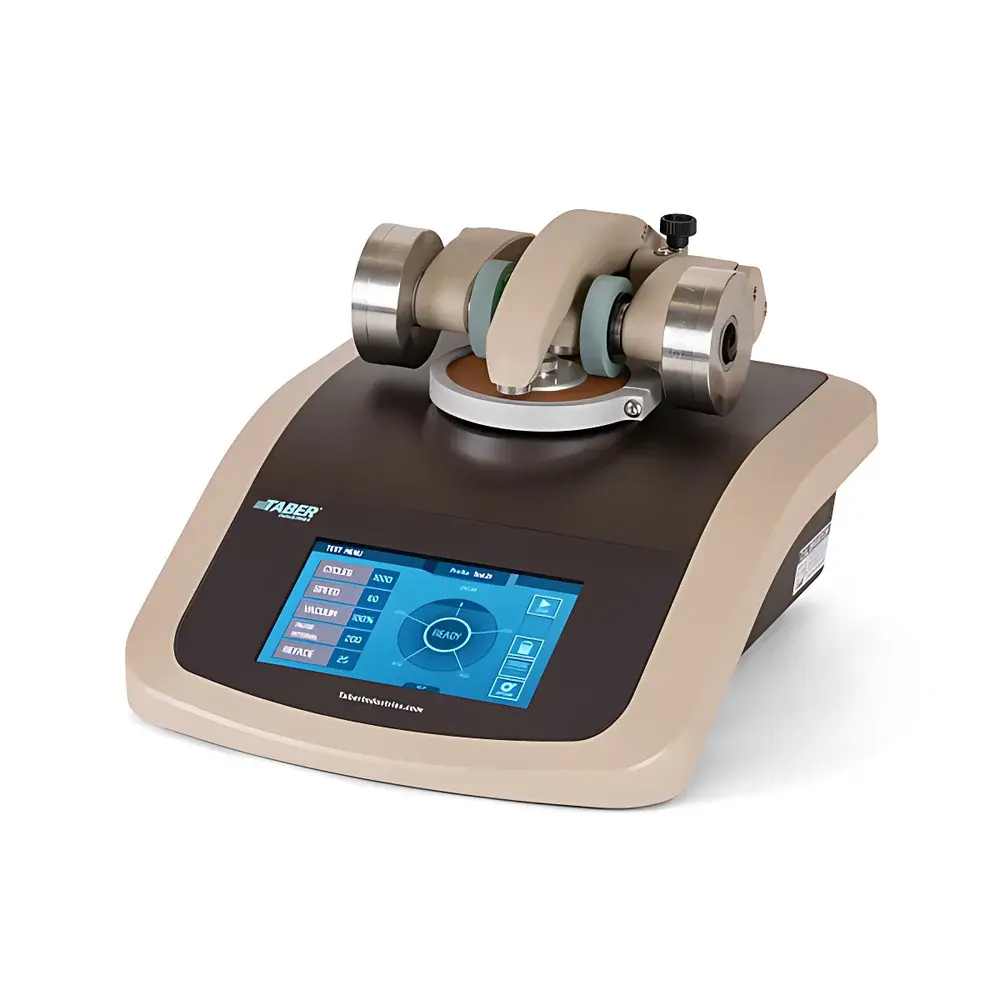
Taber Abraser Model 1700/1750 Rotational Wear Tester
| Brand | Taber Industries |
|---|---|
| Origin | USA |
| Model | TABER 1700 / TABER 1750 |
| Voltage/Frequency | 115/230 V, 50/60 Hz |
| Configuration | Single-Station (1700) or Dual-Station (1750) |
| Standard Load | 250 g (base arm weight), adjustable to 50 g–1000 g via calibrated counterweights |
| Sample Size | 100 mm square or circular |
| Max Sample Thickness | 40 mm (with optional spacers) |
| Abrasion Pattern Area | ~30 cm² per cycle |
| Rotation Speed | 60 or 72 rpm (selectable) |
| Vacuum System | Integrated, height-adjustable nozzle |
| Construction | Anodized aluminum housing, polished stainless-steel weights |
| Compliance | ASTM D4060, ISO 5470-1, TAPPI T476, BS EN 13329, JIS K 6902, GB/T 23988 |
Overview
The Taber Abraser Model 1700 and 1750 are precision-engineered rotational wear testers designed for accelerated abrasion resistance evaluation of flat, rigid, or semi-rigid materials. Based on the standardized Taber abrading method—first introduced in 1930—the instrument employs a dual-wheel, counter-rotating geometry to simulate multi-directional surface wear under controlled mechanical stress. Each test station features a horizontally rotating turntable that drives two abrasive wheels (e.g., CS-10, CS-17, S-33, or custom profiles) in opposite tangential directions across the specimen surface, generating a characteristic circular wear track approximately 30 cm² in area. This geometry ensures uniform material removal from multiple angles, replicating real-world wear mechanisms such as scuffing, scratching, and erosion more reliably than unidirectional methods. The system operates on the principle of fixed-axis rotation with constant normal force application, enabling high reproducibility across laboratories and compliance with internationally recognized test protocols.
Key Features
- Dual-station configuration (Model 1750) enables simultaneous, independent testing of two specimens—ideal for comparative studies, quality control batch verification, or accelerated method development.
- Single-station design (Model 1700) offers identical metrological performance in a compact footprint for labs prioritizing space efficiency and cost-effective validation.
- Precision-balanced abrasion arms deliver a base load of 250 g (arm-only mass); calibrated stainless-steel counterweights allow fine-tuned loading options: 50 g, 125 g, 150 g, 175 g, 500 g, and 1000 g—each traceable to NIST standards.
- Adjustable vacuum nozzle with linear height calibration ensures consistent particulate removal across sample thicknesses up to 40 mm, minimizing secondary contamination and preserving wear track integrity.
- Microprocessor-controlled interface with backlit LCD display and tactile membrane keys supports intuitive parameter setup—including speed selection (60 or 72 rpm), cycle count, and auto-stop logic—with non-volatile memory for storing up to 10 user-defined test methods.
- Quick-release hub mechanism eliminates need for locking nuts during abrasive wheel changes; all critical components—including turntable bearings, arm pivots, and vacuum ducting—are sealed and service-accessible without tools.
Sample Compatibility & Compliance
The Taber 1700/1750 accommodates flat specimens measuring 100 mm × 100 mm or Ø100 mm, with thickness ranging from 0.5 mm to 40 mm (using optional height adapters for specimens >6.35 mm). Compatible substrates include thermoplastics and thermosets (e.g., ABS, polycarbonate, PVC), coated metals, laminated safety glass, anodized aluminum, textile composites, vinyl flooring, automotive interior trim, and technical ceramics. The instrument is explicitly referenced in over 50 international standards, including ASTM D4060 (standard test method for abrasion resistance of organic coatings), ISO 5470-1 (rubber and plastics—determination of abrasion resistance), TAPPI T476 (abrasion resistance of paper and paperboard), BS EN 13329 (resilient floor coverings), JIS K 6902 (coating film abrasion resistance), and GB/T 23988 (Chinese national standard for coating abrasion testing). Its mechanical architecture supports GLP-compliant operation when paired with audit-trail-capable data logging software and calibrated weight sets.
Software & Data Management
While the base unit operates as a standalone electromechanical tester, it integrates seamlessly with Taber’s optional TaberLog™ software suite (Windows-based) for automated test sequencing, real-time cycle monitoring, and digital result archiving. TaberLog supports 21 CFR Part 11-compliant electronic signatures, user access controls, and immutable audit trails—including timestamped parameter changes, operator ID, and calibration event logs. Raw data exports to CSV or Excel formats facilitate statistical process control (SPC) analysis, trend charting, and integration into LIMS environments. All firmware updates are delivered via USB flash drive with version-locked checksum validation to ensure measurement continuity and regulatory traceability.
Applications
- Quality assurance of architectural coatings and industrial finishes—quantifying gloss retention, haze development, and pigment exposure after defined abrasion cycles.
- R&D screening of polymer blends and nanocomposite formulations for automotive dashboards, mobile device housings, and medical device enclosures.
- Validation of anti-scratch films and oleophobic coatings used in touchscreens and optical lenses.
- Comparative wear ranking of carpet fibers, resilient flooring, and upholstery textiles per ASTM F1914 and ISO 105-X12.
- Process optimization of plasma-treated or corona-modified surfaces where surface energy changes directly correlate with abrasion resistance.
- Regulatory submission support for FDA 510(k) or CE-marking dossiers requiring documented mechanical durability evidence.
FAQ
What is the difference between Model 1700 and Model 1750?
The Model 1700 is a single-test-station configuration; the Model 1750 features two independently operated turntables, allowing concurrent testing of two samples under identical or differing conditions.
Can the instrument be used for non-standard abrasion wheels?
Yes—Taber offers over 30 certified abrasive wheel types (e.g., Calibrase, S-33, H-18, EC-10) with documented wear rates; third-party wheels may be installed if they conform to ISO 5470-1 dimensional tolerances and dynamic balance specifications.
Is calibration documentation included with shipment?
Each unit ships with a Certificate of Conformance and NIST-traceable calibration report for applied load verification; annual recalibration services are available through Taber’s ISO/IEC 17025-accredited service center.
How is wear quantified post-test?
Weight loss (mg) is measured using an analytical balance per ASTM D4060; alternative metrics include visual rating (ASTM D3451), haze increase (ASTM D1003), or profilometric groove depth analysis using optional contact or non-contact surface scanners.
Does the system meet electrical safety requirements for global deployment?
Yes—both models are CE-marked, UL-listed (UL 61010-1), and comply with IEC 61000-6-3 (EMC emissions) and IEC 61000-6-2 (immunity), supporting seamless operation in EU, North America, and APAC laboratory environments.






