
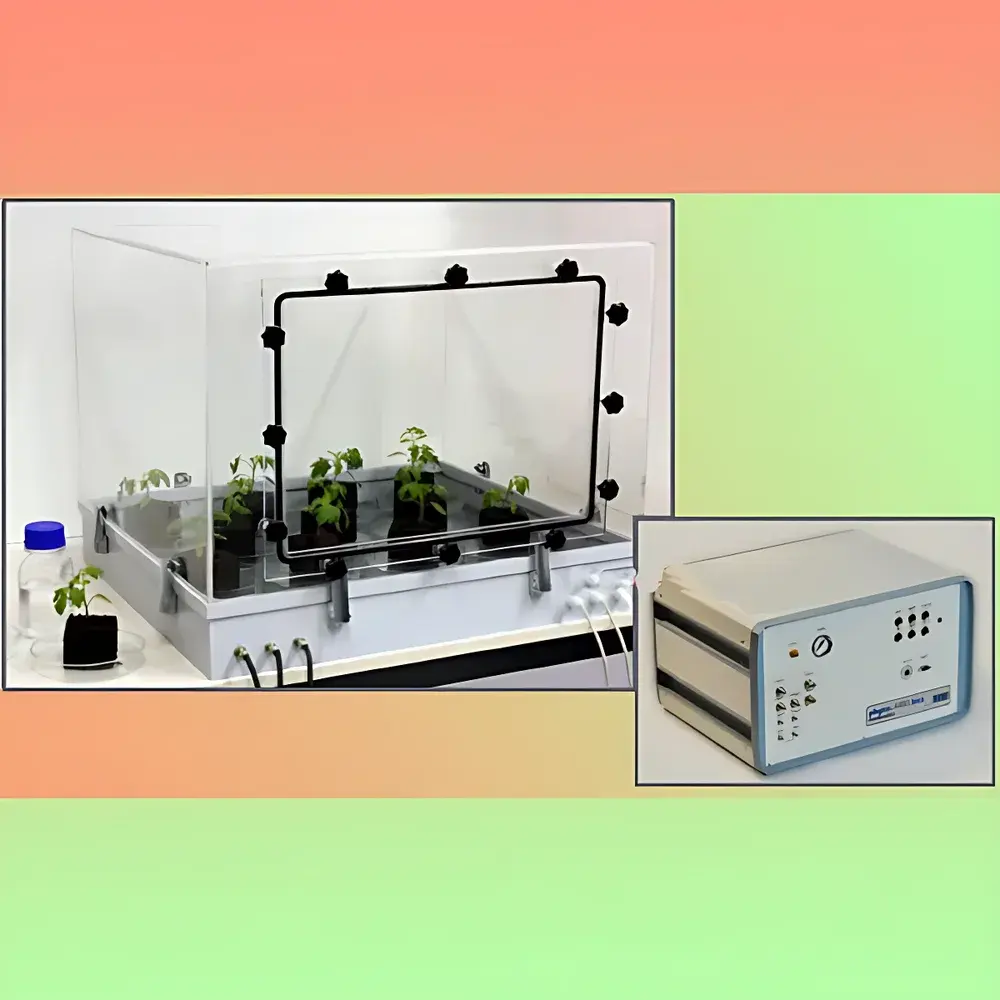
ECH PhytolabelBox 13CO₂ Isotope Labeling Plant Cultivation System
| Origin | Germany |
|---|---|
| Supplier Type | Authorized Distributor |
| Origin Category | Imported |
| Model | PhytolabelBox-13CO₂ |
| Pricing | Available Upon Request |
| Dimensions | 680 × 600 × 513 mm |
| Display | LCD with Dual-Channel Real-Time Data Visualization |
| Accuracy | ±1% FS |
| Operating Ambient Temperature | 5–35 °C |
| Measurement Interval | 3 s per reading |
| Storage Temperature Range | 0–40 °C |
| Data Output | RS232 Serial Interface (compatible with PC & thermal printer) |
| Internal Memory | Built-in non-volatile storage |
| Power Supply | 24 V DC / 100–240 V AC auto-switching |
| Enclosure Material | Stainless Steel (AISI 304) |
| Acoustic Noise Level | <45 dB(A) at 1 m |
Overview
The ECH PhytolabelBox 13CO₂ Isotope Labeling Plant Cultivation System is a self-contained, field-deployable platform engineered for quantitative carbon assimilation studies in controlled or semi-natural plant growth environments. Based on stable isotope gas labeling principles, the system delivers precisely enriched ¹³CO₂ to plant canopies under programmable concentration and flow conditions, enabling real-time tracking of photosynthetic carbon fixation kinetics via downstream isotopic analysis (e.g., IRMS, CRDS, or laser-based ¹³C/¹²C ratio detection). Unlike conventional greenhouse-based labeling setups requiring external gas cabinets, mass flow controllers, and exhaust scrubbers, the PhytolabelBox integrates all core subsystems—including CO₂ enrichment module, precision mass flow regulation, environmental monitoring sensors (T/RH), and sealed cultivation chamber—into a single, portable unit. Its compact architecture supports both laboratory-based phenotyping trials and mobile ecological field campaigns, maintaining measurement integrity across variable ambient conditions without dependency on building infrastructure.
Key Features
- Autonomous operation: Fully integrated gas delivery, environmental sensing, and data logging—no external compressors, gas cylinders, or control PCs required for basic functionality.
- Dual-channel mode: Simultaneous independent labeling of two plant cohorts (e.g., control vs. treatment) with separate ¹³CO₂ concentration profiles and timing schedules.
- Stainless steel monocoque chassis (AISI 304): Corrosion-resistant, vibration-damped enclosure rated IP54 for outdoor deployment and long-term stability in humid or dusty environments.
- High-temporal-resolution monitoring: 3-second interval measurements with ±1% full-scale accuracy, enabling dynamic capture of rapid stomatal and photosynthetic responses.
- Low-acoustic operation (<45 dB[A]): Optimized gas flow path and brushless DC pumps ensure minimal acoustic interference—critical for behavioral or electrophysiological co-assays.
- Intuitive human-machine interface: Backlit LCD panel with context-aware menu navigation; supports parameter configuration, real-time trace visualization, and alarm status indication.
- One-touch assay initiation: Predefined protocols (e.g., “Pulse-Chase”, “Steady-State Labeling”, “Diurnal Cycle”) stored in internal memory; activation requires single button press.
Sample Compatibility & Compliance
The PhytolabelBox accommodates potted plants up to 45 cm height and 30 cm canopy diameter within its sealed growth chamber. Compatible with herbaceous species (Arabidopsis, wheat, maize), woody cuttings, and small shrubs under standard growth lamp illumination (not included). Chamber sealing integrity is verified per ISO 14644-3 Class 5 cleanroom leak-test methodology. All electronic components comply with CE EN 61326-1 (EMC) and EN 61010-1 (safety); gas-handling materials meet USP Class VI biocompatibility standards. The system supports GLP-compliant workflows through timestamped audit logs, user-access levels, and exportable CSV/ASCII data files traceable to NIST-traceable calibration records.
Software & Data Management
The embedded firmware supports serial communication via RS232 (38.4 kbps) for bidirectional command exchange with Windows/macOS/Linux hosts. Optional ECH LabLink software provides protocol scheduling, multi-unit synchronization, live graphing (time-series CO₂ concentration, T/RH, chamber pressure), and automated report generation (PDF/Excel). All data are time-stamped with UTC-synced RTC and stored in non-volatile memory (≥1 million readings). Firmware updates are delivered via secure signed .bin packages; configuration backups support disaster recovery. Data export complies with FAIR principles (Findable, Accessible, Interoperable, Reusable) and integrates with ELN platforms (e.g., LabArchives, Benchling) via REST API extension.
Applications
- Quantitative assessment of photosynthetic efficiency under abiotic stress (drought, heat, salinity)
- In vivo carbon partitioning analysis across source-sink tissues using post-labeling harvest and isotopic ratio mass spectrometry
- Validation of functional genomics hypotheses (e.g., knockout/mutant lines affecting Rubisco kinetics or photorespiration)
- Soil-plant-atmosphere continuum (SPAC) modeling with time-resolved ¹³C tracer fluxes
- Field-based comparative phenotyping of crop varieties across agroecological zones
- Calibration of remote-sensing vegetation indices (e.g., PRI, SIF) against ground-truthed carbon assimilation rates
FAQ
Does the PhytolabelBox require external ¹³CO₂ gas cylinders?
No—it is designed for use with standard ¹³CO₂-enriched gas cylinders (99% ¹³C, 100–2000 ppm balance air), but includes integrated pressure regulation, filtration, and flow metering; no auxiliary gas cabinets or secondary controllers are needed.
Can it operate unattended for extended periods?
Yes—battery-backed real-time clock, non-volatile memory, and watchdog circuitry enable continuous operation for >72 hours on AC power or optional 12 V LiFePO₄ battery pack (sold separately).
Is calibration traceable to international standards?
Yes—factory calibration uses NIST-traceable reference gases (NIST SRM 1662a) and is documented in the Certificate of Conformance shipped with each unit.
What safety mechanisms prevent over-pressurization or CO₂ exposure?
Dual redundant pressure relief valves (set at 2.5 kPa gauge), chamber O₂ sensor interlock (auto-shutdown if O₂ <18%), and audible/visual high-CO₂ alarms (threshold configurable between 1000–5000 ppm).
How is data integrity ensured during power interruption?
All active measurements are buffered in RAM and committed to flash memory every 5 seconds; power-loss recovery resumes from last valid checkpoint without data corruption.




