
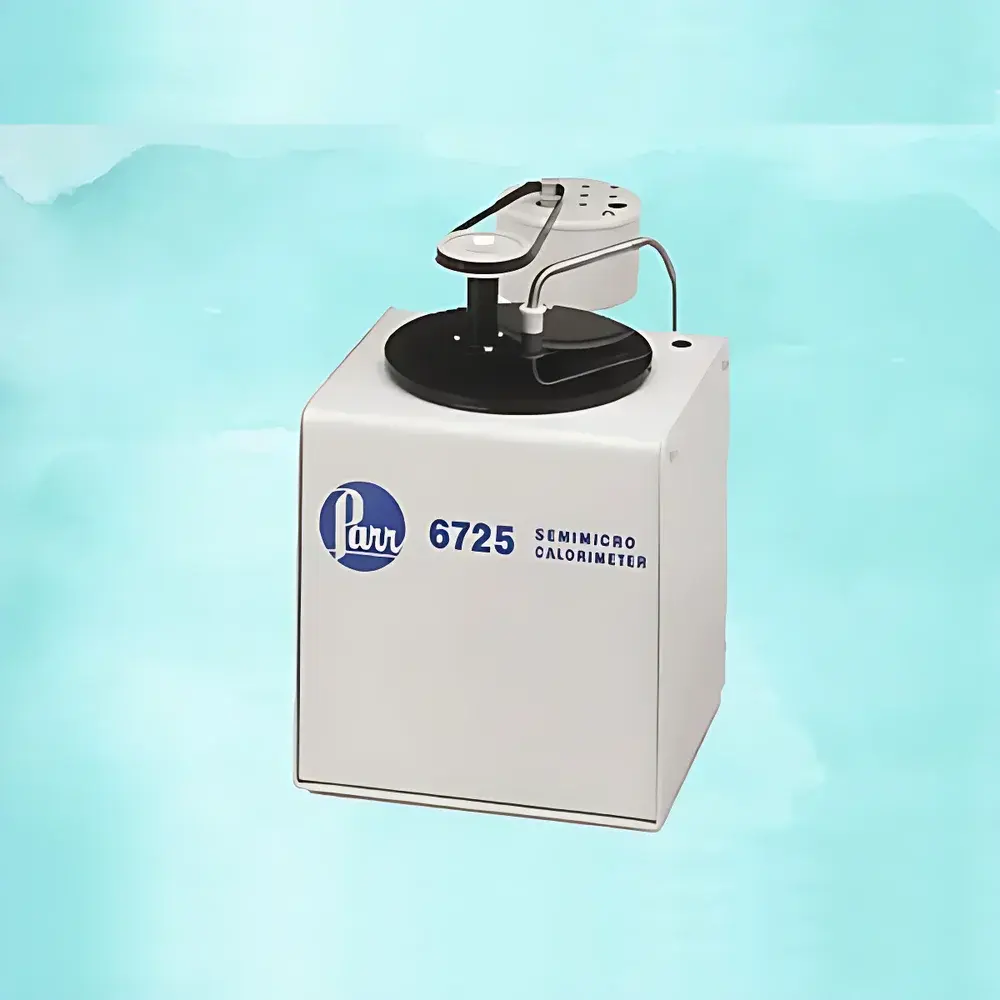
Parr 6725 Semi-Micro Bomb Calorimeter
| Brand | Parr Instruments |
|---|---|
| Origin | USA |
| Instrument Type | Oxygen Bomb Calorimeter |
| Measurement Mode | Isothermal Calorimetry |
| Automation Level | Fully Automated |
| Oxygen Bomb Options | 1109A Micro Sample Bomb (22 mL) / 1109X High-Pressure Semi-Micro Bomb |
| Sample Mass Range | 25–200 mg |
| Temperature Resolution | 0.0001 °C |
| Relative Standard Deviation | ≤0.4% |
| Throughput | 2–3 determinations per hour |
| Calorimeter Vessel | Silver-Coated Glass Dewar (450 g water capacity) |
| Dewar Housing | Stainless Steel Air Jacket for Thermal Stability and Ease of Maintenance |
| Compliance | Designed to meet ASTM D240, ASTM D4809, ISO 1928, and EN 14918 requirements for solid and liquid fuel calorimetry |
Overview
The Parr 6725 Semi-Micro Bomb Calorimeter is a precision isothermal combustion calorimeter engineered for high-accuracy determination of gross calorific value (GCV) in limited-sample applications. It operates on the fundamental principle of oxygen bomb combustion calorimetry: a precisely weighed sample is ignited under high-pressure oxygen (typically 30 atm) inside a sealed, corrosion-resistant stainless-steel bomb; the complete combustion releases thermal energy absorbed by a known mass of water in a thermally insulated Dewar vessel. Temperature rise is measured with a high-resolution platinum resistance thermometer (0.0001 °C resolution), enabling calculation of heat of combustion via calibrated heat capacity. The system’s isothermal design maintains constant jacket temperature throughout the measurement cycle—minimizing thermal drift and ensuring reproducibility ≤0.4% RSD across repeated determinations. Its semi-micro architecture accommodates sample masses as low as 25 mg, making it uniquely suited for research-grade analysis where material scarcity or compositional heterogeneity precludes conventional macro-scale testing.
Key Features
- Fully automated operation including oxygen charging, ignition sequence initiation, temperature acquisition, and data reduction—reducing operator dependency and inter-laboratory variability.
- Dual-bomb compatibility: supports both the 1109A micro sample bomb (22 mL internal volume, rated to 40 bar) and the 1109X high-pressure semi-micro bomb for elevated oxygen pressures up to 60 bar, extending applicability to low-energy or refractory materials.
- Silver-coated glass Dewar vessel immersed in 450 g of deionized water, housed within a stainless-steel air-jacketed enclosure that provides passive thermal stabilization and simplifies cleaning, refilling, and long-term calibration integrity.
- Integrated digital temperature sensing with real-time linearization and automatic baseline correction, compliant with NIST-traceable calibration protocols.
- Robust mechanical design featuring threaded cap sealing for the bomb head—ensuring gas-tight integrity and eliminating O-ring degradation risks associated with compression seals.
Sample Compatibility & Compliance
The Parr 6725 accepts solid, liquid, and powdered samples—including biological tissues, marine sediments, pharmaceutical excipients, propellants, pyrotechnic formulations, and heterogeneous environmental matrices. Its 25–200 mg working range satisfies ASTM D4809 (liquid fuels), ASTM D240 (solid biofuels), ISO 1928 (determination of gross calorific value of solid fuels), and EN 14918 (biomass pellet certification). Instrument firmware and audit trail functionality support GLP/GMP environments, with optional 21 CFR Part 11 compliance packages available for regulated laboratories requiring electronic signature, user access control, and immutable data archiving.
Software & Data Management
The system interfaces with Parr’s proprietary CalWin software, which provides full method configuration, real-time thermogram visualization, automatic correction for fuse wire, nitric acid formation, and sulfur contribution, and export to CSV, PDF, or LIMS-compatible formats. All raw temperature-time data, calibration logs, and instrument status metadata are time-stamped and stored with SHA-256 hashing for data integrity verification. Software validation documentation (IQ/OQ/PQ templates) and electronic audit trail reports are included to facilitate regulatory submissions.
Applications
- Marine and freshwater ecology: calorimetric profiling of phytoplankton, zooplankton, and benthic detritus where sample mass is inherently constrained.
- Forensic energetics: quantitative energy release assessment of trace explosive residues and improvised powder mixtures.
- Pharmaceutical development: energy content evaluation of active pharmaceutical ingredients (APIs) and low-dose formulations.
- Biomass and waste-derived fuel characterization: GCV validation for pellets, torrefied wood, and municipal solid waste fractions prior to combustion modeling.
- Academic combustion research: kinetic parameter derivation from controlled low-mass burn experiments under standardized oxygen environments.
FAQ
What is the minimum recommended sample mass for reliable results on the Parr 6725?
For optimal precision and combustion completeness, the validated lower limit is 25 mg using the 1109A bomb. Samples below this threshold may require extended equilibration or supplemental ignition aids.
Can the 6725 be used for non-fuel materials such as food or polymers?
Yes—provided the material is combustible under oxygen-rich conditions and does not generate corrosive halogenated or sulfuric combustion products that exceed the bomb’s chemical resistance limits.
Is external calibration required before each run?
No—system calibration is performed periodically using certified benzoic acid reference standards (NIST SRM 39j); daily verification is conducted via electrical calibration (Joule heating) to confirm thermal equivalence of the measurement cell.
How does the air-jacketed Dewar improve measurement stability compared to static insulation?
The stainless-steel air jacket minimizes convective heat loss while permitting rapid thermal equilibration between runs, thereby enhancing throughput consistency without sacrificing isothermal fidelity.
Does the system support remote monitoring or integration with laboratory information systems?
Yes—via Ethernet interface and OPC UA protocol support, enabling bidirectional communication with LIMS, SCADA, or centralized lab automation platforms.



