
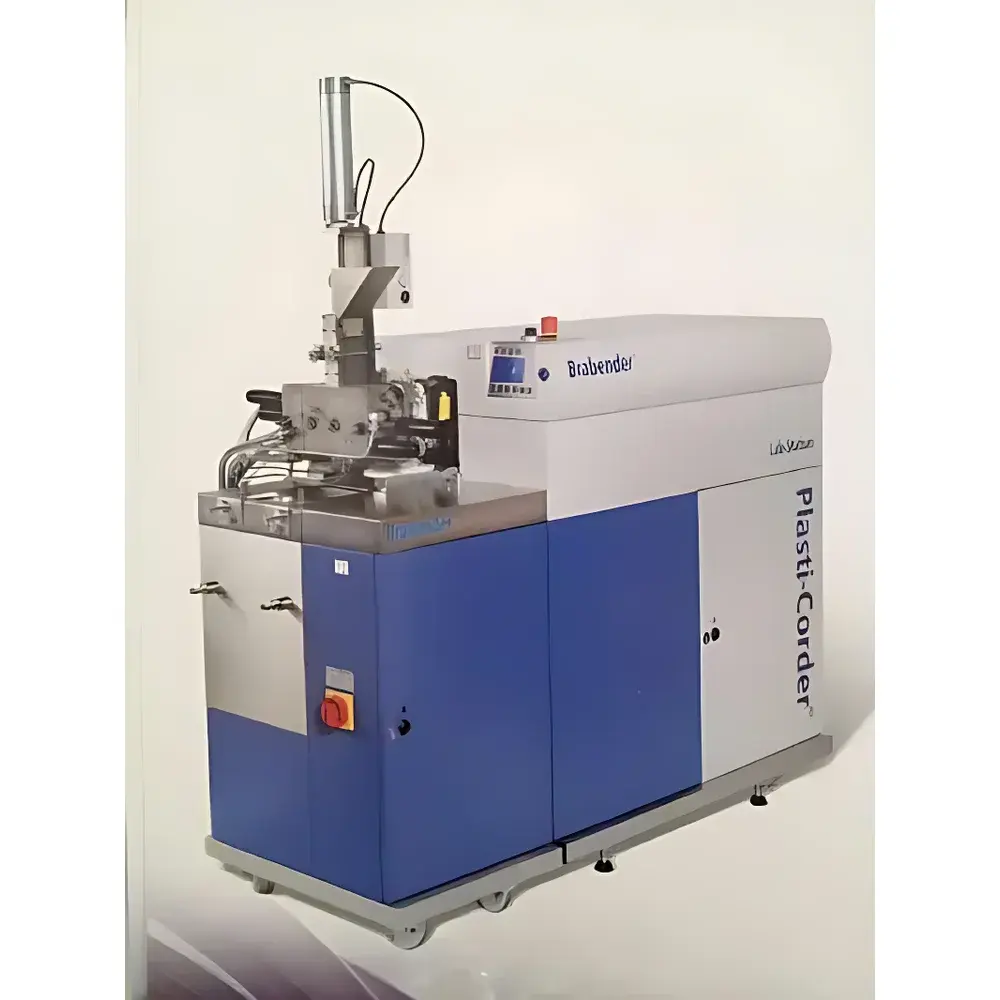
Brabender Plasti-Corder W50EHT Torque Rheometer System
| Brand | Brabender |
|---|---|
| Origin | Germany |
| Model | Plasti-Corder W50EHT |
| Maximum Torque (Main Unit) | 400 N·m |
| Speed Range | 0.2–275 rpm |
| Mixer Type | W50EHT Twin-Rotor Chamber |
| Temperature Control | 3-zone, up to 500 °C |
| Mixer Cavity Volume | ~55 cm³ |
| Mixer Torque Range | 0–200 N·m |
| Single-Screw Extruder | L/D = 19/25, Max Pressure: 700 bar, Max Temp: 450 °C, Max Torque: 150 N·m |
| Die Options | Circular dies (φ2.0 / φ3.0 / φ4.0 mm) |
Overview
The Brabender Plasti-Corder W50EHT Torque Rheometer System is an integrated laboratory-scale processing rheometer engineered for precision simulation of industrial thermoplastic compounding, mixing, and extrusion processes. Operating on the principle of controlled shear deformation under defined thermal and mechanical boundary conditions, the system measures real-time torque, temperature, pressure, and rotational speed to derive rheological signatures—including apparent viscosity, melt elasticity, thermal degradation onset, and shear sensitivity—of polymeric melts and filled compounds. Unlike capillary or rotational viscometers that isolate single-point viscosity, the Plasti-Corder replicates dynamic process environments where material undergoes sequential heating, shearing, residence time distribution, and optional downstream shaping (e.g., extrusion). Its modular architecture—comprising a high-torque drive unit, W50EHT twin-rotor mixing chamber, and optionally coupled single-screw extruder—enables multi-stage functional testing aligned with ASTM D2538, ISO 6721-6, and ISO 11443 standards for polymer melt rheology.
Key Features
- Robust 400 N·m main drive motor with closed-loop speed control (0.2–275 rpm), delivering stable shear rates across low- to high-viscosity regimes.
- W50EHT mixing chamber with dual counter-rotating rotors, 3-zone independent PID temperature control (ambient to 500 °C), and integrated melt temperature monitoring via embedded thermocouples.
- High-fidelity torque transduction system with ±0.2% full-scale accuracy and 100 Hz sampling rate, enabling detection of transient structural changes during melt homogenization or crosslinking.
- Modular extrusion module (L/D = 19/25) featuring pressure-rated barrel (up to 700 bar), active temperature zoning (to 450 °C), and interchangeable dies—including standardized circular orifices (φ2.0 / φ3.0 / φ4.0 mm) and a precision-adjustable slit die (100 mm width, 0–1.5 mm gap).
- Structural rigidity and thermal mass optimization minimize vibration-induced noise and ensure long-term calibration stability under cyclic thermal loading.
Sample Compatibility & Compliance
The Plasti-Corder W50EHT accommodates neat thermoplastics (e.g., PE, PP, PVC, PS, PC), engineering resins (PA6, PBT, POM), thermoplastic elastomers (TPEs), and highly filled systems (e.g., CaCO₃-, glass fiber-, or carbon black–loaded compounds). It supports both batch-mode mixing studies and continuous extrusion trials with residence time quantification. The system complies with CE machinery directive requirements and supports documentation traceability in accordance with GLP and GMP frameworks. Data acquisition meets FDA 21 CFR Part 11 readiness when paired with Brabender’s validated WinRHEO software, including electronic signature support, audit trail logging, and user-access-level management.
Software & Data Management
WinRHEO software provides synchronized acquisition, visualization, and post-processing of torque, temperature, pressure, and screw speed signals. Real-time graphs display dynamic curves (e.g., torque vs. time at fixed temperature; viscosity vs. shear rate at multiple setpoints). Built-in calculation modules generate Arrhenius activation energies, Bagley corrections for die pressure loss, and Rabinowitsch corrections for non-Newtonian flow. Export formats include CSV, Excel, and PDF reports compliant with internal QA/QC templates. All raw data files are timestamped, digitally signed, and stored with metadata (operator ID, sample ID, method version), fulfilling regulatory requirements for instrument qualification (IQ/OQ/PQ) and analytical method validation.
Applications
- Thermal stability assessment: Quantifying onset temperature of degradation via torque inflection or sudden viscosity drop during isothermal holds.
- Shear sensitivity profiling: Evaluating polymer chain scission or filler dispersion efficiency across logarithmic shear rate sweeps.
- Formulation development: Screening plasticizer efficiency, lubricant migration, or compatibilizer effectiveness in multi-component blends.
- Process simulation: Replicating twin-screw compounding kinetics using W50EHT rotor geometry and correlating results with production-scale data.
- Quality control: Establishing torque/time fingerprint baselines for incoming resin lots or recycled feedstocks to detect molecular weight shifts or contamination.
FAQ
What distinguishes the Plasti-Corder from conventional rotational rheometers?
Unlike parallel-plate or cone-and-plate rheometers measuring small-strain oscillatory behavior, the Plasti-Corder operates under large-deformation, high-shear, process-relevant conditions—making it suitable for predictive processing rather than fundamental viscoelastic characterization.
Can the W50EHT chamber be used independently of the extruder module?
Yes—the mixing chamber functions as a standalone batch mixer with full torque, temperature, and timing control; extrusion capability is an optional add-on.
Is the system compatible with reactive processing (e.g., peroxide-initiated crosslinking)?
Yes—temperature-stable rotor seals, inert gas purging ports, and programmable multi-step temperature/speed profiles enable safe execution of reactive melt blending protocols.
How is calibration verified for torque and temperature sensors?
Brabender provides factory calibration certificates traceable to DIN EN ISO/IEC 17025-accredited standards; users may perform periodic verification using certified reference materials (e.g., NIST-traceable viscosity standards) and calibrated thermocouple simulators.
Does the system support automated method sequencing for unattended operation?
Yes—WinRHEO allows creation of multi-segment methods (e.g., preheat → mix → hold → extrude → cool) with conditional triggers and email/SMS alerts upon completion or fault detection.



