
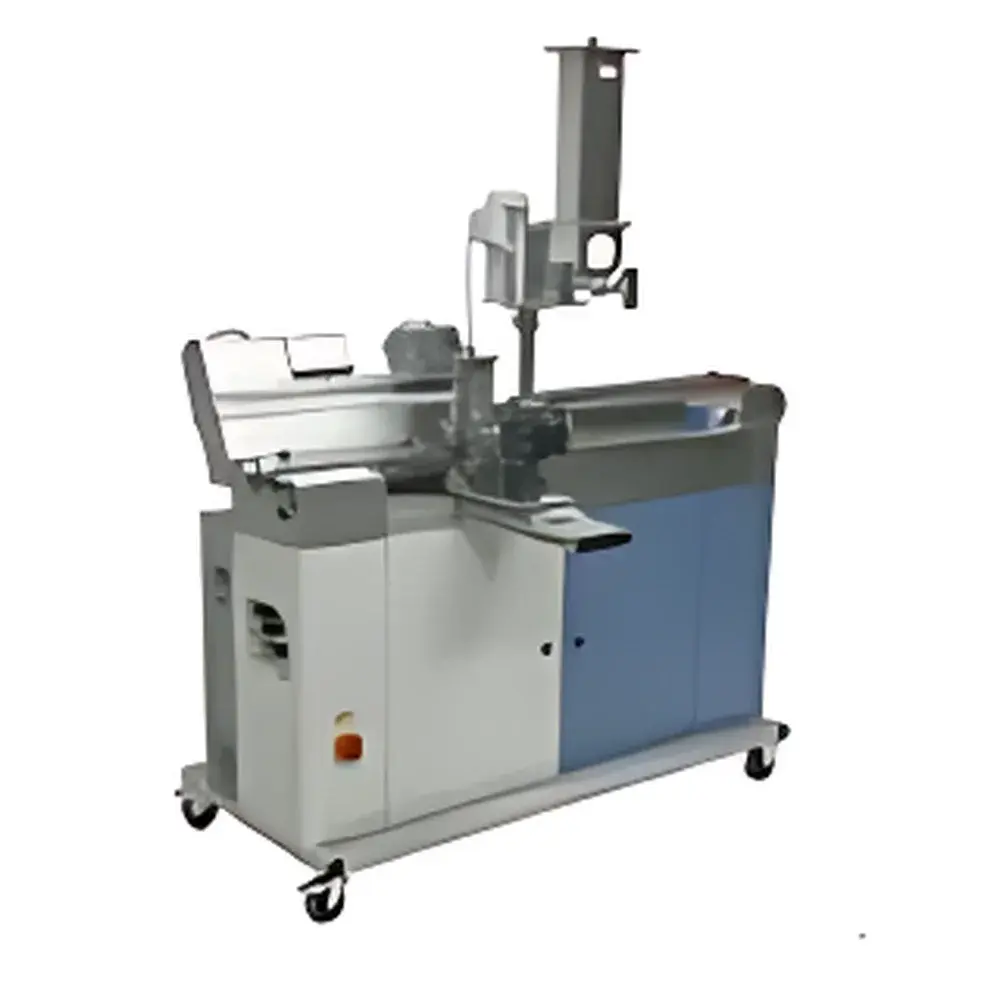
Brabender Plasti-Corder® Lab-Station Torque Rheometer
| Origin | Germany |
|---|---|
| Manufacturer Type | Authorized Distributor |
| Origin Category | Imported |
| Model | Plasti-Corder® Lab-Station |
| Quotation | Upon Request |
| Torque Range | 0–400 N·m |
| Torque Accuracy | ±0.15% of full scale |
| Motor Speed Range | 0.2–350 rpm |
| Speed Accuracy | ±0.2% (closed-loop control) |
| Temperature Control Zones | 8–12 independent zones |
| Max Heating Temperature | 500 °C |
| W50EHT Mixer Chamber Volume | ~55 cm³ |
| W50EHT Max Torque | 0–200 N·m |
| Single-Screw Extruder L/D Ratio | 19:1 or 25:1 |
| Extruder Max Pressure | 700 bar |
| Extruder Max Temp | 450 °C |
| Extruder Max Torque | 150 N·m |
| Die Options | Round (φ2.0/3.0/4.0 mm), Slit (100 mm × 0–1.5 mm adjustable) |
Overview
The Brabender® Plasti-Corder® Lab-Station is a fully integrated, high-performance torque rheometer system engineered for precise simulation and quantitative analysis of polymer melt processing behavior under realistic shear, thermal, and mechanical conditions. Based on the Couette-type rotational rheometry principle, it measures real-time torque exerted by molten polymer melts on counter-rotating rotors within a temperature-controlled mixing chamber—directly correlating torque output to complex viscosity, shear stress, and viscoelastic resistance. Unlike capillary or rotational viscometers limited to steady-state measurements, the Lab-Station enables dynamic, time-resolved characterization across full processing cycles—including dry blending, melt compounding, thermal degradation onset, crosslinking kinetics, and extrusion startup transients. Its core drive system—a digitally controlled 16 kW servo motor—delivers exceptional torque fidelity (0–400 N·m) and speed stability (0.2–350 rpm, ±0.2% closed-loop accuracy) across the entire operational range, ensuring reproducible shear history and minimal inertia-induced artifacts.
Key Features
- Modular architecture supporting interchangeable process units: W50EHT mixer (55 cm³ chamber, 3-zone heating, up to 500 °C), single-screw extruder (L/D 19:1 or 25:1, 700 bar max pressure, 450 °C), and optional twin-screw configurations
- High-fidelity torque sensing with ±0.15% full-scale accuracy, calibrated traceably to national metrology standards
- Multi-zone temperature control (8–12 independently regulated zones) with PID tuning, enabling precise thermal profiling along extruder barrels or mixer walls
- Real-time acquisition of torque, temperature, pressure (where equipped), rotor speed, and energy consumption at ≥10 Hz sampling rate
- Rugged stainless-steel construction compliant with ISO 11443, ASTM D2538, and DIN 53735; designed for continuous operation in GLP-compliant laboratories
- Integrated safety interlocks including over-torque shutdown, thermal runaway prevention, and emergency stop circuitry meeting IEC 61508 SIL2 requirements
Sample Compatibility & Compliance
The Plasti-Corder Lab-Station accommodates thermoplastic polymers (e.g., PE, PP, PS, PC, ABS), thermoplastic elastomers (TPEs), filled compounds (glass/carbon fiber, mineral fillers), reactive systems (peroxide-cured EPDM, silane-grafted polyolefins), and biopolymers (PLA, PHA). It supports sample masses from 30 g (W50EHT) to >1 kg (extrusion mode), with compatibility extended via optional vacuum venting, inert gas purging (N₂/Ar), and corrosion-resistant wetted parts (Hastelloy C-276 liners). The system conforms to key regulatory frameworks: data integrity complies with FDA 21 CFR Part 11 (electronic signatures, audit trails, role-based access); thermal calibration meets ASTM E74 and ISO/IEC 17025 requirements; and mechanical validation follows ISO 17892-7 for torque transducer linearity assessment.
Software & Data Management
WinPC software (v6.x, Windows 10/11 compatible) provides synchronized control, visualization, and post-processing. It records raw sensor data with embedded timestamps, supports custom script-driven test sequences (e.g., ramped shear rate, stepwise temperature profiles), and exports ASCII/CSV for third-party rheological modeling (e.g., Carreau-Yasuda fitting, Arrhenius activation energy calculation). Built-in reporting modules generate ASTM-compliant test certificates, including torque vs. time curves, power consumption integrals, and melt temperature gradients. All data files include immutable metadata (operator ID, instrument serial, calibration expiry), and optional network deployment enables centralized archive management aligned with ISO 27001 information security policies.
Applications
- Thermal stability screening: Quantifying onset of degradation via torque inflection points and evolved gas analysis (when coupled with FTIR/MS)
- Formulation development: Optimizing plasticizer content, filler dispersion efficiency, and compatibilizer dosage through torque hysteresis analysis
- Process simulation: Replicating industrial twin-screw compounding or single-screw extrusion conditions to predict residence time distribution and melt homogeneity
- Crosslinking kinetics: Monitoring torque rise during peroxide-initiated curing of EPDM or silane-grafted PE
- Recycled polymer evaluation: Assessing viscosity recovery, gel content, and thermal history effects in post-consumer rPET/rPP streams
- Quality assurance: Establishing torque fingerprint baselines for incoming resin lots against master batch specifications
FAQ
What distinguishes torque rheometry from capillary or rotational rheometry?
Torque rheometers simulate actual processing shear histories (e.g., mixing, extrusion) under variable temperature and residence time, whereas capillary rheometers measure steady-state viscosity at fixed L/D ratios, and rotational rheometers typically operate at low strains unsuitable for melt fracture prediction.
Can the Lab-Station be validated for GMP environments?
Yes—its WinPC software includes 21 CFR Part 11-compliant electronic signatures, full audit trail logging, and IQ/OQ documentation templates supporting qualification per Annex 15 and USP .
Is calibration traceable to national standards?
All torque sensors are factory-calibrated using deadweight standards accredited to DAkkS (German National Metrology Institute), with certificate of calibration provided upon delivery.
What maintenance intervals are recommended for long-term reliability?
Daily: Visual inspection of rotor seals and purge gas flow; quarterly: torque sensor zero-point verification and thermal gradient mapping; annually: full mechanical recalibration and motor encoder alignment check.
Does Brabender offer application support for method development?
Yes—Brabender’s global Application Labs provide remote and on-site method optimization, including DOE-based protocol design, failure mode analysis, and comparative benchmarking against industrial processing lines.



