
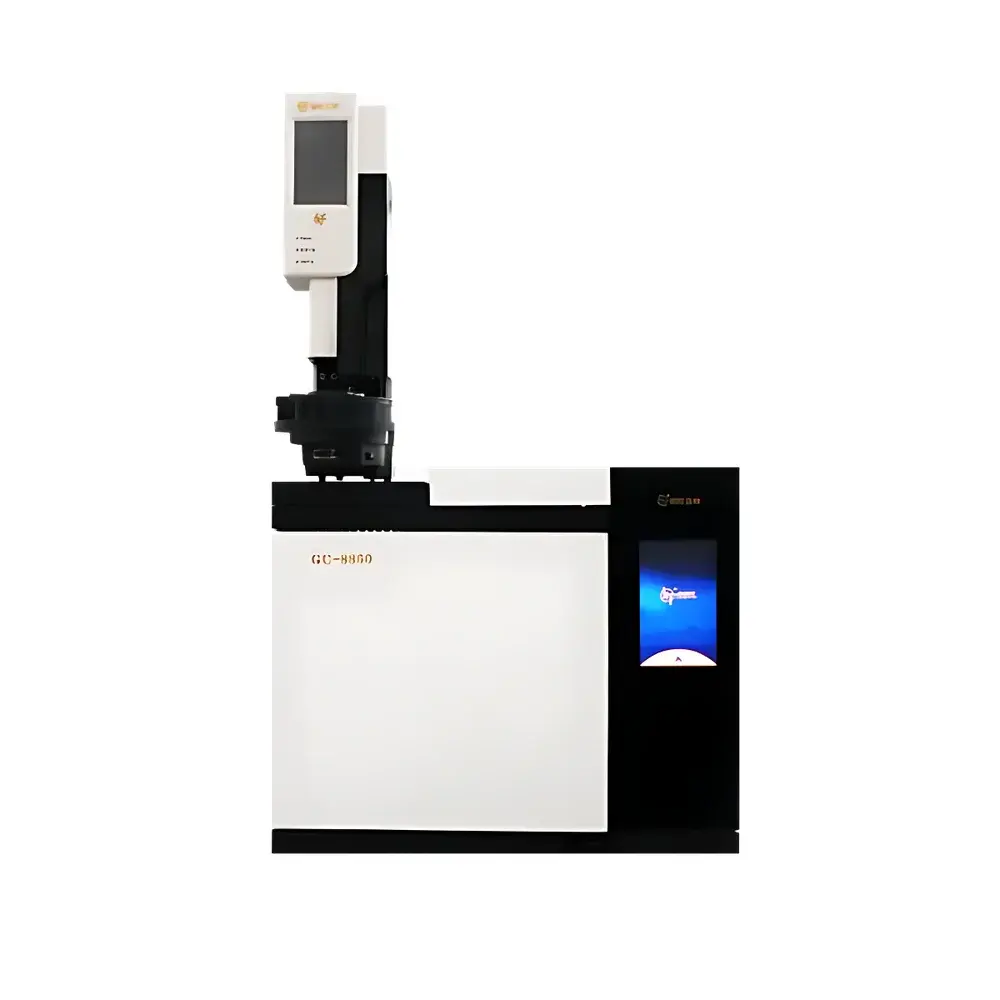
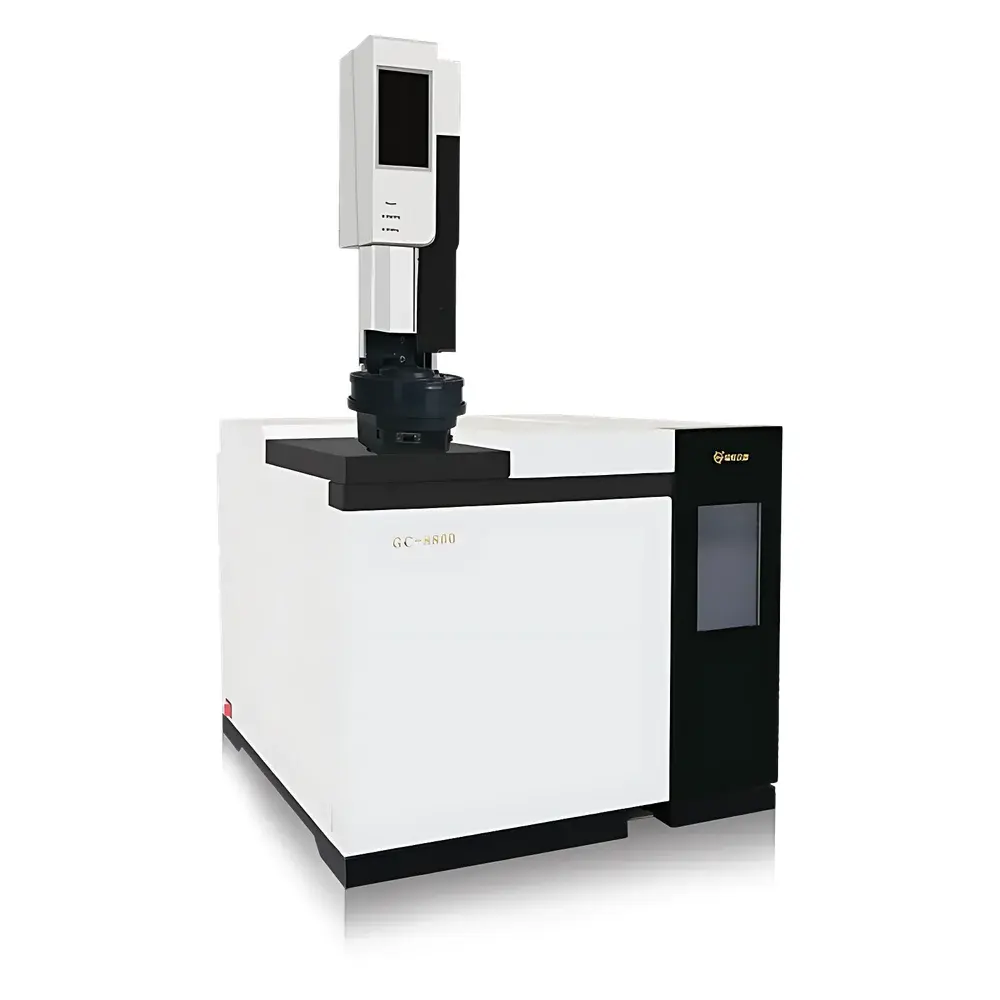
GC-8860 Full-EPC Gas Chromatograph by Lunan Ruihong
| [Brand | Lunan Ruihong |
|---|---|
| Origin | Shandong, China |
| Instrument Type | Laboratory Gas Chromatograph |
| Application Scope | General-Purpose |
| Oven Temperature Range | 4 °C to 450 °C |
| Ramp Rate | 0.1–80 °C/min |
| Cool-down Rate | ≤3 min (200 °C → 100 °C) |
| Carrier Gas Flow Control Range | 0–1000 mL/min |
| Carrier Gas Pressure Control Range | 0–100 psi |
| Injector Max Temp | 450 °C |
| Injector Pressure Setpoint Range | 0–100 psi |
| Temperature Zones | 8 independent zones |
| Programmed Temperature Steps | up to 16 ramps |
| Detector Options | FID, TCD, ECD, FPD, NPD (up to 3 simultaneously)] |
Overview
The GC-8860 Full-EPC Gas Chromatograph is a laboratory-grade analytical instrument engineered for precision separation and quantitative analysis of volatile and semi-volatile organic compounds. Built upon gas chromatographic principles—where analytes are partitioned between a mobile phase (inert carrier gas) and a stationary phase (capillary or packed column)—the system delivers high-resolution elution profiles under fully automated, digitally regulated conditions. Its core architecture integrates an embedded microprocessor-based temperature control system with eight independently programmable thermal zones, enabling complex multi-segment temperature programming (up to 16 ramp steps) and precise oven stabilization (±0.1 °C). The instrument operates across a wide thermal envelope—from 4 °C above ambient to 450 °C—supporting applications ranging from residual solvent analysis in pharmaceuticals to dissolved gas analysis (DGA) in transformer oils. The inclusion of a column oven with automatic rear-door mechanism enhances cooling efficiency, reducing cycle time without compromising baseline stability or peak shape fidelity.
Key Features
- Full Electronic Pressure and Flow Control (EPC): All carrier, makeup, and detector gases are regulated via digital mass flow controllers and pressure transducers, ensuring reproducible retention times and method transferability across instruments.
- Modular Detector Architecture: Supports simultaneous installation of up to three detectors—including Flame Ionization (FID), Thermal Conductivity (TCD), Electron Capture (ECD), Flame Photometric (FPD), and Nitrogen Phosphorus (NPD)—with dedicated temperature zones and optimized gas supply paths.
- Advanced Thermal Management: Eight independent temperature-controlled zones include oven, up to three detector compartments, injector(s), and optional methanizer or catalytic converter. Each zone features over-temperature protection and real-time PID feedback control.
- 7-inch High-Resolution Touchscreen Interface: Integrated color LCD with hot-swap capability functions as both local controller and portable operation panel; supports intuitive method setup, real-time chromatogram display, and diagnostic status monitoring.
- Gigabit Ethernet Connectivity & Industrial Protocol Support: Equipped with IEEE 802.3-compliant Ethernet port and native MODBUS/TCP implementation, enabling seamless integration into distributed control systems (DCS), LIMS, and centralized lab networks.
- High-Fidelity Data Acquisition: 24-bit analog-to-digital conversion with baseline storage and dynamic baseline subtraction algorithms ensures accurate integration of low-amplitude peaks and robust signal-to-noise performance.
Sample Compatibility & Compliance
The GC-8860 accommodates diverse sample introduction modes—including split/splitless capillary injection, packed-column injection, gas sampling valves (e.g., 6-port), and optional autosampler interfaces—making it suitable for gaseous, liquid, and solid-phase microextraction (SPME) samples. Its validated thermal and flow specifications align with routine requirements defined in ASTM D3612 (Dissolved Gas Analysis in Electrical Insulating Oil), IEC 60567, and USP for chromatographic system suitability. While not pre-certified for 21 CFR Part 11 compliance out-of-the-box, the system’s audit-trail-capable workstation software supports configuration for GLP/GMP environments when deployed with appropriate administrative controls and electronic signature protocols.
Software & Data Management
The proprietary chromatography data system (CDS) provides bidirectional communication with multiple GC-8860 units on a shared network, enabling centralized method deployment, remote instrument monitoring, and consolidated report generation. Raw data files adhere to open AIA/ANDI standards, facilitating third-party processing in platforms such as OpenLab CDS or Chromeleon. The software includes automated system suitability testing (SST), peak purity assessment, calibration curve management with weighted regression options, and customizable reporting templates compliant with ISO/IEC 17025 documentation requirements. All method parameters, sequence logs, and acquisition events are timestamped and stored with immutable metadata—critical for traceability during regulatory audits.
Applications
- Transformer oil dissolved gas analysis (DGA) per IEEE C57.104 and IEC 60599, including detection of H2, CH4, C2H2, C2H4, C2H6, CO, and CO2.
- Residual solvent quantification in active pharmaceutical ingredients (APIs) and excipients according to ICH Q3C guidelines.
- Environmental analysis of VOCs in air, water, and soil extracts (EPA Methods 8021B, 8260D).
- Petrochemical hydrocarbon profiling using dual-FID configurations and backflush-enabled column switching.
- Food flavor compound identification and stability testing via headspace-GC/FID or GC/MS coupling.
FAQ
Does the GC-8860 support method validation for regulated laboratories?
Yes—when configured with appropriate user access controls, electronic signatures, and audit trail activation, the system meets foundational requirements for method validation under ISO/IEC 17025 and can be adapted for FDA-regulated workflows.
Can the instrument operate unattended overnight?
Absolutely—the integrated scheduler, auto-start/stop functionality, and hardware-level watchdog timers enable reliable unattended operation across extended sequences.
Is remote diagnostics supported?
Yes—via secure Ethernet connection, service engineers can perform firmware updates, log file retrieval, and real-time parameter diagnostics without physical access.
What is the minimum detectable concentration for acetylene using the FID?
The system achieves ≤0.1 ppm (v/v) for C2H2 under standard operating conditions with optimized column selection and hydrogen/air flow ratios.
How many temperature ramps can be programmed in a single method?
Up to 16 linear or nonlinear temperature ramps are supported across the column oven’s thermal profile, with hold times configurable down to 0.1 minute increments.





