
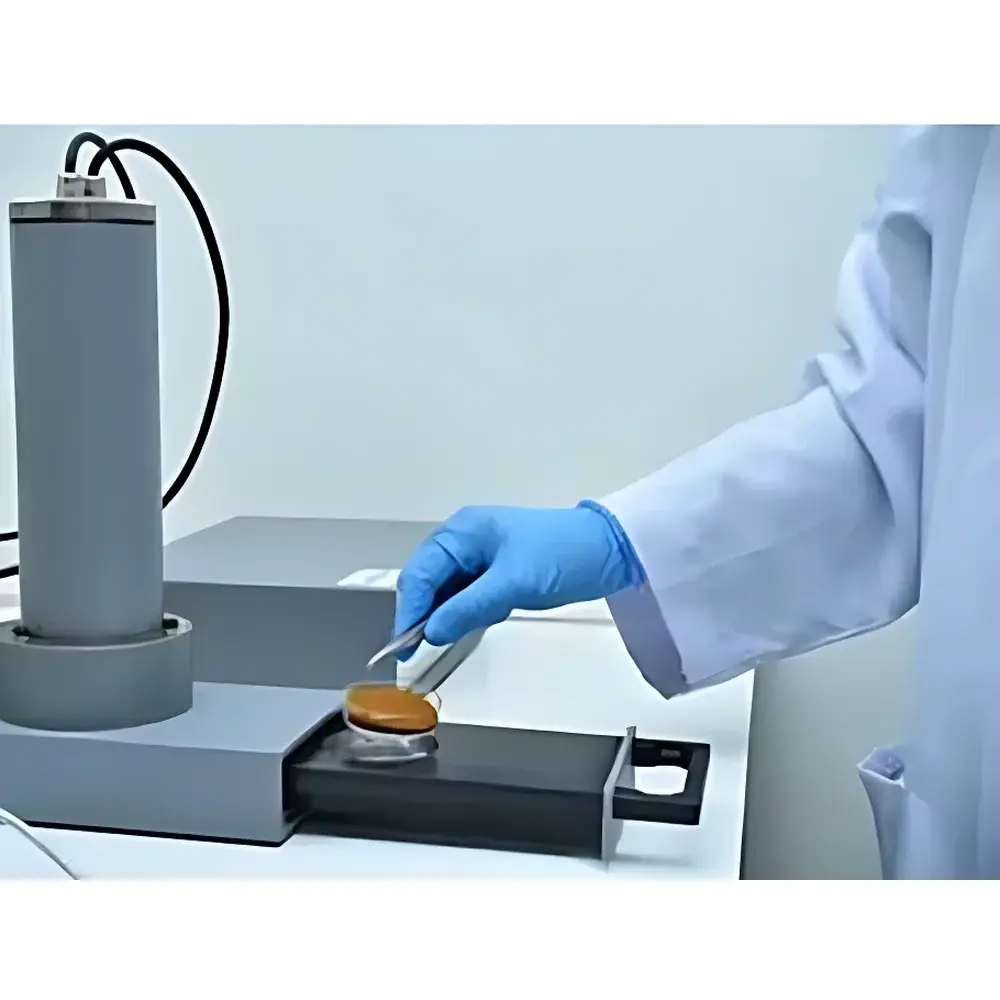
SUERC PPSL Rapid Irradiated Food Detection Instrument
| Origin | Beijing, China |
|---|---|
| Manufacturer Type | Authorized Distributor |
| Origin Category | Domestic (China) |
| Model | PPSL |
| Pricing | Available Upon Request |
Overview
The SUERC PPSL Rapid Irradiated Food Detection Instrument is a portable, field-deployable analytical platform engineered for the rapid, non-destructive screening of irradiated food products. It operates on the principle of photostimulated luminescence (PSL) — a well-established physicochemical method standardized in ISO/IEC 17025–accredited laboratories for detecting ionizing radiation exposure in foods containing silicate minerals (e.g., spices, herbs, dried vegetables, shellfish). When irradiated, crystalline lattice defects in silicates trap electrons; upon optical stimulation with specific-wavelength light, these trapped charges are released as measurable luminescence signals. The PPSL quantifies this emission intensity and classifies samples into three tiers — “irradiated”, “non-irradiated”, or “inconclusive” — in accordance with EN 13751:2009 and ASTM F1885–22 guidelines. Designed for regulatory compliance officers, food safety auditors, and mobile inspection units, the instrument delivers results within 90 seconds per sample without solvent extraction or laboratory infrastructure.
Key Features
- Integrated PSL detection module with calibrated blue-light LED stimulation source (470 ± 10 nm) and thermoelectrically cooled photomultiplier tube (PMT) for high signal-to-noise ratio
- On-board spectral filtering to suppress ambient light interference and minimize false positives during outdoor or warehouse deployment
- Automated sample positioning and dark-chamber isolation ensuring measurement repeatability (RSD < 8% for triplicate spice samples)
- Ruggedized aluminum alloy housing rated IP54 for dust and splash resistance, suitable for transport in inspection vehicles or cold-chain environments
- Embedded microprocessor with real-time background subtraction and adaptive thresholding algorithms aligned with EU Reference Laboratory (EURL) validation protocols
- Battery-operated mode (up to 6 hours continuous operation) and universal AC/DC power input (100–240 VAC, 50/60 Hz)
Sample Compatibility & Compliance
The PPSL supports direct analysis of dry, particulate, or powdered food matrices known to retain dosimetric mineral contaminants — including black pepper, paprika, cumin, oregano, dried shiitake mushrooms, and frozen shrimp shells. It is not validated for liquid, fatty, or highly hydrated foods (e.g., milk, oils, fresh produce), nor for pre-packaged items requiring X-ray-transparent windows. All measurements comply with the European Commission’s Decision 2009/76/EC and Directive 1999/2/EC on irradiated food labeling. The system’s classification logic adheres to the two-tier PSL count threshold model defined in EN 13751:2009, with built-in audit trails meeting GLP documentation requirements for traceability. Device firmware is periodically updated to reflect revisions in ISO/IEC 17025 internal calibration standards and national metrological verification procedures issued by CNAS (China National Accreditation Service).
Software & Data Management
The PPSL runs proprietary embedded firmware (v3.2.1) with encrypted local storage for up to 5,000 test records, each timestamped, geotagged (via optional GNSS module), and linked to operator ID. Data export is supported via USB-C to CSV or XML formats compatible with LIMS integration. The instrument includes a password-protected administrator interface for calibration log review, sensor diagnostic reports, and firmware version verification. All data handling conforms to GDPR-compliant anonymization protocols when exported internationally. Audit logs record every user action — including result overrides, calibration adjustments, and maintenance events — satisfying FDA 21 CFR Part 11 electronic record and signature requirements for regulated food testing environments.
Applications
- Port-of-entry screening of imported spices and dried botanicals subject to mandatory irradiation certification under EU Regulation (EC) No 1999/2
- Verification of irradiation treatment claims on retail packaging labels in domestic markets governed by GB 14891 (China’s national standard for irradiated foods)
- Surveillance testing by municipal food safety bureaus during routine market inspections and emergency response to suspected adulteration incidents
- Validation support for food manufacturers implementing HACCP-based irradiation process controls and supplier verification programs
- Training and proficiency testing in food safety laboratories accredited to ISO/IEC 17025 for PSL methodology
FAQ
Does the PPSL require consumables or reagents?**
No — the instrument is reagent-free and does not require chemical solvents, filters, or disposable cuvettes. Only clean, dry sample vials (provided with the system) are needed.
Can it detect partial or sub-threshold irradiation doses?**
The PPSL is designed for qualitative classification per EN 13751:2009 and is not intended for dose quantification. Samples delivering PSL counts between 5,000 and 25,000 photons/60 s are flagged as “inconclusive” and require confirmatory thermoluminescence (TL) analysis.
Is third-party performance validation available?**
Yes — full validation reports from the EU Reference Laboratory for Food Irradiation (BfR, Berlin) and CNAS-accredited interlaboratory trials are supplied with each unit upon request.
What maintenance is required?**
Annual optical alignment verification and PMT gain calibration are recommended. The device includes self-diagnostic routines accessible via service mode, and all calibration parameters are traceable to NIM (National Institute of Metrology, China) reference standards.
Related Products






