
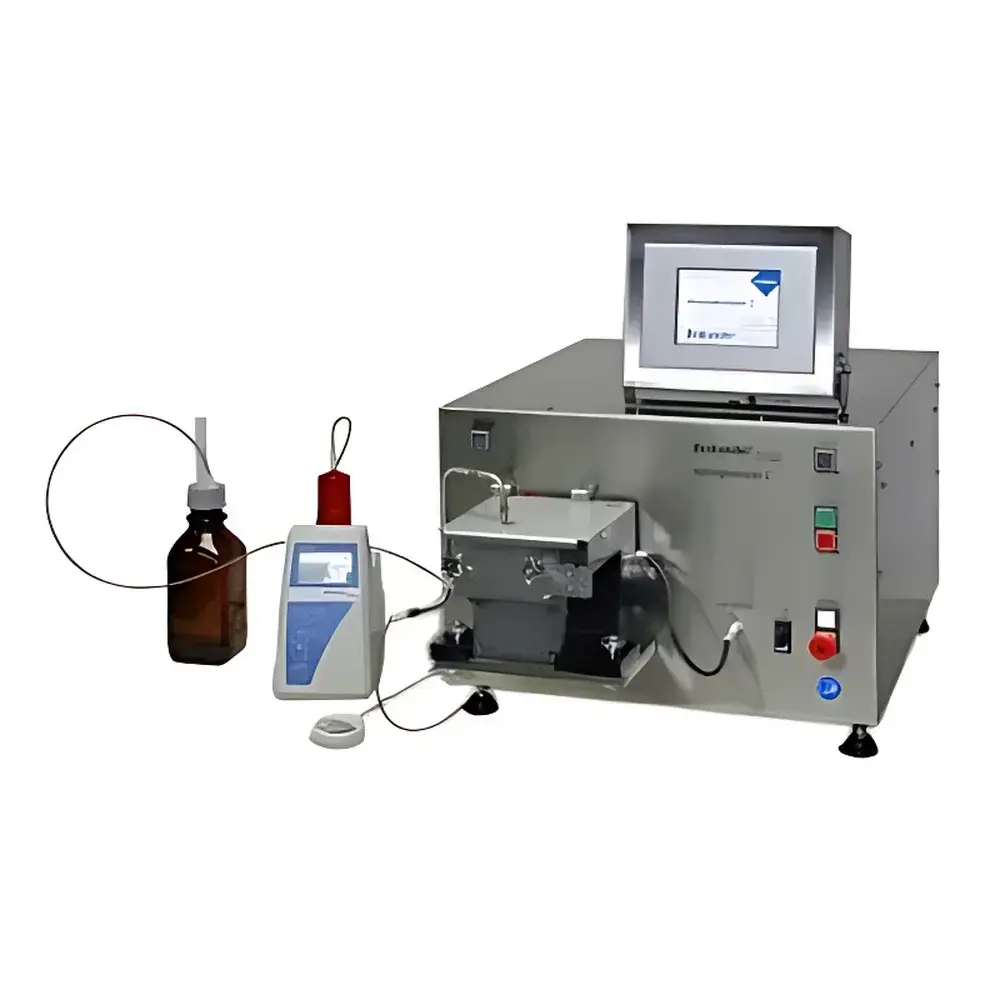
Brabender C-Type Oil Absorption Meter (Carbon Black Absorption Tester)
| Brand | Brabender |
|---|---|
| Origin | Germany |
| Model | Brabender C-Type Oil Absorption Meter |
| Compliance | ASTM D2414, ASTM D3493 (Methods A, B, C) |
| Measurement Principle | Torque-based rheological transition detection during oil titration |
| Temperature Control Option | Optional jacketed mixing chamber for isothermal testing |
| Output | Direct OAN (Oil Absorption Number) in mL/100g |
| Calibration | Automatic software calibration without pre-established reference standards |
Overview
The Brabender C-Type Oil Absorption Meter is the globally recognized reference instrument for determining the Oil Absorption Number (OAN) of carbon black—defined as the volume (mL) of dibutyl phthalate (DBP) or paraffin oil absorbed per 100 g of dry carbon black sample. Unlike conventional volumetric or gravimetric methods, this instrument operates on a fundamental rheological principle: it monitors real-time torque evolution in a precision-engineered mixing chamber during controlled oil addition. As oil is incrementally dosed into the carbon black powder under constant shear, the system transitions through three distinct mechanical states—free-flowing (low torque), agglomerate formation (rising torque plateau), and final fluidization (torque decline)—enabling unambiguous endpoint detection. This dynamic, torque-derived endpoint eliminates subjective visual assessment and delivers high inter-laboratory reproducibility. Designed and manufactured in Germany, the C-Type meter serves as the de facto standard referenced in ASTM D2414 (for DBP absorption) and ASTM D3493 (for paraffin oil absorption, Methods A, B, and C), and is routinely specified in carbon black supplier technical data sheets and rubber compound formulation protocols.
Key Features
- High-precision digital torque sensor with resolution ≤ 0.01 mN·m, enabling detection of subtle rheological transitions during oil titration
- Stainless-steel, temperature-stabilized mixing chamber with geometrically optimized blade geometry to ensure uniform shear distribution and minimal wall effects
- Automated oil dosing system with programmable flow rate and incremental step control (0.05–0.2 mL increments)
- Integrated real-time torque vs. oil volume curve display with automatic inflection point identification and OAN calculation
- Optional thermostatically controlled jacketed chamber (±0.5 °C stability) for evaluating temperature-dependent absorption behavior relevant to processing conditions
- Self-calibrating firmware that references internal mechanical zero and torque linearity checks—no external reference standards required prior to analysis
Sample Compatibility & Compliance
The C-Type Oil Absorption Meter is validated for use with all commercially available furnace, thermal, and acetylene carbon blacks, including N110–N990 series and specialty conductive grades. It accommodates sample masses from 5.0 to 10.0 g with consistent repeatability (RSD < 1.2% within-run, < 1.8% between-laboratory per ASTM D2414 interlaboratory study data). The instrument meets the mechanical and procedural requirements of ASTM D2414 (Method C), ASTM D3493 (Method C), and ISO 3478 (Carbon black — Determination of oil absorption number). Its torque-based endpoint detection satisfies GLP documentation requirements for audit trails, including timestamped raw torque data export, operator ID logging, and method version control—fully compatible with FDA 21 CFR Part 11-compliant LIMS integration when paired with Brabender’s optional LabSoft Suite.
Software & Data Management
The embedded Brabender Control Software (v5.2+) provides full method definition, real-time visualization of torque curves, and automated OAN reporting per ASTM-defined criteria. Each test generates a structured .CSV and .PDF report containing raw torque/time/oil volume datasets, annotated transition points, statistical summaries (mean, SD, RSD), and compliance flags for ASTM pass/fail thresholds. Data files are stored with SHA-256 hash integrity verification and support hierarchical folder organization by batch, lot, and operator. Audit trail functionality records all parameter changes, calibration events, and user actions with immutable timestamps—essential for GMP-regulated rubber compounding labs and quality assurance departments performing supplier qualification audits.
Applications
This instrument is deployed across carbon black manufacturing QA/QC labs, rubber compound development centers, and tire OEM R&D facilities. Primary applications include: specification conformance testing against ASTM D2414/D3493; correlation of OAN with compound viscosity (Mooney viscosity), filler dispersion quality, and scorch time in sulfur-cured systems; optimization of dispersant dosage in masterbatch formulations; and investigation of surface oxidation or silane treatment effects on oil affinity. Research users also employ the torque curve morphology—particularly the width and slope of the “cohesive plateau”—as a proxy for aggregate structure and surface energy heterogeneity.
FAQ
What distinguishes the Brabender C-Type from other oil absorption testers?
It is the only instrument that defines the endpoint via torque inflection rather than visual paste consistency, eliminating operator subjectivity and ensuring traceability to ASTM Method C.
Can the instrument be used for non-carbon-black fillers such as silica or calcium carbonate?
While not ASTM-validated for those materials, research-grade applications exist; however, method adaptation and independent validation per ISO 24318 are required.
Is temperature control mandatory for routine testing?
No—ambient operation suffices for standard OAN determination—but the jacketed option is recommended when studying process-relevant mixing behavior or comparing batches across seasons.
How often does the system require recalibration?
Torque sensor linearity is verified automatically at startup; full mechanical calibration is recommended annually or after impact events, using Brabender-certified reference weights and torque simulators.
Does the software support multi-language interfaces and electronic signature workflows?
Yes—English, German, French, Japanese, and Simplified Chinese UI options are available; electronic signatures comply with Annex 11 and 21 CFR Part 11 when configured with LDAP/Active Directory authentication.



