

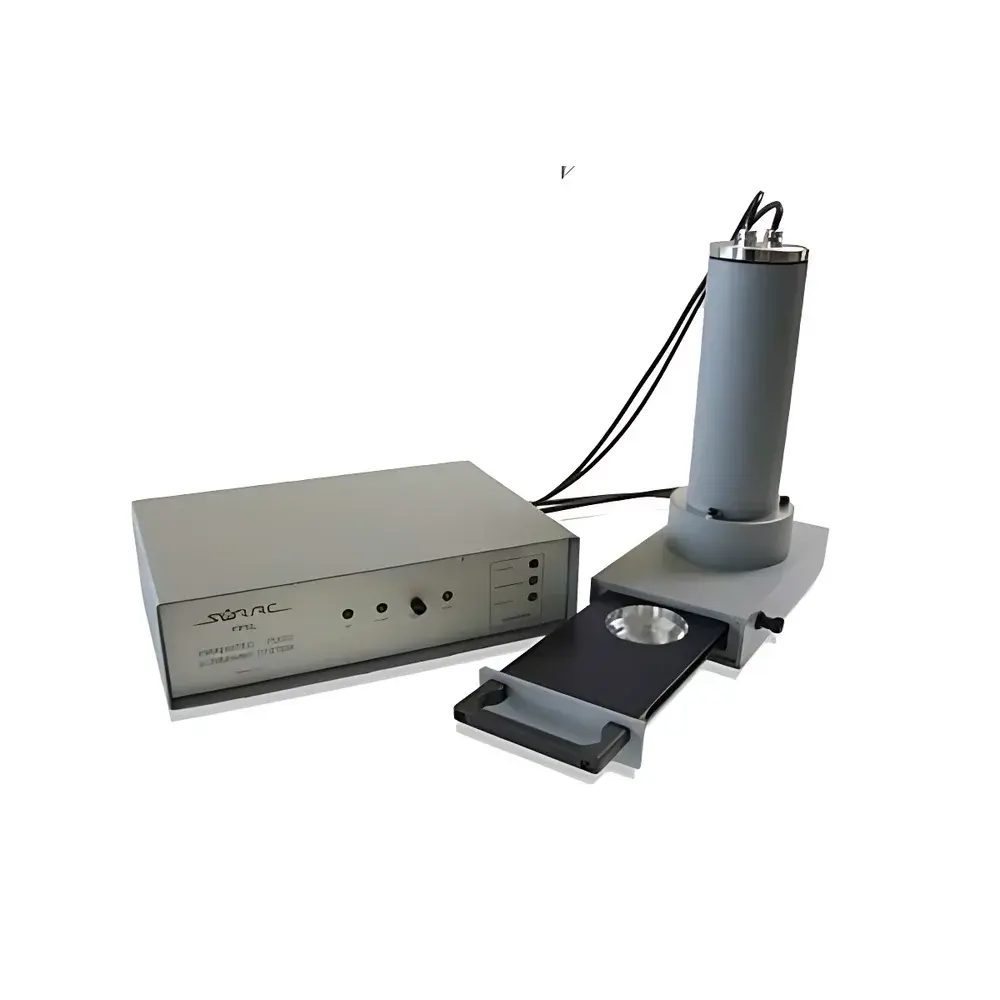
SURRC PPSL Pulse Photo-Stimulated Luminescence Screening System for Irradiated Food
| Brand | SUERC |
|---|---|
| Origin | Germany |
| Model | SURRC PPSL |
| Background Count (20°C) | 50 cps (typ.), 150 cps (max) |
| Pulse Width | 15 µs |
| Preloaded Count | 256 counts |
| Median Threshold | 768 counts |
| Positive Threshold | 4096 counts |
| Preset Test Duration | 15 s |
Overview
The SURRC PPSL Pulse Photo-Stimulated Luminescence Screening System is a dedicated, non-destructive analytical instrument engineered for the rapid and reliable detection of ionizing radiation treatment in foodstuffs. It operates on the principle of photo-stimulated luminescence (PSL), a physical phenomenon wherein crystalline mineral contaminants—such as silicates or silicate-rich debris naturally present in herbs, spices, dried fruits, nuts, and seafood—emit measurable photons upon exposure to controlled pulsed visible light following prior irradiation. These trapped charge carriers, generated during gamma, X-ray, or electron beam irradiation, are released and recombine radiatively under precise optical stimulation, producing a quantifiable luminescent signal proportional to absorbed dose history. Unlike conventional methods requiring complex sample preparation or chemical reagents, the SURRC PPSL system delivers objective, physics-based screening without extraction, dissolution, or derivatization—making it suitable for routine compliance verification under food safety regulations including EU Regulation (EC) No 1333/2008 and Codex Alimentarius Standard CXS 106-1983.
Key Features
- True walk-up operation: No sample pre-treatment required for most dry particulate matrices—including ground spices, dried herbs, tea leaves, cereal grains, and shellfish fragments.
- Single-button screening mode: Delivers pass/fail classification within 15 seconds using factory-calibrated thresholds; fully autonomous without PC connection.
- High specificity and sensitivity: Demonstrates ≥95% correct classification rate for irradiated botanicals and condiments under validated test conditions.
- Integrated diagnostic capabilities: Supports dark count measurement (detector background in absence of stimulation), blank chamber count (system contamination assessment), and PMT gain calibration—enabling traceable instrument performance verification.
- Flexible parameter control: When connected to host software, users may adjust stimulation pulse duration, integration time, threshold levels, and data logging intervals per ISO/IEC 17025-aligned workflows.
- Robust architecture: Designed for laboratory, inspection facility, and mobile deployment environments; compact footprint and low power consumption support field-deployable food safety monitoring.
Sample Compatibility & Compliance
The SURRC PPSL system is validated for use with a broad spectrum of food categories regulated for irradiation control, including but not limited to: dried aromatic herbs (e.g., oregano, basil), ground spices (e.g., black pepper, paprika), dehydrated vegetables, frozen berries, shellfish (e.g., shrimp, scallops), and cereal-based products. It complies with EN 13751:2009 (“Foodstuffs — Detection of Irradiated Food Using Photo-Stimulated Luminescence”) and supports audit readiness for GLP and GMP environments. All measurement protocols adhere to the principles outlined in IAEA Technical Reports Series No. 409 and CEN Workshop Agreement CWA 16355, ensuring alignment with international reference methodologies. The absence of consumables or hazardous reagents further facilitates compliance with ISO 14001 environmental management requirements.
Software & Data Management
The optional PC interface enables full traceability and regulatory documentation. Software provides timestamped raw photon count logs, configurable report templates (PDF/CSV), user-access-level controls, and electronic signature support compatible with FDA 21 CFR Part 11 requirements when deployed in validated environments. Audit trails record all parameter modifications, calibration events, and result classifications. Data export functions integrate with LIMS platforms via standard ODBC drivers. Instrument self-diagnostics include real-time PMT voltage monitoring, temperature-compensated background drift correction, and automated flagging of out-of-specification chamber conditions.
Applications
- Routine screening of imported spices and herbs at port-of-entry laboratories.
- QC/QA verification of irradiated ingredients in food manufacturing facilities.
- Regulatory surveillance by national food safety authorities conducting market monitoring programs.
- Research applications investigating dose-response relationships in PSL-active minerals across varied food matrices.
- Method validation studies supporting accreditation to ISO/IEC 17025 for testing laboratories.
- Training and proficiency testing in food authenticity and irradiation compliance education programs.
FAQ
What types of food samples are suitable for PSL analysis using the SURRC PPSL system?
Dry, particulate foods containing natural silicate minerals—such as spices, herbs, nuts, dried fruits, and seafood—are ideal candidates. Liquid, fatty, or highly processed matrices typically lack sufficient mineral content for reliable PSL response.
Does the system require consumables or chemical reagents?
No. The method is entirely reagent-free and does not consume any disposables beyond standard Petri dishes or sample holders.
Can the SURRC PPSL be used in field or mobile laboratory settings?
Yes. Its low power draw, compact form factor, and battery-compatible operation (with optional external power bank) support deployment in customs checkpoints, cold-chain inspection units, and remote testing sites.
How is instrument performance verified between analyses?
Built-in diagnostics allow daily verification via dark count, blank chamber count, and reference standard checks—fully documented within the software audit trail.
Is technical support available globally?
Yes. Manufacturer-authorized service partners provide installation, application training, preventive maintenance, and remote troubleshooting aligned with ISO/IEC 17025 competency requirements.




