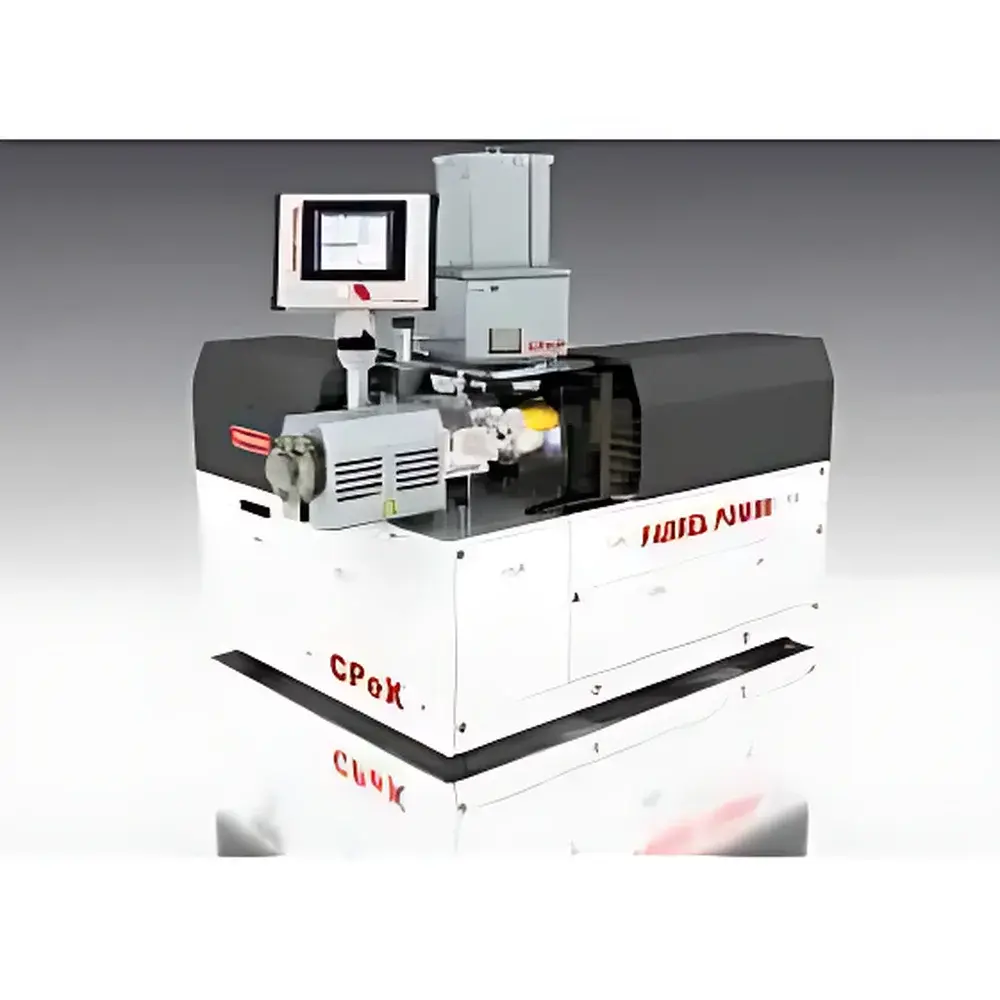
Farrel CPeX™ Laboratory-Scale Continuous Mixer
| Brand | Farrel |
|---|---|
| Origin | USA |
| Model | CPeX™ |
| Nominal Production Rate | 10–30 kg/hr |
| Mixer Power | 7.5 kW (10 hp) |
| Max. Rotor Speed | 1000 rpm |
| Rotor Diameter | 35 mm (1.38 in) |
| Hot Feed Extruder Power | 7.5 kW (10 hp) |
| Max. Screw Speed | 100 rpm |
| Screw Diameter | 60 mm (2.36 in) |
| Screw Length-to-Diameter Ratio | 11:1 |
| Overall Weight | 3000 kg (6500 lb) |
| Length | 2260 mm (89.0 in) |
| Width | 1500 mm (59.1 in) |
| Height | 1690 mm (66.5 in) |
| Floor-to-Extruder Centerline Height | 914 mm (36.0 in) |
Overview
The Farrel CPeX™ is a laboratory-scale continuous mixer engineered for precision compound development and process validation in polymer, elastomer, and advanced composite formulations. Unlike batch mixers or extrusion-based lab systems, the CPeX™ implements Farrel’s proven Pomini continuous mixing technology—characterized by a counter-rotating twin-rotor configuration operating within a closed, temperature-controlled chamber. This architecture generates high shear, uniform residence time distribution, and controlled thermal history—critical parameters for replicating industrial-scale dispersion, distributive mixing, and devolatilization behavior in a compact footprint. Designed explicitly for R&D laboratories, pilot plants, and formulation centers, the CPeX™ bridges the gap between small-scale screening and full-scale production, enabling direct scale-up correlation without intermediate pilot trials.
Key Features
- True Continuous Mixing Architecture: Twin counter-rotating rotors with optimized profile geometry ensure consistent material throughput, minimal dead zones, and repeatable specific mechanical energy (SME) input across the 10–30 kg/hr operational range.
- Integrated Hot-Feed Extruder: A co-located 60 mm single-screw extruder (L/D = 11:1) feeds pre-heated or pre-compounded material directly into the mixing zone, supporting multi-stage feeding strategies including masterbatch dilution and reactive extrusion protocols.
- Thermal & Mechanical Control Precision: Independent jacketed temperature control of the mixing chamber and extruder barrel (±1 °C stability), combined with real-time torque, power, and rotor speed monitoring, enables precise mapping of rheological response under defined processing conditions.
- Modular Design for Process Flexibility: Interchangeable rotor configurations (e.g., kneading, conveying, reverse-pitch) and adjustable clearance settings allow optimization for filler dispersion, polymer blending, or thermoset compounding without hardware replacement.
- Robust Industrial Build: Constructed with hardened alloy steel components, heavy-duty bearings, and sealed drive systems rated for continuous operation—consistent with Farrel’s legacy in production-scale continuous mixers.
Sample Compatibility & Compliance
The CPeX™ accommodates a broad spectrum of viscoelastic materials, including thermoplastics (PP, PE, PC, PA), thermoplastic elastomers (TPEs), silicone compounds, carbon-black- or silica-filled rubber compounds, conductive composites, and reactive systems (e.g., peroxide-cured EPDM, silane-grafted polyolefins). Its closed mixing chamber design supports ASTM D3418 (thermal transitions), ISO 34-1 (tensile properties of vulcanized rubber), and ISO 1133 (melt flow rate) sample preparation protocols. All electrical and safety subsystems comply with UL 508A (industrial control panels) and CE machinery directive 2006/42/EC. Optional integration with explosion-proof enclosures meets ATEX Zone 2 / IECEx requirements for volatile solvent-based formulations.
Software & Data Management
Control and data acquisition are managed via Farrel’s proprietary CPeX™ Control Suite—a Windows-based HMI platform compliant with FDA 21 CFR Part 11 for electronic records and signatures. The system logs timestamped, audit-trail-enabled datasets including rotor torque, power consumption, melt pressure, barrel temperatures, screw speed, and feed rate at 100 ms intervals. Export formats include CSV, Excel, and HDF5 for downstream statistical analysis (e.g., JMP, MATLAB). Batch recipe management supports version-controlled parameter sets, user-level access permissions, and automated report generation aligned with GLP and GMP documentation standards.
Applications
- Rapid screening of filler dispersion efficiency (e.g., nanocellulose, graphene, carbon nanotubes) under defined SME and thermal profiles
- Development and validation of low-VOC or bio-based polymer blends requiring precise moisture and volatiles removal
- Formulation of electrically conductive or EMI-shielding compounds with narrow resistivity tolerances
- Process window definition for high-viscosity engineering thermoplastics prior to transfer to Farrel production-scale PMX or FCM systems
- Accelerated aging studies using controlled shear-thermal histories to simulate service-life degradation mechanisms
FAQ
What is the minimum batch size supported for statistically valid rheological characterization?
The CPeX™ achieves steady-state mixing within ~90 seconds after start-up; stable data collection begins after 120 seconds of continuous operation, corresponding to ~2–3 kg of processed material—sufficient for ASTM D792, ISO 1183 density testing, and extraction-based filler analysis.
Can the CPeX™ be integrated with inline rheometry or NIR spectroscopy?
Yes—standard 1/2″ NPT and flanged ports are provided at the die exit for mounting commercial inline viscometers (e.g., Gottfert RheoLog, Anton Paar MCR) and fiber-optic NIR probes compatible with ASTM E1655 spectral calibration frameworks.
Is rotor wear compensated for during long-duration experiments?
Rotor clearance is manually adjustable via calibrated micrometer dials on both sides of the mixing chamber; typical wear rates under standard polymer processing are <0.02 mm per 500 hours—verified via periodic laser profilometry per ISO 4287.
Does Farrel provide scale-up correlation tools with production CPM or PMX systems?
Yes—Farrel supplies dimensionless scale-up coefficients (e.g., constant specific energy, constant tip speed, constant Reynolds number) and validated empirical models linking CPeX™ SME, residence time, and dispersion quality to full-scale Farrel continuous mixer outputs.