
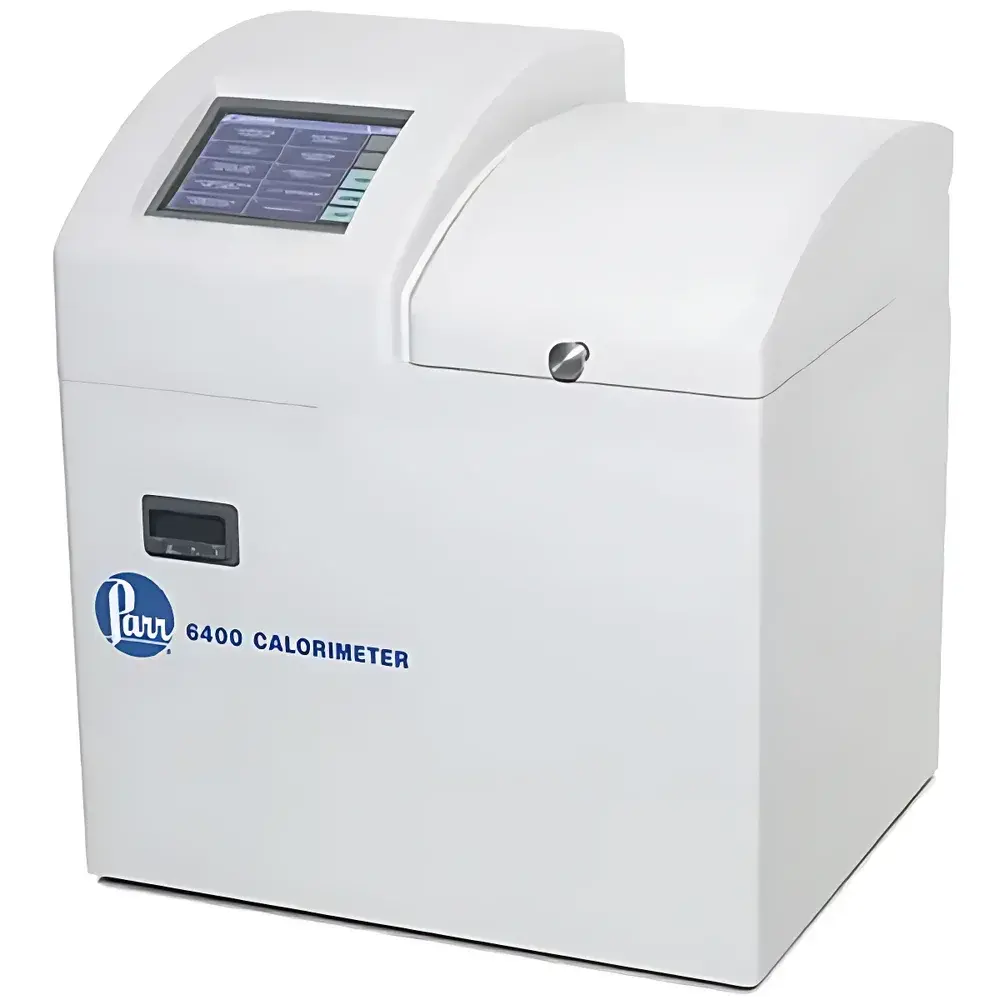
Parr 6400 Automated Oxygen Bomb Calorimeter
| Brand | Parr Instrument Company |
|---|---|
| Origin | USA |
| Model | 6400 |
| Measurement Mode | Isoperibol Calorimetry |
| Instrument Type | Oxygen Bomb Calorimeter |
| Automation Level | Fully Automated |
| Temperature Resolution | 0.0001 °C |
| Sample Throughput | 6–7 determinations per hour |
| Heat Capacity Calibration Range | Up to 3000 J/K |
| Accuracy | ±0.05% RSD |
| Bomb Configuration | Fixed-body, moving-head design with quick-twist locking seal |
| Optional Bomb Materials | Alloy 20 (Parr 1138) or Hastelloy G30 (Parr 1138CL) |
| Cleaning | Fully automated bomb and crucible rinse cycle without manual disassembly |
| Water Filling & Oxygen Charging | Motorized, pressure-regulated, and software-controlled |
| Data Storage Capacity | 1000 test records |
| Interface | RS-232, USB, parallel printer port, and analytical balance integration |
| Operating Modes | Dynamic combustion mode and equilibrium-based heat measurement mode |
| Display | Integrated touchscreen LCD interface |
Overview
The Parr 6400 Automated Oxygen Bomb Calorimeter is a precision-engineered isoperibol calorimetric system designed for high-throughput, traceable determination of gross calorific value (GCV) in solid and liquid samples. Based on the classical oxygen bomb combustion principle—where a precisely weighed sample is ignited under high-pressure oxygen (typically 30 bar) inside a sealed, water-jacketed stainless-steel bomb—the instrument measures the temperature rise of a thermally stable water bath surrounding the bomb. This temperature change, corrected for thermal leakage and electrical calibration energy, yields the total heat released per unit mass (MJ/kg or cal/g), fully compliant with ASTM D240, ASTM D4809, ISO 1928, ISO 6976, and EN 14918 standards. The 6400’s isoperibol architecture ensures consistent thermal environment across runs, eliminating the need for adiabatic correction algorithms and enhancing inter-laboratory reproducibility. Its core application domain spans fuel certification (coal, biomass, petrochemicals), food energy labeling (AOAC 963.13), feedstuff analysis (AOAC 960.42), waste-derived fuel characterization (EN 15400), and energetic materials safety testing.
Key Features
- Fully integrated automation: automatic bomb filling (deionized water), pressurization (O2 up to 30 bar), ignition, post-combustion cooling, quantitative drain-and-rinse of bomb interior and crucible—no manual bomb removal required.
- Fixed-body/moving-head bomb configuration with quick-twist locking mechanism ensures repeatable sealing integrity and eliminates gasket alignment variability.
- High-resolution platinum resistance thermometer (PRT) with 0.0001 °C resolution enables detection of sub-millikelvin thermal transients, critical for low-energy samples and tight uncertainty budgets.
- Dual-mode operation: dynamic mode captures full combustion kinetics for method development; equilibrium mode delivers certified-grade results per ISO/IEC 17025 requirements.
- Modular bomb options—including Alloy 20 (Parr 1138) for general-purpose use and Hastelloy G30 (Parr 1138CL) for chlorine- or sulfur-rich matrices—extend service life and reduce acid corrosion artifacts.
- Onboard memory stores 1000 complete test records with timestamps, operator ID, calibration history, and raw thermal curves—supporting audit readiness under GLP and FDA 21 CFR Part 11 environments when paired with compliant software.
Sample Compatibility & Compliance
The Parr 6400 accommodates a broad range of heterogeneous, high-ash, or halogenated matrices—including bituminous coal, refuse-derived fuel (RDF), animal feed pellets, chocolate formulations, nitrocellulose-based propellants, and municipal solid waste composites. Its robust bomb design tolerates sample masses from 0.5 g to 1.2 g (depending on expected energy density) and supports both benzoic acid (NIST SRM 39j) and certified coal reference materials (e.g., NIST SRM 184a) for routine calibration verification. All operational protocols align with ISO/IEC 17025 clause 7.7 (uncertainty estimation), ASTM E1710 (calorimeter validation), and USP for pharmaceutical excipient energy profiling. Traceability is maintained via NIST-traceable temperature sensors and gravimetric oxygen delivery calibration.
Software & Data Management
The system operates via embedded firmware with a 7-inch resistive touchscreen interface supporting multilingual menus (English, Spanish, Chinese, German). Raw thermal data (temperature vs. time) is exportable in CSV format via USB or RS-232. Optional Parr WinCAL software (Windows-based) provides advanced features: automated uncertainty propagation per GUM (JCGM 100:2018), batch reporting with statistical control charts (X̄/R), electronic signature workflows, and secure user-role management (admin/operator/auditor tiers). Audit trails log all parameter changes, calibration events, and result modifications—fully compliant with FDA 21 CFR Part 11 when deployed with validated electronic record infrastructure.
Applications
- Coal and coke quality control in mining and power generation facilities (ASTM D5865)
- Energy content verification for biofuel blends (ASTM D7566 Annex A3)
- Nutritional labeling compliance for packaged foods and dietary supplements (FDA 21 CFR 101.9)
- Thermodynamic characterization of pyrotechnic compositions and propellant formulations
- Waste-to-energy facility feedstock qualification (EN 15400, ISO 21643)
- Research-scale combustion kinetics studies in university thermochemistry labs
FAQ
What calibration standards are recommended for routine verification?
NIST Standard Reference Material (SRM) 39j (benzoic acid) is used for energy equivalence calibration; NIST SRM 184a (bituminous coal) validates matrix-specific recovery performance.
Can the Parr 6400 comply with ISO/IEC 17025 accreditation requirements?
Yes—when operated with documented SOPs, scheduled maintenance logs, annual metrological verification of PRT and pressure transducers, and traceable calibration certificates, the system meets clause 6.4 (equipment) and 7.7 (results reporting) of ISO/IEC 17025:2017.
Is remote monitoring or network integration supported?
The instrument includes Ethernet-ready hardware; third-party SCADA or LIMS integration is achievable via Modbus TCP or custom API development using the provided communication protocol manual.
How is moisture correction handled for heterogeneous fuels?
The system does not measure moisture directly; users must input proximate analysis data (ASTM D3173) manually or import via CSV to compute net calorific value (NCV) using standard thermodynamic corrections.
What maintenance intervals are specified for long-term reliability?
Daily: crucible inspection and O-ring cleaning; quarterly: bomb seal torque verification and water bath pH monitoring; annually: full sensor recalibration by an accredited metrology lab.



