
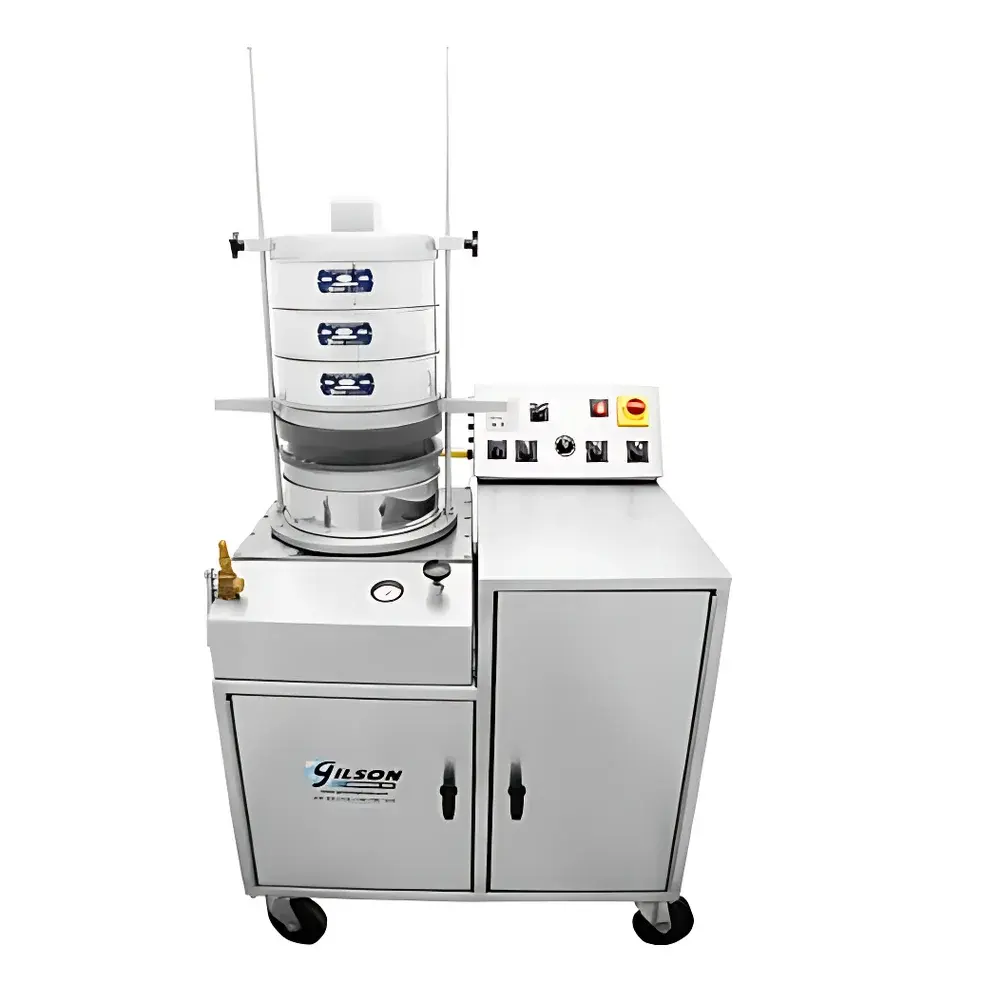
Gilson Wet-Vac® Sieve Shaker Series (WV-1, WV-1F, WV-2, WV-2F, WV-3, WV-3F)
| Origin | USA |
|---|---|
| Manufacturer Type | Authorized Distributor |
| Origin Category | Imported |
| Models | WV-1, WV-1F, WV-2, WV-2F, WV-3, WV-3F |
| Pricing | Upon Request |
Overview
The Gilson Wet-Vac® Sieve Shaker Series is a fully integrated, benchtop particle size analysis system engineered for high-reproducibility wet sieving—particularly where fine particle recovery, slurry handling, and adherence to standardized test protocols are critical. Unlike conventional mechanical shakers, the Wet-Vac® platform combines three synchronized physical forces: controlled electromagnetic vibration, regulated water delivery via rotating spray bar, and consistent vacuum-assisted aspiration (2 in Hg / 50.8 mm Hg). This tri-modal separation mechanism enables efficient disaggregation and transport of cohesive or hydrophobic fines—materials that typically resist conventional dry or static wet sieving. The system complies with core principles outlined in ASTM C136/C136M (Standard Test Method for Sieve Analysis of Fine and Coarse Aggregates), ASTM D422 (Particle-Size Analysis of Soils), ISO 17892-4 (Geotechnical Investigation and Testing — Laboratory Testing of Soil — Part 4: Determination of Particle Size Distribution), and USP (Particle Size Distribution). Its design replicates industrial-scale wet classification conditions—making it suitable not only for QC/QA labs but also for method development and validation under GLP/GMP-aligned workflows.
Key Features
- Tri-functional operation: Simultaneous control of vibration amplitude, water flow pressure (adjustable up to 35 psi / 2.4 bar), and vacuum level (fixed at 2 in Hg)
- Rotating spray bar within the sieve lid ensures uniform material saturation and minimizes particle agglomeration during wet sieving
- Integrated 7-gallon (22.5 L) recirculating water reservoir with sight gauge, inlet/outlet valves, and direct tap/drain connectivity for single-pass or closed-loop operation
- Electromagnetic drive system with continuously adjustable amplitude—optimized for both coarse aggregate fractionation and fine silt/clay separation
- Modular sieve compatibility: WV-1/WV-1F supports 12-inch (305 mm) diameter sieves; WV-2/WV-2F accommodates 8-inch (203 mm); WV-3/WV-3F accepts both sizes via interchangeable lid assemblies and lifting rings
- Ergonomic front-mounted control panel featuring analog gauges for water pressure and vacuum, LED status indicators, and a programmable digital timer (0–99 minutes with pause/resume capability)
- Stainless steel welded cabinet housing pump, solenoid valves, vibration actuator, and fluid management components—mounted on locking casters for lab mobility and stability
Sample Compatibility & Compliance
The Wet-Vac® Sieve Shaker is validated for use with insoluble, non-flocculating, and moderately cohesive particulates—including coal fines, mining tailings, marine sediments, glacial till, pipeline slurries, foundry sands, and construction aggregates. It is not intended for organic colloids, highly flocculated clays, or samples requiring dispersants beyond standard sodium hexametaphosphate pretreatment. All models support ASTM E11-22 and ISO 3310-1 compliant test sieves in stainless steel, brass, or nylon frames—with aperture ranges from 20 µm to 100 mm. Optional accessories—including WVA-161 filter papers, WVA-165 filter holders, WVA-100 base plates, nested cylinder spacers, and sealing gaskets—ensure full traceability and repeatability across multi-lab studies. Vacuum and water delivery parameters meet documented requirements for ASTM D1140 (Fine Aggregate Content of Bituminous Mixtures) and AASHTO T 27 (Sieve Analysis of Fine and Coarse Aggregates).
Software & Data Management
While the Wet-Vac® operates as a standalone electromechanical instrument without embedded firmware or network connectivity, its operational parameters are fully documentable per FDA 21 CFR Part 11 requirements when used within validated laboratory information management systems (LIMS). The built-in timer provides auditable run-time logs; pressure and vacuum gauges enable manual recording of process-critical setpoints. For automated data capture, third-party USB/RS-232 interface modules (e.g., National Instruments DAQ devices) may be integrated to log timestamped vibration amplitude, water pressure, and vacuum levels. Gilson-provided SOP templates align with ISO/IEC 17025 clause 7.2.2 (Method Validation) and include calibration checklists for water flow rate (gravimetric verification), vacuum stability (digital manometer cross-check), and vibration amplitude (laser Doppler vibrometer traceable to NIST standards).
Applications
- Aggregate gradation testing in civil engineering and asphalt QC labs
- Sedimentological analysis of fluvial, lacustrine, and marine core samples
- Mineral processing optimization—especially for liberation studies of sulfide ores and phosphate rock
- Environmental soil screening per EPA Method 1684 (Total Suspended Solids) and ASTM D4318 (Liquid Limit, Plastic Limit, and Plasticity Index)
- Pharmaceutical excipient particle distribution profiling where wet dispersion mimics tablet granulation fluid dynamics
- Research-grade validation of computational fluid dynamics (CFD) models for slurry transport behavior
FAQ
What voltage/frequency options are available for the Wet-Vac® Sieve Shaker?
The WV-1 and WV-2 models operate on 115 V / 60 Hz (North America, Japan); WV-1F and WV-2F are configured for 230 V / 50 Hz (EU, UK, Australia); WV-3 and WV-3F support both input configurations via internal jumper selection.
Can the system perform dry sieving without water or vacuum activation?
Yes—vibration-only mode is fully functional and independently controllable; water and vacuum circuits remain isolated unless manually engaged via front-panel valves.
Is the 7-gallon water tank sufficient for extended testing cycles?
For continuous operation, the reservoir supports ~45 minutes of recirculation at nominal 35 psi flow; for longer runs or high-solids slurries, direct tap connection is recommended to maintain consistent hydraulic head.
How is filter paper retention managed during wet sieving?
Fine fractions are captured on standard WVA-161 filter papers held in WVA-165 filter holders mounted beneath the sieve stack—allowing mid-test paper replacement without interrupting vibration or vacuum.
Are calibration certificates included with shipment?
Factory calibration reports for vibration amplitude linearity, water pressure accuracy, and vacuum stability are provided; NIST-traceable recalibration services are available through Gilson’s certified service centers.
Related Products






