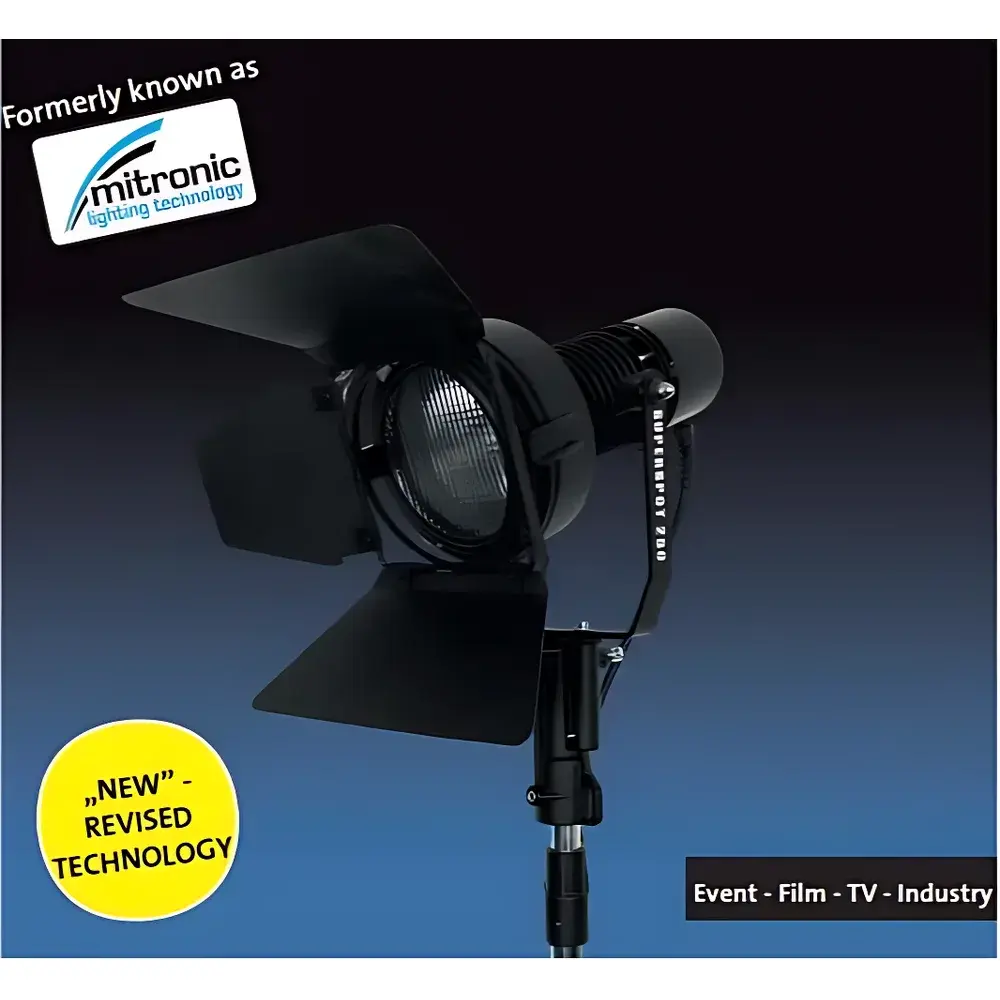
Superspot 250 W UV Spot Curing System by Hönle
| Brand | Hönle |
|---|---|
| Origin | Germany |
| Model | Superspot 250 W |
| Light Source | MSD 250 W/SE UV Lamp |
| Reflector | High-Precision Parabolic Aluminum Reflector |
| Cooling | Patented Reflector Cooling System |
| Housing | Three-Part Cast Aluminum with Thermal Decoupling Ignition |
| Socket Type | GY 9.5 |
| Diffusers | 4 Interchangeable Options for Variable Irradiance Distribution |
| Lens Diameter | 145 mm |
| Dimensions | 300 × 170 mm |
| Weight | ~2.8 kg |
| Surface Finish | High-Temperature-Resistant Black or Anodized Aluminum Powder Coating |
| Safety | Dual-Pole Automatic Cut-Off When Rear Access Panel Is Open |
Overview
The Hönle Superspot 250 W is a high-intensity, precision-engineered UV spot curing system designed for laboratory, R&D, and low-to-medium volume production environments requiring localized, repeatable photopolymerization. It operates on the principle of focused ultraviolet irradiation (UVA, peak ~365 nm) delivered via a high-efficiency parabolic reflector and quartz lens assembly, enabling controlled energy density (mW/cm²) at the target surface. Unlike broad-area flood systems, the Superspot delivers collimated, directional UV output ideal for bonding, coating curing, adhesive setting, and micro-encapsulation where thermal management, spatial selectivity, and process reproducibility are critical. Its cast aluminum architecture incorporates thermal decoupling between the lamp ignition circuitry and optical path—minimizing thermal drift during extended operation—and supports stable irradiance output over time, essential for quantitative UV dose (J/cm²) delivery in validated processes.
Key Features
- Three-part cast aluminum housing engineered for mechanical stability, thermal dissipation, and long-term dimensional integrity under repeated thermal cycling.
- Patented reflector cooling system actively manages heat accumulation at the parabolic mirror surface, preserving reflectivity (>92% UVA reflectance) and preventing focal shift during multi-minute exposures.
- Gyration-free focusing mechanism: Precision-machined spindle, locking nut, and toothed belt drive enable micron-level repeatability in working distance adjustment without tooling.
- Tool-free rear-access lamp replacement: The MSD 250 W/SE mercury short-arc lamp can be exchanged in under 90 seconds; dual-pole safety interlock automatically de-energizes both live and neutral conductors upon panel removal.
- Four standardized diffuser optics (0°, 8°, 15°, and 30° beam divergence) allow systematic optimization of irradiance uniformity and spot size (10–45 mm Ø at 100 mm working distance), supporting DOE-based process development.
- High-temperature-resistant powder coating (black or anodized aluminum finish) rated to 200 °C continuous surface exposure, ensuring compatibility with cleanroom and industrial ambient conditions.
Sample Compatibility & Compliance
The Superspot 250 W is compatible with substrates ranging from silicon wafers and glass slides to flexible polymer films and metalized PCBs. Its compact footprint (300 × 170 mm) and low socket-zone temperature (<65 °C at GY 9.5 interface) permit integration into gloveboxes, laminar flow hoods, and automated stages without auxiliary cooling. The system complies with IEC 61000-6-3 (EMC emission limits) and IEC 62471 (Photobiological Safety Classification — Risk Group 3 for direct viewing; appropriate UV-blocking eyewear and shielding required per ANSI Z136.1). While not intrinsically rated for hazardous locations, its electrical isolation and thermal design meet general-purpose industrial safety requirements per EN 61010-1. For regulated manufacturing (e.g., medical device assembly), users may document irradiance mapping, lamp aging curves, and interlock functionality to support ISO 13485 or FDA 21 CFR Part 820 traceability protocols.
Software & Data Management
The Superspot 250 W operates as a stand-alone analog-controlled unit; no embedded firmware or digital interface is included. However, it is fully compatible with external programmable power supplies (e.g., Hönle UV-Controller series) that provide TTL-triggered on/off, analog intensity modulation (0–10 V), and real-time irradiance monitoring via calibrated photodiode sensors. When integrated with third-party data acquisition systems (e.g., LabVIEW, Python + NI DAQ), users can log exposure time, trigger events, and correlate dose with material property outcomes (e.g., Shore D hardness, lap shear strength). Audit trails, user access control, and electronic signatures are achievable through companion software platforms compliant with 21 CFR Part 11 when paired with validated controllers—enabling GLP/GMP-aligned process documentation.
Applications
- Micro-optics bonding: UV-curable epoxies and acrylates for lens alignment in telecom transceivers and endoscopic assemblies.
- MEMS packaging: Hermetic sealing of pressure sensor cavities using low-outgassing silicone-acrylate hybrids.
- Lab-on-chip fabrication: Selective curing of SU-8 photoresist features <50 µm wide with minimal thermal cross-talk.
- Electronics rework: Localized reflow of UV-conductive adhesives on flex circuits without damaging adjacent components.
- Academic photopolymer research: Parameter sweeps across irradiance (100–1200 mW/cm²), dose (0.5–20 J/cm²), and spectral filtering for kinetic modeling of radical vs. cationic mechanisms.
FAQ
What is the typical lifetime of the MSD 250 W/SE lamp under standard operating conditions?
Rated average life is 1,000 hours at nominal voltage; actual service life depends on cold-start frequency, ambient temperature, and duty cycle—lamp aging should be monitored via radiometric calibration every 200 hours in critical applications.
Can the Superspot 250 W be used with ozone-generating lamps?
No—the MSD 250 W/SE is a fused quartz, ozone-free lamp; the system’s optical train and housing are not rated for ozone exposure or VUV transmission.
Is radiometric calibration traceable to NIST standards available?
Yes—Hönle offers factory calibration certificates (traceable to PTB, Germany) for irradiance measurement at defined working distances; users may also employ third-party NIST-traceable handheld radiometers (e.g., ILT950UV) for in-house verification.
Does the unit include a shutter or exposure timer?
No—timing must be controlled externally via TTL signal or footswitch; optional Hönle UV-Controller units provide programmable exposure sequencing with ±0.01 s resolution.
What maintenance is required beyond lamp replacement?
Biannual inspection of reflector cleanliness (isopropyl alcohol wipe), lens surface integrity (no scratches or haze), and thermal interface paste condition at ignition module mounting points is recommended for sustained optical performance.