
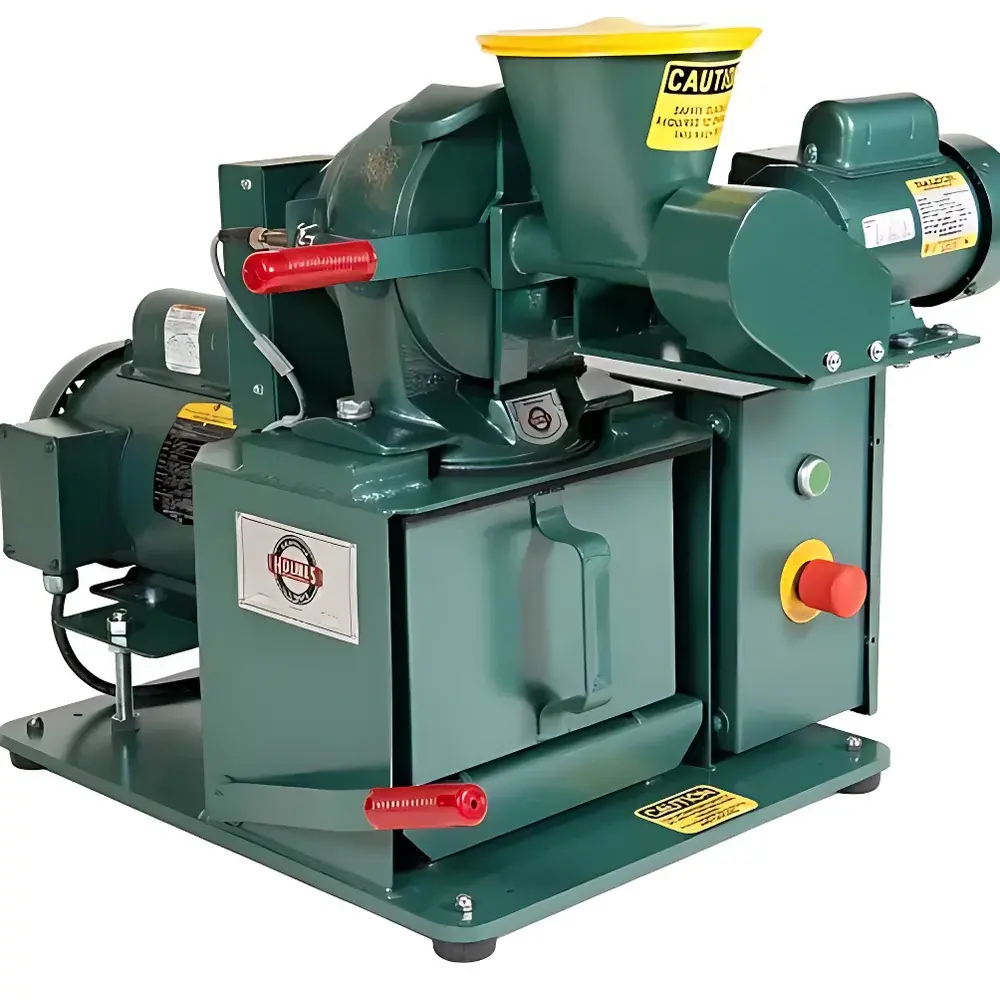
Holmes LC-350 / LC-350F / LC-500 / LC-500F / LC-502 / LC-502F Coal Pulverizers
| Origin | USA |
|---|---|
| Manufacturer Type | Authorized Distributor |
| Origin Category | Imported |
| Models | LC-350, LC-350F, LC-500, LC-500F, LC-502, LC-502F |
| Voltage/Frequency | 115V/60Hz, 230V/50Hz, 220V/50Hz, 230V/60Hz |
| Motor | 1 HP single-phase with thermal overload protection |
| Feed Options | Manual or auger-driven |
| Rotor | Integral balanced rotor with hardened-coating hammers |
| Chamber | Fully sealed, quick-release latched door with safety interlock |
| Sieve Plates | Six standard aperture sizes (0.508–2.36 mm), five supplied per unit |
| Feed Hopper Capacity | 0.5 L standard (1 L optional), vinyl snap-on cover |
| Sample Container | 325 in³ (5.32 L) for LC-502/LC-502F models |
| Throughput (0.610 mm sieve) | ~400 g/min (LC-350/LC-500 series) |
| Construction | Painted steel frame and cast iron housing |
| Base | Lightweight steel plate mounted on four rubber isolation pads |
| Power Cord | Approx. 3 m (10 ft), unterminated |
Overview
The Holmes LC-series Coal Pulverizers are laboratory-scale, benchtop mechanical pulverization systems engineered for consistent size reduction of coal, coke, and other brittle carbonaceous materials to precise particle size distributions required for ASTM D3174 (ash), D3175 (volatile matter), and D3176 (ultimate analysis) testing protocols. Operating on the principle of high-speed impact comminution, these units utilize a dynamically balanced, hardened-steel hammer rotor rotating at fixed speed within a fully enclosed chamber. Material is introduced either manually via gravity-fed hopper or continuously via motor-driven auger feed mechanism—enabling reproducible sample preparation under controlled conditions. Designed for compliance with ISO/IEC 17025 laboratory quality management requirements, each model integrates mechanical safety interlocks, thermal motor protection, and rigid structural construction to support routine operation in accredited coal testing laboratories, power plant QA/QC facilities, and university energy research centers.
Key Features
- Two feed configurations: manual feed (LC-350/LC-350F) and auger-assisted feed (LC-500/LC-500F/LC-502/LC-502F) for improved throughput consistency and operator safety
- Integral balanced rotor with hardened-coating hammers mounted on a precision-machined shaft—optimized for wear resistance and rotational stability
- Fully sealed pulverization chamber with quick-release latched door and integrated safety interlock switch that de-energizes the motor immediately upon door opening
- Six standardized sieve aperture options (0.508 mm to 2.36 mm), with five plates included per unit; all plates secured by locking pins for vibration-resistant positioning
- Robust construction using cast iron housing and painted structural steel frame, mounted on vibration-dampening rubber isolation pads
- Thermally protected 1 HP single-phase induction motor with automatic reset overload circuit—rated for continuous duty under variable load conditions
- Galvanized feed hopper (0.5 L standard, 1 L optional) with vinyl snap-on cover and galvanized sample collection container (325 in³ / 5.32 L on LC-502 variants)
Sample Compatibility & Compliance
The LC-series pulverizers process dry, friable samples including bituminous and anthracite coal, petroleum coke, lignite, and char. They are not intended for wet, fibrous, or highly abrasive non-carbonaceous materials. All models meet mechanical safety requirements outlined in ANSI B11.1–2020 (Safety Requirements for Mechanical Power Transmission Equipment) and incorporate design elements aligned with OSHA 1910.212 (Machine Guarding). The sealed chamber and interlocked access satisfy containment expectations for dust-generating operations per NIOSH Recommended Exposure Limits (RELs) for respirable coal dust (1.5 mg/m³ TWA). Units are compatible with GLP-compliant sample handling workflows when paired with traceable sieve calibration certificates and documented maintenance logs.
Software & Data Management
These are standalone electromechanical instruments with no embedded firmware, touchscreen interface, or digital data output. Operation is entirely manual: start/stop control via front-panel switch, with no programmable parameters or automated cycle logging. For laboratories requiring audit-ready documentation, integration with external Laboratory Information Management Systems (LIMS) is achieved through operator-entered metadata—including sample ID, sieve size used, feed mode selected, and run duration—recorded in paper logbooks or electronic lab notebooks compliant with FDA 21 CFR Part 11 when configured with electronic signature capability. Calibration verification of sieve apertures must be performed periodically per ASTM E11 and documented per ISO/IEC 17025 Clause 6.4.3.
Applications
- Preparation of representative sub-samples for proximate and ultimate coal analysis per ASTM D3172–D3176
- Homogenization of coal blends prior to calorimetry (ASTM D5865) or sulfur determination (ASTM D3177)
- Routine QA screening of incoming coal shipments at utility power stations
- Particle size distribution studies supporting combustion modeling and mill performance evaluation
- Research-grade comminution trials in fuel science and carbon material characterization laboratories
FAQ
What voltage configurations are available for the LC-series pulverizers?
Standard models are offered for 115V/60Hz (North America), 230V/50Hz (Europe), 220V/50Hz (Asia/Oceania), and 230V/60Hz (special order); consult technical specifications sheet for regional certification markings.
Can I use non-Holmes branded sieve plates?
Only OEM-specified sieve plates with matching mounting geometry and aperture tolerance (±0.005 mm) are recommended to ensure mechanical integrity, safety interlock function, and analytical reproducibility.
Is the power cord terminated with a plug?
No—the supplied ~3 m (10 ft) cord is unterminated to allow field installation of region-specific plugs meeting local electrical codes (e.g., NEMA 5-15P, CEE 7/7, AS/NZS 3112).
What maintenance is required between sample runs?
Chamber and rotor surfaces should be cleaned with a stiff brush or low-pressure air; inspect hammer edges and sieve plate wear before each shift; verify interlock switch operation weekly per preventive maintenance checklist.
Does the LC-502 include a motorized discharge system?
No—it features an integrated 325 in³ (5.32 L) sample container mounted directly beneath the discharge port; material exits solely by gravity after pulverization ceases.






