
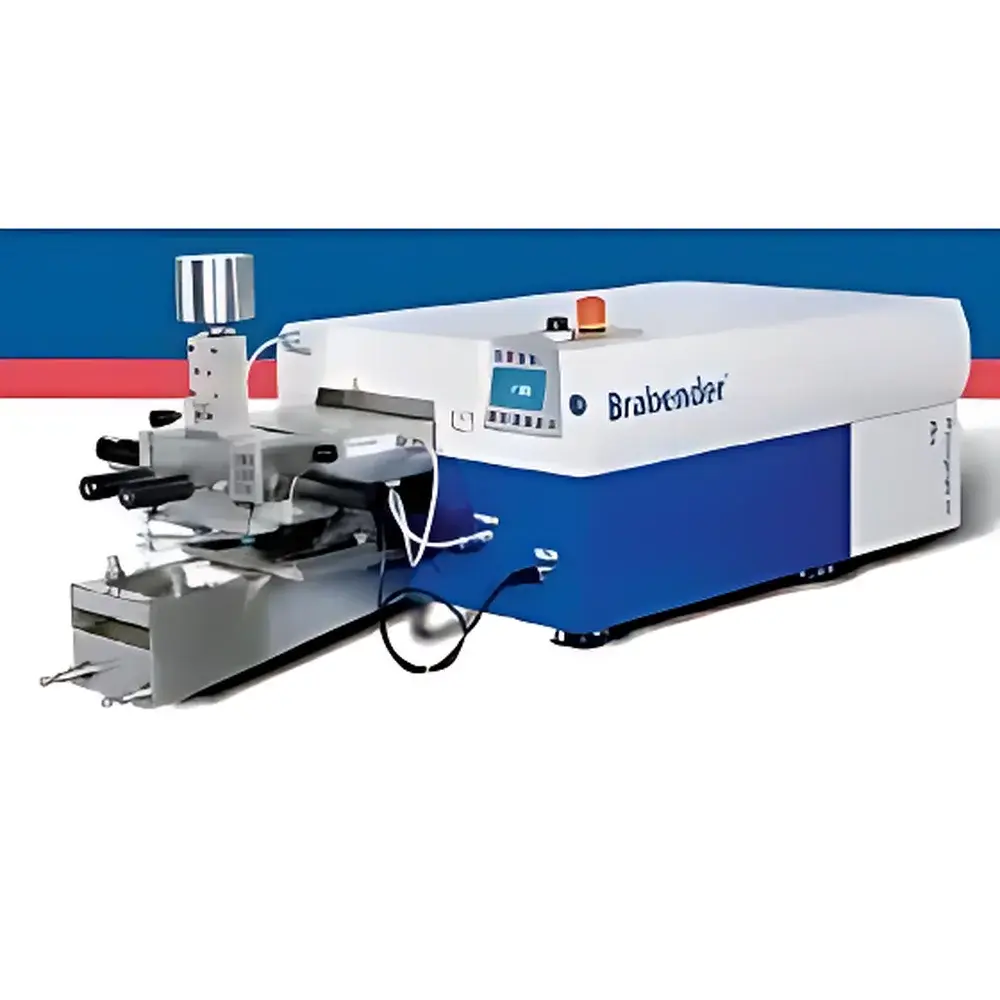
Brabender Plastograph EC Economical Internal Mixer
| Brand | Brabender |
|---|---|
| Origin | Germany |
| Model | EC |
| Rated Power | 3.8 kW |
| Heating Zones | 3 |
| Max Temperature | 500 °C |
| Torque Range | 0–200 N·m (at max speed) |
| Torque Measurement Accuracy | ±0.15% of full scale |
| Motor Speed Range | 0.2–150 rpm (at max torque) |
| Speed Control Accuracy | ±0.2% (closed-loop) |
| Rotor Speed Ratio | 2:3 |
| Chamber Volume | 120 cm³ |
| Temperature Control | Electric heating + compressed-air cooling |
| Overload Protection | Electronic & mechanical |
| Sensors | Integrated thermocouples |
| Safety | Slow-motion mode, emergency stop, rotor interlock |
Overview
The Brabender Plastograph EC Economical Internal Mixer is a rigorously engineered laboratory-scale internal mixer designed for precise, repeatable rheological and compounding characterization of thermoplastics, elastomers, thermoplastic elastomers (TPEs), and filled polymer systems. Based on Brabender’s proven 50EHT platform architecture, the EC model delivers high-fidelity torque rheometry and process simulation capabilities while optimizing operational cost and footprint for quality control laboratories, R&D departments, and academic polymer science facilities. It operates on the fundamental principle of controlled shear deformation within a sealed mixing chamber, where two counter-rotating rotors (configured in a 2:3 speed ratio) subject the sample to defined mechanical energy input under programmable temperature and time profiles. This enables quantitative assessment of melt viscosity, dispersion quality, thermal stability, crosslinking kinetics, and filler-matrix interaction—critical parameters for formulation development and production process validation.
Key Features
- Robust 3.8 kW drive system with closed-loop speed control ensuring ±0.2% rotational accuracy across the full range of 0.2–150 rpm, enabling precise replication of industrial processing conditions.
- Three independently controlled electric heating zones provide uniform thermal distribution and rapid stabilization up to 500 °C, essential for high-temperature polymers such as polyimides, PEEK, and fluoropolymers.
- High-resolution torque transduction (0–200 N·m range, ±0.15% full-scale accuracy) captures subtle viscoelastic transitions, gelation onset, and degradation events with exceptional sensitivity.
- 120 cm³ mixing chamber volume balances statistical representativeness with material economy—ideal for screening formulations using limited raw material batches.
- Integrated compressed-air cooling system enables rapid quenching and precise thermal ramping, supporting ASTM D3763 and ISO 20417-compliant thermal profiling protocols.
- Comprehensive safety architecture includes electronic and mechanical torque overload cutoff, slow-motion rotor engagement mode, thermocouple-monitored chamber wall temperature, and hardware-interlocked rotor guard activation.
Sample Compatibility & Compliance
The Plastograph EC accommodates a broad spectrum of polymeric materials—including PVC compounds, polyolefins, styrenics, engineering resins, rubber compounds (NR, SBR, EPDM), and highly filled systems (e.g., carbon black or CaCO₃ loaded). Its sealed, corrosion-resistant chamber design supports aggressive formulations containing plasticizers, stabilizers, and reactive additives. The instrument meets core mechanical safety requirements per EN 61000-6-2/6-4 and carries CE marking. While not inherently GLP-certified, its deterministic control logic, calibrated torque/temperature traceability, and audit-ready operation logs align with ISO/IEC 17025 method validation frameworks and support FDA 21 CFR Part 11–compliant data integrity when paired with Brabender’s WinWeld software (with optional electronic signature and audit trail modules).
Software & Data Management
The Plastograph EC interfaces seamlessly with Brabender’s WinWeld software suite (Windows-based), providing real-time visualization of torque, temperature, and power consumption curves synchronized to millisecond resolution. Experimental protocols—including multi-stage temperature ramps, variable-speed sequences, and hold-time segments—are fully programmable and exportable as XML-based method files. All raw data are stored in binary .WLD format with embedded metadata (operator ID, timestamp, calibration certificate IDs, environmental conditions), ensuring ALCOA+ compliance (Attributable, Legible, Contemporaneous, Original, Accurate). Export options include CSV, Excel, and PDF reports compatible with LIMS integration and regulatory submission packages.
Applications
- Quality assurance of incoming polymer pellets and masterbatches via standardized mixing curves (e.g., torque peak, equilibrium torque, fusion time).
- Rheokinetic analysis of peroxide- or sulfur-cured rubber compounds, including scorch time (ts₁, ts₂) and cure rate determination.
- Evaluation of thermal degradation onset during extended mixing at elevated temperatures (e.g., monitoring torque drop and gas evolution indicators).
- Dispersion efficiency quantification for nanofillers (graphene, CNTs) and pigment concentrates through torque hysteresis and standard deviation analysis.
- Process simulation for twin-screw extrusion and injection molding feedstock preparation, correlating lab-scale energy input with production-scale specific mechanical energy (SME).
FAQ
What is the maximum continuous operating temperature of the Plastograph EC?
The instrument supports sustained operation up to 500 °C across all three heating zones, verified by integrated Class I thermocouples and validated per IEC 60584-2 calibration standards.
Does the EC model support automated data export for regulatory submissions?
Yes—when used with WinWeld v5.2 or later and configured with audit-trail licensing, it generates 21 CFR Part 11–compliant electronic records, including user authentication, change history, and digital signatures.
Can the 120 cm³ chamber be replaced with alternative volumes?
No—the EC is a fixed-volume configuration; Brabender offers other models (e.g., EC-20, EC-50) for smaller-scale screening, but chamber interchangeability is not supported on the EC platform.
Is compressed air supply mandatory for cooling?
Yes—effective thermal regulation below 300 °C requires a clean, oil-free compressed air source (minimum 6 bar, 10 L/min flow); water-cooling variants are not available for the EC series.
How is torque calibration maintained over time?
The system includes an internal reference load cell; annual recalibration against NIST-traceable torque standards is recommended and documented via Brabender’s certified service reports.
Related Products





