FlexScribe Station Wafer Scribing System
| Origin | USA |
|---|---|
| Manufacturer Type | Authorized Distributor |
| Origin Category | Imported |
| Model | FlexScribe Station |
| Price Range | USD $0–15,000 (FOB) |
| Max Scribeline Speed | 500–600 mm/min |
| Application Scope | R&D Laboratories & Pilot-Scale Packaging |
Overview
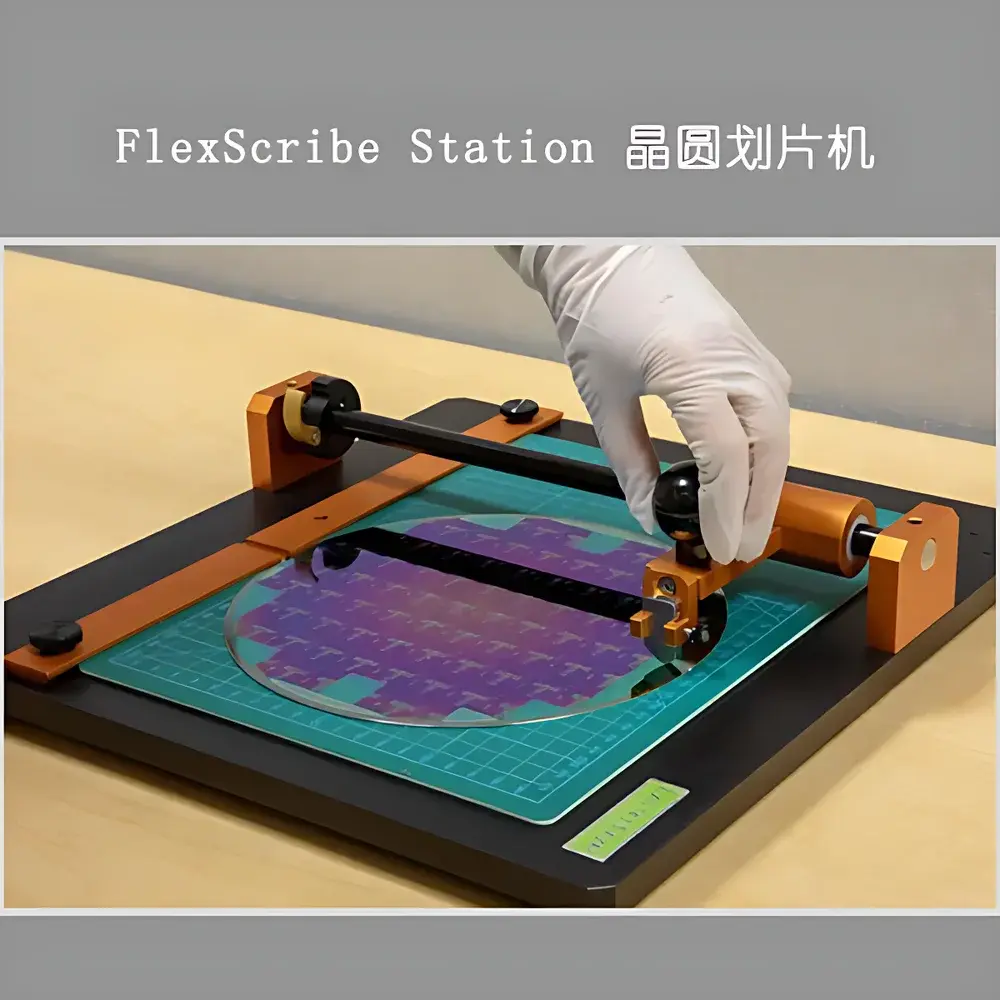
The FlexScribe Station Wafer Scribing System is a precision mechanical scribing platform engineered for controlled, non-destructive surface marking and partial-depth groove formation on brittle semiconductor and optical substrates. Unlike rotary dicing saws that rely on abrasive blade rotation and coolant delivery, the FlexScribe employs a static, kinematically constrained diamond stylus to generate repeatable linear scribe lines via controlled lateral force application—operating on the principle of micro-fracture initiation under calibrated normal load and traverse velocity. This makes it particularly suited for pre-dicing alignment marking, wafer-level metrology reference line generation, chip singulation prototyping, and low-volume substrate conditioning where kerf loss, thermal damage, or particulate generation must be strictly minimized. Designed explicitly for laboratory environments—including university cleanrooms, semiconductor packaging R&D labs, and materials science test facilities—the system delivers deterministic scribe placement without electrical power, vacuum, or compressed air dependencies.
Key Features
- Purely mechanical architecture: No motors, controllers, or external power required—ensures intrinsic ESD safety and operational simplicity in Class 100–1000 cleanrooms.
- Adjustable diamond scribe assembly: Interchangeable pre-aligned diamond-tipped cartridges with independent vertical height and angular tilt adjustment (±5°), enabling optimization for material hardness (e.g., Si, GaAs, sapphire, fused silica, LiNbO₃) and desired groove depth (sub-micron to ~10 µm).
- Universal sample handling: Accommodates substrates from 5 mm × 5 mm die up to full 200 mm wafers; accommodates irregular geometries, beveled edges, and variable thicknesses (100 µm–1.5 mm) without fixture redesign.
- Integrated precision alignment system: Engraved stainless-steel stage ruler (0.1 mm resolution) combined with orthogonal vernier guides ensures sub-0.2 mm positional repeatability across scribe lengths ranging from 1 mm to 100 mm.
- Tool-free setup and calibration: All mechanical adjustments are accessible via knurled knobs and locking screws; no software calibration or firmware updates required.
Sample Compatibility & Compliance
The FlexScribe Station supports scribing across crystalline and amorphous substrates commonly used in microelectronics, photonics, and MEMS fabrication—including silicon (Si), gallium arsenide (GaAs), indium phosphide (InP), silicon carbide (SiC), sapphire (Al₂O₃), fused quartz, borosilicate glass, lithium niobate (LiNbO₃), and polymer-based temporary carriers. It complies with standard laboratory safety protocols for manual microfabrication tools (ANSI Z87.1 for eye protection compatibility) and meets baseline requirements for GLP-compliant documentation workflows when paired with lab notebook entries or digital imaging logs. While not certified for ISO 9001 production-line integration, its mechanical traceability and zero-software dependency make it suitable for IQ/OQ validation under internal lab SOPs aligned with ASTM F39-22 (Standard Practice for Visual Inspection of Semiconductor Wafers) and SEMI D3-0202 (Specification for Wafer Marking).
Software & Data Management
The FlexScribe Station operates entirely without embedded electronics or proprietary software. All process parameters—including scribe length, stylus load estimation (via calibrated spring tension), traverse speed (manually controlled by operator hand motion at 500–600 mm/min), and alignment coordinates—are documented externally using standard lab practices: annotated digital microscopy images, calibrated stage photographs, or spreadsheet-based logbooks. For laboratories requiring audit-ready records, the system integrates seamlessly with LIMS platforms via manual entry or image metadata tagging (EXIF/XTIFF). No FDA 21 CFR Part 11 compliance is applicable due to absence of electronic records generation; however, its mechanical determinism supports full traceability per GMP Annex 11 principles when operated within documented procedures.
Applications
- Pre-dicing alignment mark generation on compound semiconductor wafers prior to blade dicing or laser stealth dicing.
- Rapid prototyping of chip separation lines on low-yield or developmental substrates (e.g., 2D material heterostructures, flexible electronics substrates).
- Reference line etching for optical interferometry, wafer-level metrology, and DIC (differential interference contrast) calibration.
- Controlled crack initiation for fracture-based cleaving of laser bars, photonic crystals, and piezoelectric resonators.
- Teaching tool in semiconductor processing courses: demonstrates fundamental principles of brittle fracture mechanics and mechanical scribing without consumables or hazardous waste streams.
FAQ
Is the FlexScribe Station compatible with automated wafer handlers or cluster tools?
No—it is a benchtop manual scribing station designed exclusively for discrete sample handling in R&D settings. Integration with robotic handlers is neither supported nor intended.
What diamond tip geometry is supplied with the standard cartridge?
Each cartridge includes a conical diamond stylus (120° included angle, 5 µm tip radius) optimized for Si and glass; alternative geometries (e.g., chisel, wedge) are available as optional accessories.
Can scribe depth be quantitatively measured or controlled?
Depth is functionally controlled via stylus load (adjustable spring tension) and traverse speed; quantitative depth verification requires post-scribe cross-sectional SEM or profilometry—no in situ depth sensor is integrated.
Does the system require recalibration after stylus replacement?
No—cartridges are factory pre-aligned; mechanical re-zeroing is achieved via the stage’s engraved reference marks and vernier scale, eliminating need for optical or electronic recalibration.
Is training or certification required to operate the FlexScribe Station?
Basic operation requires less than 30 minutes of supervised instruction; no formal certification is mandated, though users should adhere to institutional EHS policies for handling sharp diamond tools and brittle substrates.