
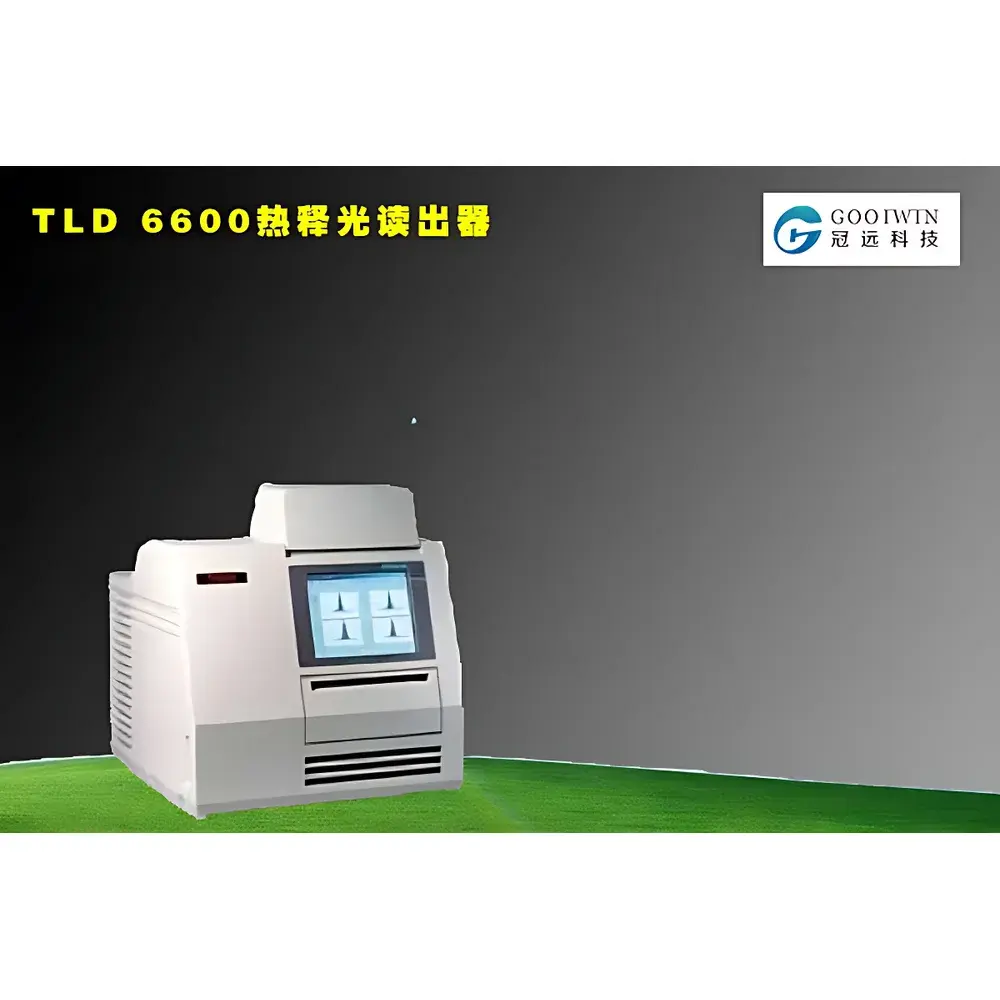
Harshaw TLD 6600 Thermoluminescent Dosimeter Reader
| Brand | UNION |
|---|---|
| Origin | Germany |
| Manufacturer Type | Authorized Distributor |
| Origin Category | Imported |
| Model | 6 |
| Pricing | Available Upon Request |
Overview
The Harshaw TLD 6600 Thermoluminescent Dosimeter (TLD) Reader is a fully automated, high-precision instrument engineered for quantitative readout of thermoluminescent dosimeters used in personnel and environmental radiation monitoring. It operates on the fundamental principle of thermoluminescence: when irradiated TLD materials (e.g., LiF:Mg,Ti or CaF2:Dy) are heated under controlled conditions, trapped electrons recombine with lattice defects, emitting visible photons proportional to the absorbed radiation dose. The TLD 6600 integrates precise temperature ramping (linear heating profiles), low-noise photomultiplier tube (PMT) detection, and real-time signal digitization to deliver reproducible, traceable dose measurements across clinical, nuclear, and research applications. Designed and manufactured in Germany, the system meets stringent requirements for regulatory compliance in radiation protection programs governed by IEC 62387, ISO/IEC 17025, and national regulations such as those enforced by the U.S. NRC and Germany’s BfS.
Key Features
- Fully automated sample handling: Integrated robotic loader accommodates up to 60 planchettes or powder vials per batch—eliminating manual loading and reducing operator-induced variability.
- Programmable thermal stimulation: Linear heating rates from 1°C/s to 20°C/s; maximum temperature up to 300°C with ±0.5°C stability over full cycle.
- High-sensitivity photon detection: Low-dark-current PMT with spectral response optimized for common TLD emission bands (e.g., 390 nm for LiF:Mg,Ti).
- Dose linearity range: 10 µGy to 10 Gy (dependent on phosphor type and reader configuration); typical coefficient of variation (CV) < 2.5% for repeated readouts of identical dosimeters.
- Energy dependence compensation: Built-in correction algorithms support application-specific calibration factors based on reference spectra (e.g., 137Cs, 60Co, X-ray NIST beams); optional spectral matching modules available for mixed-field environments.
- Robust architecture: Stainless-steel heating chamber, EMI-shielded electronics, and redundant thermal safety interlocks compliant with IEC 61010-1.
Sample Compatibility & Compliance
The TLD 6600 supports standard geometries including disc-shaped (3.2 mm × 0.9 mm), rod, and powdered forms of common TL phosphors. For powder-based dosimetry, consistent sample mass distribution is critical: use calibrated vibratory dispensers to achieve ≤±1% mass variation between aliquots—empirical data show uncontrolled tapping introduces up to 10% deviation in delivered mass, directly impacting dose accuracy. Solid-element integrity must be verified prior to readout: reject chips exhibiting mechanical damage, surface contamination, discoloration, or crystalline degradation. All heating plates and sample holders are precision-machined to ensure uniform thermal contact and geometric repeatability. The system conforms to GLP/GMP documentation standards and supports audit trails compliant with FDA 21 CFR Part 11 when paired with validated LIMS integration.
Software & Data Management
Controlled via Harshaw DoseSuite™ v4.x software (Windows 10/11), the TLD 6600 provides full traceability through encrypted acquisition logs, user-access controls, electronic signatures, and configurable reporting templates aligned with ISO/IEC 17025 clause 7.8. Raw glow curve data (intensity vs. temperature) are stored in vendor-neutral ASCII format; integrated peak deconvolution tools support multi-peak analysis for mixed-phosphor systems. Batch processing includes automatic background subtraction, sensitivity normalization, and outlier detection based on statistical thresholds (e.g., Grubbs’ test). Data export supports CSV, XML, and DICOM-RT Dose objects for PACS integration in radiotherapy QA workflows.
Applications
- Personnel dosimetry in nuclear power plants, hospitals, and accelerator facilities.
- Environmental monitoring networks requiring long-term stability and minimal drift (typical annual sensitivity drift < 0.3%).
- Radiotherapy quality assurance: verification of beam output, wedge transmission, and MLC leaf positioning using high-resolution TLD arrays.
- Space radiation dosimetry: flight-certified configurations available with extended temperature tolerance and vibration-damped mounts.
- Research into novel TL materials: programmable annealing protocols enable kinetic parameter extraction (e.g., activation energy via initial rise or peak shape methods).
FAQ
What calibration standards are recommended for routine TLD 6600 operation?
NIST-traceable 137Cs and 60Co reference sources are required for primary calibration; secondary calibration may use accredited laboratory-issued transfer standards meeting ISO/IEC 17025 requirements.
Can the TLD 6600 read non-LiF phosphors such as CaSO4:Dy or Al2O3:C?
Yes—spectral response and heating profile parameters can be customized per phosphor family; users must validate sensitivity and fading characteristics according to IEC 62387 Annex C.
Is remote diagnostics supported?
The system includes embedded Ethernet connectivity and TLS-secured remote access for firmware updates and technical support—subject to site-specific IT policy approval.
How often should the PMT gain be verified?
Daily verification using internal LED reference source is recommended; full PMT linearity check every 6 months using calibrated light source.
Does the TLD 6600 meet EU CE marking requirements for in vitro diagnostic use?
It is classified as a Class I measuring instrument under Directive 2014/30/EU (EMC) and 2014/35/EU (LVD); for IVD applications, additional conformity assessment per IVDR 2017/746 is required and must be performed by the end-user’s notified body.





