
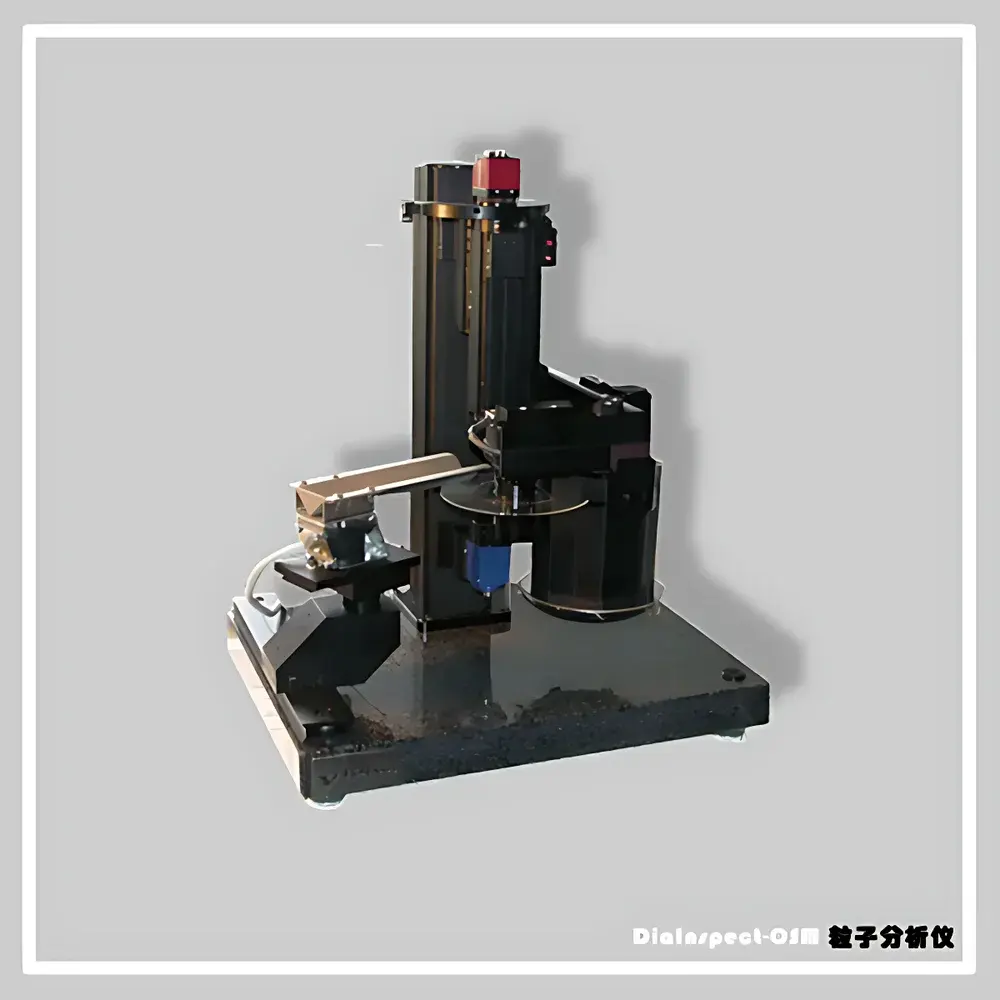
DiaInspect-P Diamond Automatic Particle Analyzer by Volstaedt
| Brand | Volstaedt |
|---|---|
| Origin | Germany |
| Model | DiaInspect-P |
| Power Supply | 110–240 V AC |
| Pixel Resolution (Lens 1) | 8.8 µm/pixel, 2889 dpi |
| Pixel Resolution (Lens 2) | 3.7 µm/pixel, 6904 dpi |
| Particle Size Range | 230/270 to 8/10 US Mesh |
| Throughput | Up to 5,000 particles/min (≤400 µm) |
| Analysis Time | ~2–3 min per sample (5,000 particles, ≤400 µm) |
| PC Requirements | Windows 7 or XP (32-bit, DE/EN), 1× USB 2.0, 1× PCI Express slot, CPU ≥ Intel Core 2 Duo, Clock ≥ 2.5 GHz, RAM ≥ 2 GB, Monitor ≥ 22″ (1680×1050) |
Overview
The DiaInspect-P Diamond Automatic Particle Analyzer is a high-precision, automated image-based particle characterization system engineered for the quantitative morphological and dimensional analysis of abrasive particles—particularly industrial diamond grits, silicon carbide, aluminum oxide, and other hard, irregularly shaped abrasives used in grinding, lapping, and polishing applications. Unlike laser diffraction or dynamic light scattering systems, the DiaInspect-P employs static image analysis under controlled optical conditions, leveraging dual-magnification microscopy and motorized stage automation to capture high-fidelity digital images of individual particles on a rotating sample plate. Each particle is imaged, segmented, and measured using ISO 9276-6–compliant algorithms for equivalent circle diameter (ECD), Feret diameters, aspect ratio, convexity, circularity, and solidity. The system operates on the principle of deterministic single-particle imaging: particles are dispersed across a rotating glass plate, transported into the field of view via centrifugal and gravitational forces, imaged at two calibrated magnifications, and pneumatically ejected post-analysis into a dedicated collection chamber—ensuring zero carryover and enabling true statistical representation of batch heterogeneity.
Key Features
- Automated dual-magnification imaging with motorized objective turret and precision-encoded rotation axis for repeatable focus and positioning
- Digital firewire (IEEE 1394) interface for low-latency, high-bandwidth image transfer to host PC—optimized for real-time frame acquisition at full sensor resolution
- Integrated particle transport mechanism: programmable rotational speed (0–300 rpm) and tilt-controlled dispersion ensure uniform monolayer presentation without agglomeration
- One-click report generation compliant with ISO 13322-1 (static image analysis) and ASTM E2457 (particle shape characterization)
- Direct Excel export functionality preserving raw measurement matrices (e.g., x/y coordinates, perimeter, area, bounding box dimensions) for downstream statistical process control (SPC)
- Multi-parameter histogram visualization and cross-parameter scatter plots (e.g., circularity vs. aspect ratio, ECD vs. convexity) supporting granulometric classification and outlier detection
- Calibration traceability to NIST-traceable stage micrometers; software includes audit trail logging per FDA 21 CFR Part 11 requirements when configured with electronic signatures
Sample Compatibility & Compliance
The DiaInspect-P is optimized for dry, free-flowing, non-fibrous abrasive particles ranging from coarse US Mesh 8/10 (~2,000 µm) down to fine US Mesh 230/270 (~63 µm). It accommodates materials with high refractive index contrast (e.g., diamond, cBN, sintered carbides) and moderate surface roughness without requiring conductive coating or vacuum environments. Sample preparation is minimal: particles are loaded into the vibratory feeder hopper (<5 g typical), and the system autonomously controls dispersion kinetics via closed-loop rotational velocity and dwell time. All hardware components—including the LED-based Köhler illumination module and telecentric lens assembly—meet CE and RoHS directives. Software complies with GLP/GMP documentation standards, supporting version-controlled method files, user access levels, and electronic signature workflows aligned with ISO/IEC 17025 and ISO 9001 quality management frameworks.
Software & Data Management
The DiaInspect-P runs on proprietary Volstaedt ParticleVision™ v4.x software, built on a modular .NET architecture compatible with Windows 7 (32-bit) and legacy XP environments. Image processing pipelines include adaptive thresholding, noise suppression via morphological filtering, and sub-pixel edge localization using gradient-based contour tracing. Measurement data is stored in structured SQLite databases with embedded metadata (operator ID, timestamp, calibration ID, instrument configuration). Export options include CSV (for JMP, Minitab), XML (for LIMS integration), and PDF reports containing summary statistics, distribution curves, and annotated particle thumbnails. Audit trails record all parameter changes, image reprocessing events, and report modifications—enabling full traceability during regulatory inspections. Optional add-ons support automated pass/fail decision logic against user-defined specification limits (e.g., “% particles > 300 µm must be < 0.5%”) and integration with enterprise MES platforms via OPC UA.
Applications
- Quality assurance of synthetic diamond powders for electroplated and resin-bonded grinding wheels
- Batch-to-batch consistency verification of coated abrasives in coated abrasive manufacturing
- Root-cause analysis of premature tool wear linked to oversized or elongated grit fractions
- Development and validation of分级 (grading) protocols for recycled diamond grit recovery systems
- Supporting ASTM B963 density testing by correlating particle shape metrics with tap density behavior
- Research-grade morphological profiling for tribological modeling of abrasive–substrate interaction mechanisms
FAQ
What particle size ranges can the DiaInspect-P accurately resolve?
The system supports nominal sizing from US Mesh 8/10 (~2,000 µm) to US Mesh 230/270 (~63 µm), with reliable morphological characterization down to ~40 µm depending on optical contrast and particle transparency. At 400 µm maximum size, throughput reaches 5,000 particles per minute with statistical confidence exceeding 95% at n ≥ 10,000.
Is the system suitable for wet dispersion or slurry analysis?
No—the DiaInspect-P is designed exclusively for dry, free-flowing particulate samples. Liquid dispersion requires alternative instrumentation such as dynamic image analysis (DIA) systems with flow cells or laser diffraction with wet modules.
Can the software interface with laboratory information management systems (LIMS)?
Yes, via configurable CSV/XML exports and optional OPC UA gateway licensing. Raw data tables include unique sample IDs, timestamps, operator credentials, and calibration status flags required for LIMS ingestion.
Does the system meet FDA or ISO regulatory requirements for pharmaceutical excipients?
While not intended for sterile or parenteral-grade material analysis, its software audit trail, electronic signature, and calibration traceability features align with FDA 21 CFR Part 11 and ISO 13322-1 for non-sterile solid dosage form development where particle morphology impacts dissolution or blend uniformity.



