
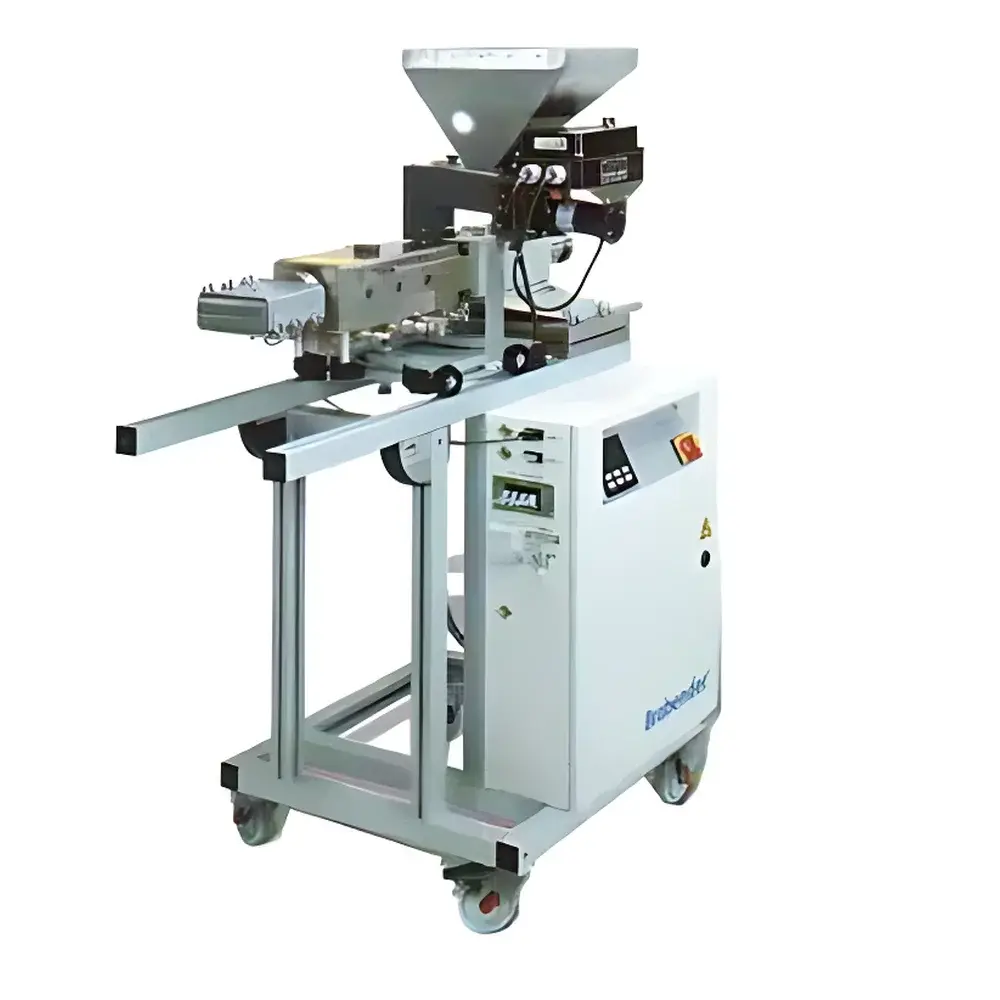
CTSE Conical Twin-Screw Extruder
| Origin | Germany |
|---|---|
| Manufacturer Type | Authorized Distributor |
| Origin Category | Imported |
| Model | CTSE |
| Pricing | Upon Request |
Overview
The CTSE Conical Twin-Screw Extruder is a precision-engineered laboratory-scale extrusion system designed for formulation development, process optimization, and small-batch production in polymer compounding, thermoplastic elastomer processing, and reactive extrusion applications. Unlike parallel twin-screw extruders, the CTSE employs a conical geometry—where screw diameter tapers from feed zone to die end—enabling progressive compression, enhanced melt homogenization, and superior self-wiping action. Its counter-rotating configuration generates high shear stress in the intermeshing zone while maintaining low axial thrust, making it particularly suitable for heat-sensitive polymers, filled systems, and devolatilization-intensive processes such as solvent removal or moisture evacuation. The system operates under fully instrumented conditions, with real-time monitoring of pressure and temperature at multiple critical locations—including vent ports, barrel zones, and screw shafts—to support mechanistic understanding of residence time distribution, melt temperature profiling, and pressure build-up dynamics.
Key Features
- Counter-rotating conical twin-screw architecture with precise intermeshing geometry for high self-cleaning efficiency and minimal material stagnation
- Modular barrel design featuring multiple venting ports (including atmospheric and vacuum-assisted degassing zones) to facilitate efficient volatiles removal
- Integrated pressure transducers and calibrated thermocouples at feed throat, barrel segments, and screw top—enabling spatially resolved process analytics
- Thermally isolated barrel zones with independent PID-controlled heating/cooling circuits to maintain consistent thermal profiles across the extrusion path
- Interchangeable screw elements—including conveying, kneading, reverse-pitch, and mixing blocks—allowing rapid reconfiguration for diverse material rheologies and functional requirements
- Robust drive system with torque monitoring and variable-speed control (typically 10–300 rpm range) to accommodate both low-shear dispersion and high-intensity distributive mixing
Sample Compatibility & Compliance
The CTSE accommodates a broad spectrum of polymeric materials—including PVC, PP, PE, TPU, PLA, and engineering resins—as well as filled compounds (e.g., CaCO₃, talc, glass fiber), masterbatches, and reactive monomer systems. Its sealed, corrosion-resistant barrel construction supports processing of abrasive fillers and mildly aggressive additives. The system complies with CE machinery directives (2006/42/EC) and meets electrical safety standards per IEC 60204-1. All pressure and temperature instrumentation is traceably calibrated to NIST-traceable references. Data acquisition workflows can be configured to align with GLP documentation requirements, including audit trails, user access controls, and electronic signature capability when integrated with compliant SCADA or LIMS platforms.
Software & Data Management
The CTSE is operated via an industrial-grade HMI interface running deterministic real-time control firmware. Process parameters—including screw speed, zone temperatures, motor torque, and measured pressures—are logged at configurable intervals (down to 100 ms resolution) and exported in CSV or HDF5 format for post-processing. Optional integration with third-party data analysis tools (e.g., MATLAB, Python-based Pandas/NumPy pipelines) enables advanced modeling of specific mechanical energy input (SMEI), melt viscosity estimation, and residence time distribution (RTD) deconvolution. Raw sensor data includes timestamped metadata (sensor ID, calibration date, uncertainty budget), supporting ISO/IEC 17025-compliant reporting frameworks.
Applications
- Development and scale-up of polymer blends and nanocomposites requiring controlled dispersion kinetics
- Devulcanization and recycling studies of crosslinked rubber matrices under inert or reactive atmospheres
- In-line compounding of conductive polymers with carbon black or graphene nanoplatelets
- Hot-melt extrusion (HME) of pharmaceutical solid dispersions, where thermal history and volatile content critically impact API stability
- Evaluation of filler-matrix interfacial adhesion through controlled shear history and dwell time modulation
- Process validation studies aligned with ASTM D3835 (Standard Test Method for Determining Properties of Thermoplastic Melt by Capillary Rheometry) and ISO 11443
FAQ
What is the typical throughput range for the CTSE in lab-scale operation?
Typical output ranges from 0.5 kg/h to 8 kg/h depending on material density, screw configuration, and operating temperature profile.
Can the CTSE be used for reactive extrusion with initiators or crosslinking agents?
Yes—the modular venting system and precise thermal zoning allow controlled initiation of free-radical, condensation, or addition reactions; compatibility must be verified case-by-case for chemical resistance of seals and barrel liners.
Is screw cleaning required between different formulations?
Due to the self-wiping conical geometry and accessible barrel disassembly, cleaning time is significantly reduced versus parallel systems; standard purging protocols using LDPE or PP are typically sufficient.
Does the system support automated recipe management and batch traceability?
When paired with optional MES-level integration, the CTSE supports version-controlled recipe loading, automatic parameter logging per batch ID, and export of full process narratives compliant with FDA 21 CFR Part 11 Annex 11 requirements.






