
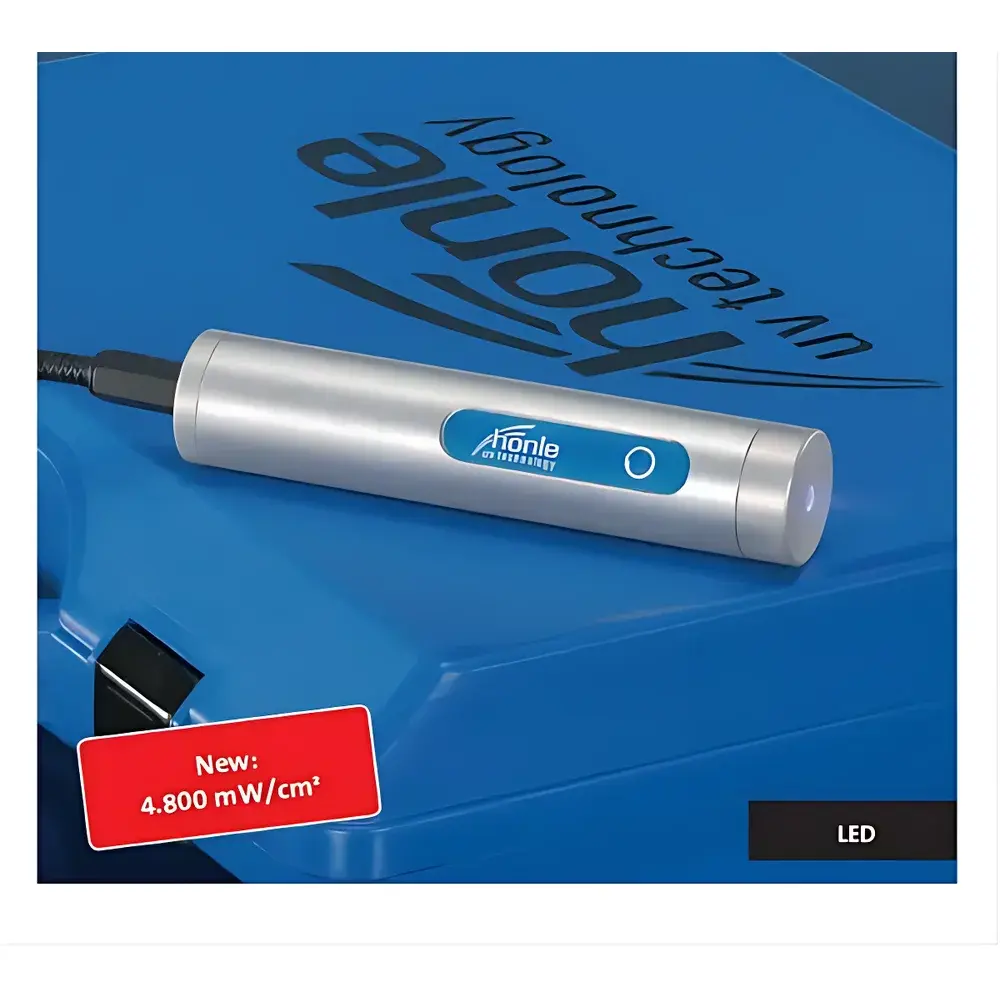
Hoenle LED Pen 2.0 UV Curing Point Source
| Brand | Hoenle |
|---|---|
| Origin | Germany |
| Model | LED Pen 2.0 |
| Wavelength | 365 nm ±10 nm |
| Spectral Output | Near-monochromatic UV-A |
| Power Supply | External universal AC adapter (included) |
| Activation | Manual pressure switch, optional footswitch or dry-contact PLC input |
| Safety Features | Integrated thermal cutoff, internal power regulation |
| Compliance | CE, RoHS, IEC 62471 (Photobiological Safety) |
Overview
The Hoenle LED Pen 2.0 is a compact, hand-held, high-intensity point-source ultraviolet (UV-A) emitter engineered for precision photopolymerization and fluorescence excitation in industrial and laboratory environments. Unlike broadband mercury-vapor or arc lamps, this device employs solid-state LED technology centered at 365 nm ±10 nm — a wavelength deliberately selected to align with the peak absorption profiles of common acrylate-based photoinitiators used in UV-curable adhesives, coatings, and encapsulants. Its near-monochromatic output eliminates unnecessary spectral energy outside the effective curing band, thereby minimizing thermal load on substrates and enabling reliable processing of thermally sensitive components such as polymer films, microfluidic devices, optical lenses, and medical-grade plastics. The absence of infrared (IR) radiation ensures negligible radiant heating — a critical advantage over conventional UV sources where substrate warping, adhesive discoloration, or premature initiator decomposition may occur. Designed for integration into automated or semi-automated workflows, the LED Pen 2.0 operates without warm-up or cool-down phases, delivering instantaneous on/off response and stable irradiance over its rated lifetime.
Key Features
- Stable 365 nm ±10 nm UV-A emission optimized for photoinitiator activation (e.g., Irgacure 369, Darocur 1173)
- Compact ergonomic design (pen-shaped housing) with integrated pressure-actuated switch for manual operation
- No IR emission — eliminates substrate heating; suitable for heat-sensitive materials including PET, polycarbonate, and silicone elastomers
- Optional external control interface: dry-contact PLC input (24 V DC, non-polarized) or footswitch compatibility for hands-free activation
- Integrated thermal protection circuitry and regulated current driver ensure consistent output and extended diode lifetime
- Universal AC power supply (100–240 V, 50/60 Hz) included; no additional ballast or cooling system required
- CE-marked and compliant with IEC 62471:2006 for photobiological safety (Risk Group 2 – low hazard under normal use conditions)
Sample Compatibility & Compliance
The LED Pen 2.0 is compatible with a broad range of UV-curable chemistries, including cationic epoxies, free-radical acrylates, and hybrid formulations used in electronics bonding, medical device assembly, and optical component fixation. Its narrow spectral bandwidth enables selective excitation of fluorescent dyes (e.g., DAPI, FITC, and coumarin derivatives) in material inspection and quality assurance protocols. From a regulatory standpoint, the device supports GLP-compliant documentation when paired with external process monitoring systems via its TTL-compatible status output signal. While not a standalone analytical instrument, it fulfills functional requirements referenced in ASTM D4459 (Standard Practice for Fluorescent UV Exposure of Plastics), ISO 11341 (Paints and varnishes — Artificial weathering), and USP for UV exposure validation in pharmaceutical packaging component testing.
Software & Data Management
The LED Pen 2.0 operates as a stand-alone hardware module and does not require proprietary software for basic functionality. However, its optional control box provides a digital status output (TTL-level signal) that can be logged by third-party SCADA systems, PLCs, or LabVIEW-based data acquisition platforms to record actuation timing, cumulative exposure duration, and operational cycle counts. This capability supports audit-ready traceability in regulated manufacturing environments governed by FDA 21 CFR Part 11 (where electronic records and signatures apply) and facilitates alignment with GMP Annex 11 requirements for equipment qualification and process validation. No embedded firmware updates or cloud connectivity are provided; all configuration remains hardware-defined and deterministic.
Applications
- Localized UV curing of structural adhesives in microelectronics assembly (e.g., camera modules, MEMS packaging)
- Fixation of optical fibers and lens elements in precision optomechanical systems
- Fluorescence-based leak detection and surface defect mapping in sterile barrier packaging
- Controlled photoactivation in bioconjugation workflows and microplate-based assay development
- Rapid prototyping support for UV-curable 3D-printed jigs and fixtures in cleanroom tooling
- In-line verification of UV inkjet print adhesion on flexible packaging substrates
FAQ
Is the LED Pen 2.0 suitable for continuous-duty operation?
Yes — it is rated for intermittent and continuous use up to 60 minutes per cycle, with automatic thermal shutdown if internal temperature exceeds safe thresholds.
Can multiple LED Pen 2.0 units be synchronized?
Synchronization is achievable via shared PLC trigger signals or master-slave configurations using the dry-contact input; no built-in wireless or network synchronization capability is provided.
Does the device require recalibration over time?
No — LED output stability is maintained through constant-current regulation; however, annual verification of irradiance (mW/cm² at 1 cm working distance) using a NIST-traceable UV-A radiometer is recommended for critical applications.
What is the typical working distance for optimal irradiance?
Peak irradiance (>100 mW/cm²) is achieved at 1–3 mm from the aperture; intensity follows inverse-square decay beyond 5 mm, necessitating application-specific distance validation.
Is replacement of the LED module possible in the field?
The LED module is not user-replaceable; end-of-life units are serviced exclusively by authorized Hoenle service centers to maintain optical alignment and thermal integrity.





