
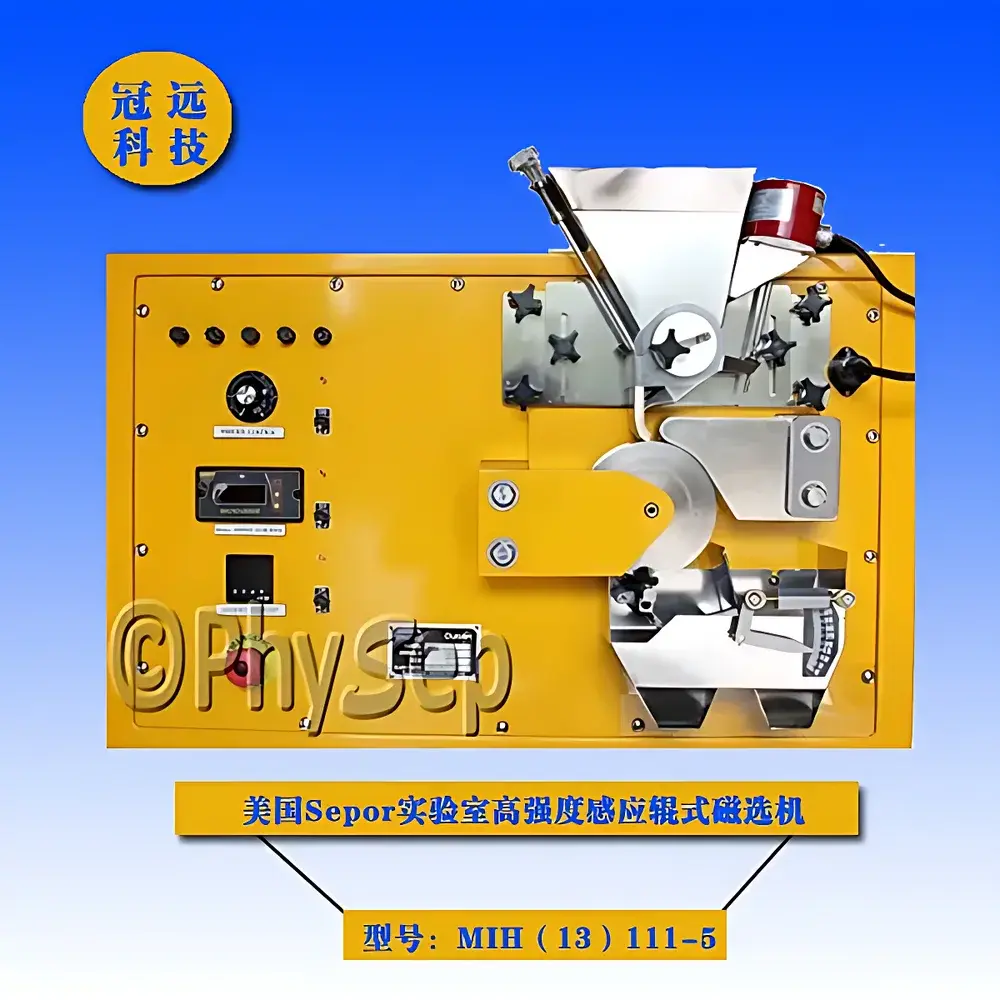
Sepor MIH(13)111-5 High-Intensity Induced-Roll Magnetic Separator
| Origin | USA |
|---|---|
| Manufacturer Type | Authorized Distributor |
| Import Status | Imported |
| Model | MIH(13)111-5 |
| Instrument Type | Benchtop Magnetic Separator |
| Magnetic Field Range | 0–16,000 Gauss (adjustable via DC current control) |
| Separation Gap | 5 mm |
| Feed Size Range | 0.034–1.0 mm (400–18 mesh) |
| Maximum Feed Rate | 100 kg/h (220 lb/h) |
| Batch Sample Capacity | ≥10 g |
| Rotor Speed | 0–300 rpm (DC TEFC motor, quarter-horsepower) |
| Operating Temperature | Up to 150 °C |
| Power Supply | 110–120 V or 230 V AC, 50/60 Hz, single-phase |
| Dimensions | 200 × 100 × 300 mm |
| Cabinet | Epoxy-coated orange steel enclosure |
| Feed System | Vibratory feeder with standard 62 in³ (1.0 L) hopper (optional 276 in³ / 4.5 L) |
| Compliance | Designed for ASTM D297, ISO 5725-2, and GLP-compliant mineralogical research workflows |
Overview
The Sepor MIH(13)111-5 High-Intensity Induced-Roll Magnetic Separator is a precision-engineered benchtop instrument for dry, high-gradient magnetic separation of weakly to moderately paramagnetic minerals. Unlike conventional centrifugal or gravity-based separators, this system operates on the principle of induced magnetic roll separation: a rotating, electrically excited stainless-steel roll generates a steep, localized magnetic field gradient at its surface. When dry particulate feed passes through the 5 mm air gap between the roll and pole piece, particles with differing magnetic susceptibilities experience differential magnetic forces—weakly magnetic species are captured against centrifugal and gravitational forces, while non-magnetic material exits freely. This mechanism enables quantitative partitioning of mineral assemblages based on intrinsic magnetic properties—not density, size, or conductivity—making it indispensable for fundamental mineralogical characterization, process development, and pilot-scale feasibility studies. The device is not a centrifuge (despite historical misclassification in some catalogs); its “rotor” serves solely as the magnetically active separation surface, not a centrifugal force generator. Its scalability—from gram-scale analytical batches to continuous 100 kg/h throughput—has been empirically validated against industrial-scale induced-roll units per ASTM D297 guidelines for magnetic susceptibility measurement.
Key Features
- Digitally controlled DC excitation circuit enabling precise, repeatable magnetic field adjustment from 0 to 16,000 Gauss, monitored in real time via integrated digital ammeter
- Induced-roll architecture with fully enclosed, self-lubricating ball bearings and variable-speed DC TEFC motor (0–300 rpm), ensuring low vibration and long-term rotational stability
- Manually adjustable 5 mm separation gap via front-end translation mechanism, facilitating rapid optimization for diverse particle size distributions and feed densities
- Epoxy-coated structural steel cabinet (orange RAL 2004 finish) providing mechanical rigidity, corrosion resistance, and EMI shielding for consistent electromagnetic performance
- Vibratory feed system delivering constant mass flow rate; standard 62 in³ hopper (1.0 L) with optional 276 in³ (4.5 L) upgrade for extended run times
- Thermally robust design supporting feed temperatures up to 150 °C—critical for processing roasted or calcined ores without magnetic property degradation
Sample Compatibility & Compliance
The MIH(13)111-5 accepts dry, free-flowing powders with particle sizes between 0.034 mm (400 mesh) and 1.0 mm (18 mesh), optimal for liberated mineral grains in crushed ore samples. It has demonstrated reproducible separation efficacy across silicates (e.g., garnet, biotite), oxides (ilmenite, hematite), rare-earth-bearing phases (monazite, xenotime), and industrial minerals (zircon, rutile, feldspar). All internal components contacting feed—feed chute, roll surface, splitter plates—are fabricated from non-magnetic alloys (316 stainless steel, brass, aluminum) to prevent contamination and preserve magnetic field integrity. The system complies with ISO 5725-2 for method precision in mineralogical assays and supports GLP audit trails when operated with calibrated current meters and documented field calibration curves. It is not intended for wet slurries, ferromagnetic bulk metals, or materials exceeding 150 °C inlet temperature.
Software & Data Management
This analog-digital hybrid instrument requires no proprietary software. Magnetic field strength is directly traceable to NIST-calibrated ammeters; rotor speed is set via analog potentiometer with ±1 rpm repeatability. Users record field intensity (Gauss), feed rate (kg/h), rotor speed (rpm), and split ratios manually in laboratory notebooks or LIMS-compatible spreadsheets. For regulatory environments (e.g., ISO/IEC 17025-accredited labs), operators may integrate external data loggers to capture time-stamped current and speed values, satisfying FDA 21 CFR Part 11 requirements for electronic records when paired with appropriate audit trail protocols. Calibration certificates for the built-in ammeter and optional external tachometer are available upon request.
Applications
- Mineralogical phase identification and quantification prior to XRF, ICP-MS, or SEM-EDS analysis
- Determination of magnetic susceptibility distribution in complex ores to inform comminution and concentration circuit design
- Removal of weakly magnetic contaminants (e.g., iron-stained quartz, titanomagnetite) from high-purity industrial sands and feldspars
- Process validation for downstream magnetic separation stages in flowsheet development
- Operator training for full-scale induced-roll plants—results correlate linearly with production units under matched field intensity and residence time conditions
- Research into magnetic enhancement techniques (e.g., roasting-induced magnetization of hematite)
FAQ
Is this device classified as a centrifuge?
No. Despite occasional categorization errors in third-party listings, the MIH(13)111-5 is a high-intensity magnetic separator. Its rotating roll induces magnetic capture—not centrifugal sedimentation—and it lacks centrifuge-specific safety interlocks, rotor balance systems, or vacuum chambers.
Can it process wet feeds?
No. The system is strictly for dry, free-flowing powders. Moisture causes agglomeration, clogging, and inconsistent magnetic response. Sample drying to <0.5% moisture is required prior to feeding.
What standards does it support for method validation?
It aligns with ASTM D297 (Standard Test Methods for Rubber Properties—Magnetic Susceptibility), ISO 5725-2 (Accuracy of measurement methods), and supports GLP/GMP documentation practices for mineral assay laboratories.
How is magnetic field strength calibrated?
Field intensity is derived from measured coil current using the manufacturer-provided Gauss-per-Amp curve (valid for 5 mm gap). Calibration verification is performed annually using a NIST-traceable Hall-effect gaussmeter.
Does it require external cooling or exhaust?
No. The DC excitation coil and motor are thermally rated for continuous operation at ambient temperatures up to 40 °C. No forced-air or water cooling is needed under nominal operating conditions.
Related Products



