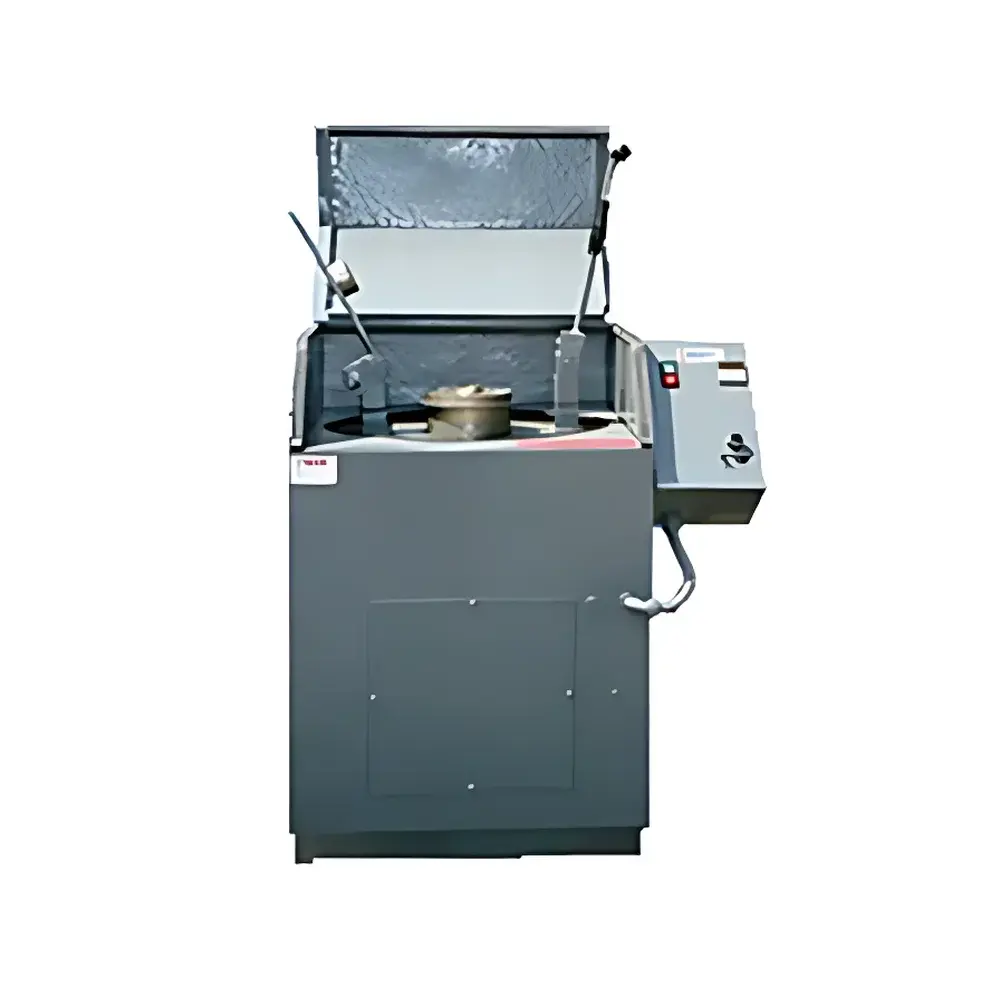
Bico 010G-120 Rotary Cup Mill
| Origin | USA |
|---|---|
| Manufacturer Type | Authorized Distributor |
| Origin Category | Imported |
| Model | 010G-120 |
| Pricing | Upon Request |
| Motor | 1 HP, 900 RPM |
| Voltage/Frequency | 220–440 V / 3-Phase / 60 Hz or 380 V / 3-Phase / 50 Hz |
| Dimensions (W×D×H) | 610 × 610 × 1092 mm |
| Shipping Weight | 295 kg |
| Grinding Bowl Capacity | 250 mL |
| Bowl Material | Hardened Chromium Alloy Steel |
| Grinding Media | Two Rings + One Disc |
| Feed Size | ≤ 12.7 mm (1/2 in) |
| Final Particle Size | ≤ 44 µm (325 mesh) |
| Noise Enclosure | Integrated Acoustic Cabinet |
Overview
The Bico 010G-120 Rotary Cup Mill is a precision-engineered laboratory pulverizer designed for rapid, reproducible size reduction of brittle, medium-hard to hard materials. Operating on the principle of eccentric oscillation—where a motor-driven eccentric shaft imparts high-frequency, low-amplitude pendular motion to a sealed grinding chamber—the mill subjects sample material to intense compressive and shear forces between two hardened chromium alloy steel rings and a central disc. This mechanical action achieves efficient comminution without significant heat generation or contamination, making it suitable for preparatory grinding prior to X-ray fluorescence (XRF), X-ray diffraction (XRD), atomic absorption spectroscopy (AAS), or wet chemical analysis. The unit complies with standard laboratory safety protocols for mechanical sample preparation and is routinely employed in geological survey labs, cement quality control facilities, mining R&D centers, and environmental testing laboratories where consistent sub-44 µm particle distribution is required for homogenization and analytical representativeness.
Key Features
- Robust 1 HP induction motor delivering stable 900 RPM output under continuous load, engineered for thermal endurance and torque consistency across voltage configurations (220–440 V / 3Φ / 60 Hz or 380 V / 3Φ / 50 Hz).
- Hardened chromium alloy steel grinding bowl (250 mL capacity) with precisely matched rings and disc—designed for wear resistance, minimal metallic leaching, and long service life under abrasive mineral processing.
- Integrated acoustic enclosure with gasketed door and vibration-dampening mounts reduces operational noise to ≤ 72 dBA at 1 m distance—meeting OSHA and EU Directive 2003/10/EC occupational exposure limits.
- Compact footprint (610 × 610 × 1092 mm) optimized for benchtop integration in ISO 17025-accredited laboratories; total shipping weight of 295 kg reflects structural rigidity and cast-iron base stability.
- Tool-free bowl access and quick-release clamping mechanism enable rapid cleaning and media exchange—critical for cross-sample contamination control in regulated QC/QA workflows.
Sample Compatibility & Compliance
The 010G-120 is validated for use with geologically representative matrices including silicates, carbonates, sulfides, oxides, Portland cement clinker, shale, basalt, quartzite, lateritic soils, and fly ash. It is not recommended for ductile metals, polymers, or hygroscopic organics. All grinding components meet ASTM E177 (Standard Practice for Use of the Terms Precision and Bias in ASTM Test Methods) requirements for repeatability in particle size reduction. The mill’s mechanical design conforms to IEC 61000-6-2 (EMC immunity) and IEC 60204-1 (safety of machinery – electrical equipment). Optional documentation packages support GLP/GMP audit readiness, including calibration logs, preventive maintenance records, and traceable component certifications.
Software & Data Management
This is a standalone electromechanical instrument with no embedded microprocessor or digital interface. Operation is controlled via a NEMA 4X-rated manual start/stop switch with thermal overload protection. No firmware, cloud connectivity, or data logging capability is integrated—ensuring deterministic operation, electromagnetic compatibility in sensitive instrumentation environments (e.g., adjacent to SEM or ICP-MS suites), and full compliance with FDA 21 CFR Part 11 when used within paper-based or validated LIMS-integrated SOPs. Maintenance history and usage logs are maintained externally per ISO/IEC 17025 Clause 6.4.10.
Applications
- Preparation of homogeneous subsamples for major/minor element analysis (XRF, ICP-OES) in exploration geochemistry.
- Routine fineness testing of cement and supplementary cementitious materials (SCMs) per ASTM C114 and EN 196-6.
- Particle size standardization of reference materials (RMs) and certified reference materials (CRMs) prior to certification campaigns.
- Soil digestion prep for EPA Method 3050B and ISO 11466, ensuring complete acid-accessible surface area.
- Rock powder homogenization for whole-rock geochemical profiling in academic and government geological surveys.
FAQ
What is the maximum feed size accepted by the 010G-120?
The mill accepts particles up to 12.7 mm (1/2 inch) in nominal dimension; oversized feed may cause jamming or uneven wear.
Can the 010G-120 be operated continuously?
No—recommended duty cycle is ≤ 5 minutes per batch, followed by ≥ 10 minutes cooling to prevent thermal degradation of motor insulation and bearing lubricant.
Is the grinding bowl interchangeable with other Bico models?
The 250 g bowl assembly (010G-120) is mechanically and dimensionally compatible only with the 010G series; adapters (e.g., 010G-123) enable use of 100 g kits but require recalibration of retention time.
Does the unit include a certificate of conformance?
Yes—each shipment includes a manufacturer-signed CoC referencing ASTM E456, serial-number-traceable component certifications, and factory performance verification against 325-mesh sieve retention.
What maintenance intervals are recommended?
Lubrication of eccentric shaft bearings every 500 operating hours; visual inspection of ring/disc wear and bowl integrity before each use; annual torque verification of mounting hardware per ANSI/ASME B18.2.1.