
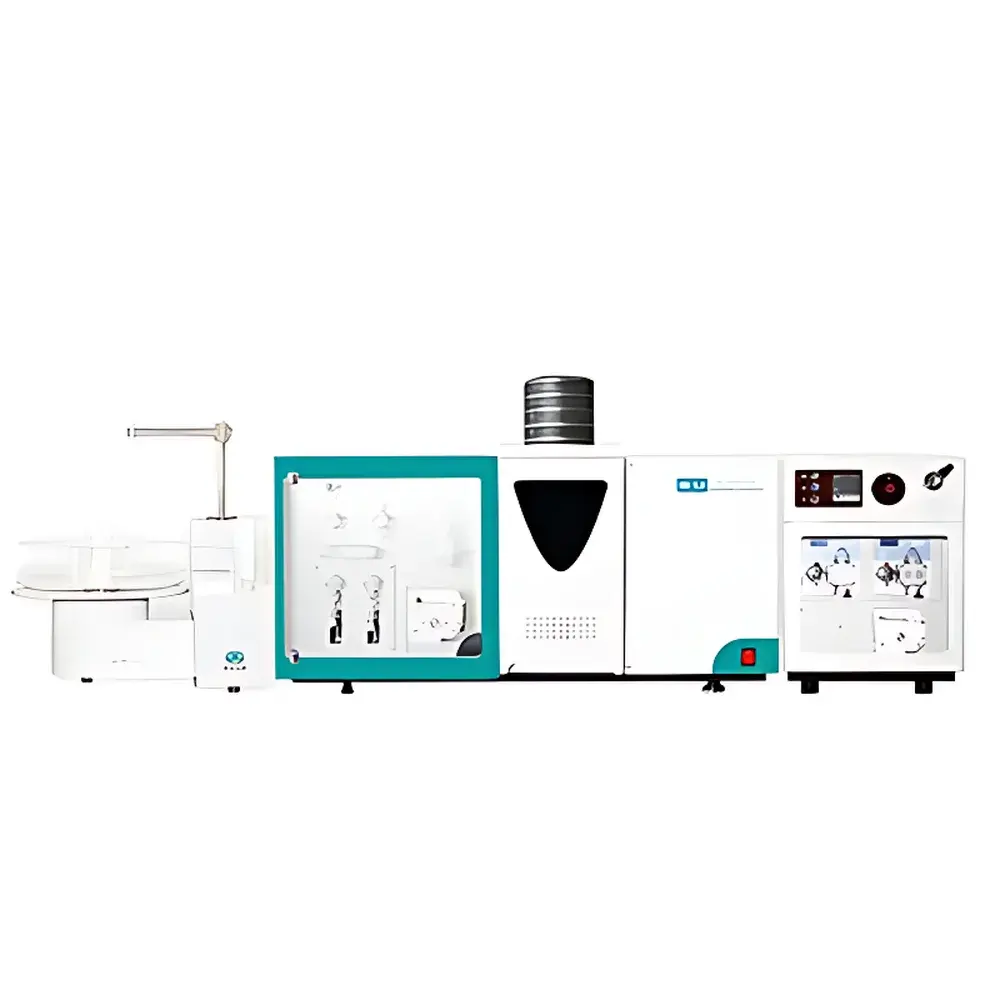
Haiguang LC-AFS9530 Liquid Chromatography–Atomic Fluorescence Spectrometer
| Brand | Haiguang Instrument |
|---|---|
| Origin | Beijing, China |
| Model | LC-AFS9530 |
| Instrument Type | Multi-channel Atomic Fluorescence Spectrometer |
| Sample Introduction | Dual Sequential Injection Pumps |
| Detectable Elements (Speciation) | As, Se, Pb, Bi, Sb, Te, Sn, Hg, Cd, Zn, Ge, Au |
| Speciation Capabilities | Inorganic/organic As (e.g., As(III), As(V), MMA, DMA), Hg species (e.g., Hg²⁺, MeHg⁺, EtHg⁺), Se species (e.g., Se(IV), Se(VI), SeMet, SeCys) |
| UV Digestion Mode | On-line, switchable between UV and non-UV pathways |
| Chromatographic Modes | Isocratic and gradient elution |
| Column Temperature Control | Integrated, programmable (ambient to 80 °C) |
| Dual Lamp Holder | Supports simultaneous pre-heating of two hollow cathode lamps |
| Software Control | Unified workstation for LC module, UV digestion, hydride generation, AFS detection, and data processing |
| Automation Compatibility | Compatible with third-party HPLC autosamplers for unattended operation |
| Arsenic(V) Analysis Time (Isocratic) | <7 min |
| Column Equilibration Optimization | Reduced solvent consumption and column stress during method re-equilibration |
Overview
The Haiguang LC-AFS9530 is a fully integrated liquid chromatography–atomic fluorescence spectrometry (LC-AFS) system engineered for trace-level elemental speciation analysis in complex matrices. It couples high-resolution liquid chromatographic separation—typically reversed-phase or anion-exchange—with hydride generation atomic fluorescence detection (HG-AFS), enabling quantitative determination of individual element species (e.g., As(III), As(V), monomethylarsonic acid [MMA], dimethylarsinic acid [DMA], inorganic Hg²⁺, methylmercury [MeHg⁺], ethylmercury [EtHg⁺], selenite [Se(IV)], selenate [Se(VI)], selenomethionine [SeMet]) at sub-picogram-per-milliliter levels. The system operates on the principle of post-column photochemical or thermal vapor generation, where separated species are converted into volatile hydride or cold-vapor forms, atomized in a quartz cell, and excited by a high-intensity hollow cathode lamp; emitted fluorescence is measured at element-specific wavelengths with photomultiplier tube (PMT) detection. This architecture delivers superior selectivity over total-element techniques (e.g., ICP-MS), avoids polyatomic interferences common in plasma-based methods, and complies with regulatory frameworks requiring species-resolved quantification—including food safety standards (GB 5009.11, GB 5009.17), environmental monitoring protocols (EPA Method 1638), and clinical toxicology guidelines.
Key Features
- Patented LC-AFS Interface Module: Incorporates ZL 2014202805509 mechanical design for seamless switching between total-element AFS and speciation LC-AFS modes without hardware reconfiguration.
- Integrated Speciation Unit: Combines binary gradient-capable LC pump, thermostatically controlled analytical column (30–80 °C), low-dead-volume six-port injection valve, on-line UV photolysis reactor (254 nm, adjustable irradiation time), gas–liquid separator, and hydride generation manifold within a single compact chassis—minimizing band broadening and memory effects.
- Dual Sequential Injection System: Enables precise, pulse-free delivery of reductant (e.g., NaBH₄) and carrier solutions, ensuring reproducible hydride formation kinetics and long-term signal stability (RSD < 2.5% for 10 ng/L As(III) over 8 h).
- Multi-Element Simultaneous Speciation: Dual-lamp turret supports concurrent excitation of As and Hg (or Se and Sb), allowing co-elution monitoring and cross-validation without sequential lamp changes.
- Optimized Fluidic Architecture: Low-volume (<12 µL) flow paths, minimized dwell volume (<80 µL), and pressure-balanced mixing reduce analysis cycle time; As(V) is resolved in ≤6.8 min under isocratic conditions (150 mm × 4.6 mm, PRP-X100 column, 15 mM NH₄H₂PO₄, pH 6.0).
- Eco-Friendly UV Digestion: Mercury- and arsenic-species-compatible photochemical reactor permits rapid mode switching between UV-assisted oxidation (for organometallics) and direct hydride generation (for inorganic species), eliminating manual tubing swaps and reducing chemical waste.
Sample Compatibility & Compliance
The LC-AFS9530 is validated for aqueous extracts from food (rice, seafood, dairy), biological tissues (urine, blood, hair), environmental samples (soil leachates, wastewater), and pharmaceutical intermediates. Its performance aligns with ISO/IEC 17025:2017 requirements for testing laboratories, supports GLP-compliant audit trails via time-stamped raw data logging, and meets critical validation parameters outlined in USP / for elemental impurities. All speciation methods are designed to satisfy Chinese National Standard GB 5009.11–2023 (determination of inorganic arsenic in food) and GB 5009.17–2021 (methylmercury in fish and shellfish), including linearity (r² ≥ 0.999 over 0.1–10 µg/L), spike recovery (85–115%), and method detection limits (MDLs) of 0.008 µg/L for As(III) and 0.003 µg/L for MeHg⁺ in urine matrix.
Software & Data Management
The dedicated Haiguang Speciation Workstation v3.2 provides unified control of all hardware modules—including LC gradient profile, UV lamp intensity/duration, reaction coil temperature, PMT high voltage, and data acquisition rate (up to 20 Hz). It supports dual-channel chromatogram overlay, peak purity assessment via spectral deconvolution, automated calibration curve generation (linear, quadratic, or weighted), and report export compliant with FDA 21 CFR Part 11 (electronic signatures, audit trail, user access levels). Raw data files (.hgd) are stored in vendor-neutral HDF5 format, enabling third-party integration with LIMS platforms (e.g., LabWare, Thermo Fisher SampleManager) and open-source analysis tools (e.g., Python-based speciation libraries).
Applications
- Regulatory testing of inorganic arsenic in rice products per EU Commission Regulation (EU) No 2023/915
- Speciation of mercury in tuna and swordfish to assess neurotoxic risk (MeHg⁺/total Hg ratio)
- Monitoring selenium speciation in dietary supplements to verify bioavailable SeMet content
- Environmental fate studies of antimony species (Sb(III)/Sb(V)) in landfill leachate
- Pharmaceutical quality control of platinum-based anticancer drugs (e.g., cisplatin metabolites)
- Research on arsenolipid transformation in marine algae and sediments
FAQ
What sample preparation methods are recommended for biological tissues prior to LC-AFS9530 analysis?
Enzymatic extraction (e.g., protease XIV for urine, cysteine-assisted alkaline digestion for hair) followed by centrifugal filtration (10 kDa MWCO) is preferred to preserve species integrity. Acid hydrolysis is avoided unless total-element verification is required.
Can the system quantify thiol-bound metalloids such as arsenobetaine or selenocystine?
Yes—the integrated UV photolysis module enables selective cleavage of C–As bonds while preserving As–S linkages; method validation data for arsenobetaine in fish extract shows recovery >92% and RSD < 3.1% (n=6).
Is compliance with ISO 17025 internal audit requirements supported?
The workstation logs all instrument parameter changes, calibration events, and user actions with timestamps and operator IDs; audit trail reports are exportable in PDF/A-1b format and include digital hash verification.
What column chemistries are compatible with the integrated LC module?
Reversed-phase (C18, C8), anion-exchange (PRP-X100, Hamilton PRP-X200), cation-exchange (Hamilton PRP-X300), and mixed-mode columns (e.g., Agilent PL-SAX) are supported; column switching valves (optional) allow automated method sequencing across ≥3 columns.
How is carryover mitigated during high-concentration sample runs?
The system employs post-run needle wash (solvent + surfactant), active column flushing (100% organic for 3 min), and programmable reactor purge cycles (Ar gas sweep for 90 s) to achieve <0.05% carryover for 10 µg/L As(V).
Related Products






