
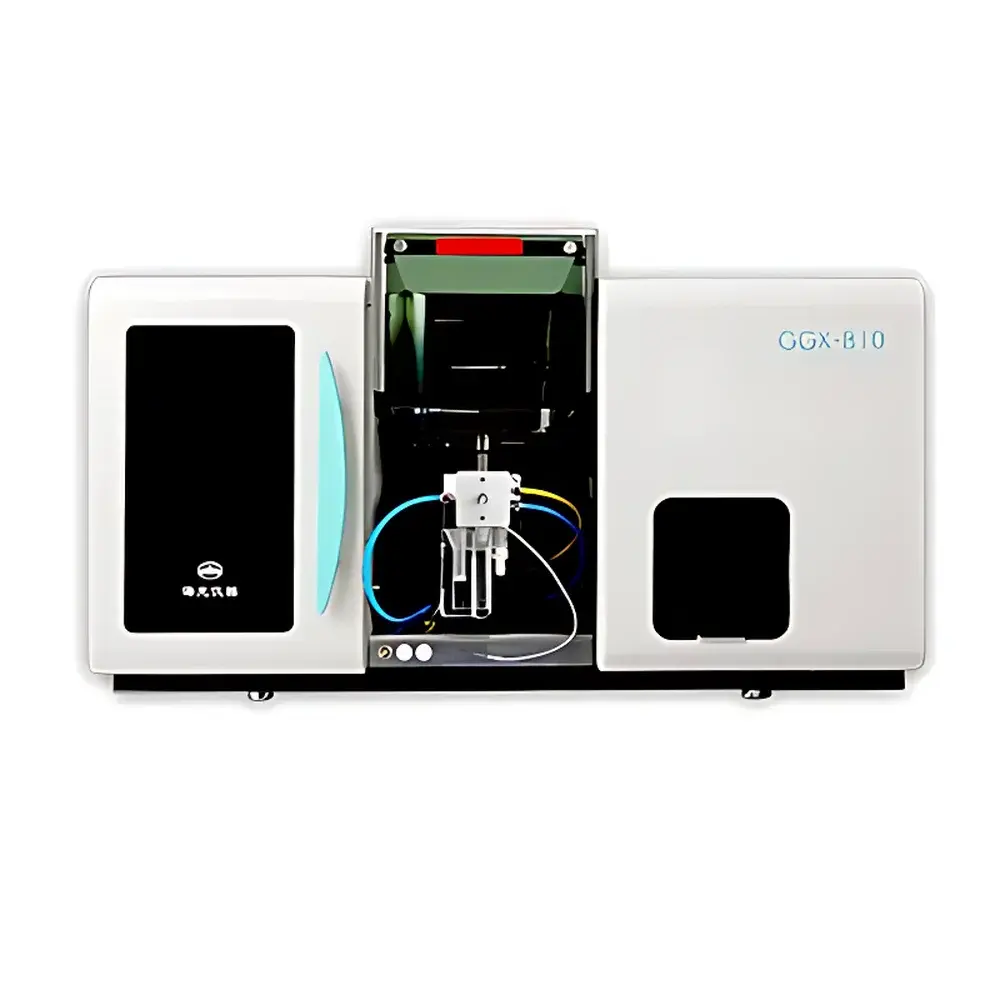
Haiguang GGX-810 Flame Atomic Absorption Spectrometer
| Brand | Haiguang Instrument |
|---|---|
| Origin | Beijing, China |
| Model | GGX-810 |
| Instrument Type | Flame AAS |
| Monochromator | Plane grating (1800 lines/mm) |
| Optical System | Single-beam |
| Detector | Photomultiplier tube (PMT) |
| Background Correction | Deuterium lamp (D₂) method |
| Burner Head | Titanium alloy |
| Atomization System | Full-plastic nebulizer chamber + high-efficiency glass concentric nebulizer |
| Safety Features | Water seal detection, waste liquid level monitoring, gas pressure monitoring, flame sensor, automatic gas cutoff on flameout, anti-flashback protection |
| Graphite Furnace Option | Longitudinal heating |
| Temp. range | ambient to 3000 °C |
Overview
The Haiguang GGX-810 Flame Atomic Absorption Spectrometer is a robust, CE-compliant benchtop analytical instrument engineered for precise quantification of trace metallic elements in liquid samples. It operates on the fundamental principle of atomic absorption spectroscopy (AAS): ground-state free atoms in a flame absorb characteristic radiation emitted by a hollow cathode lamp (HCL) tuned to the element-specific wavelength. The GGX-810 employs a single-beam optical architecture with a Czerny–Turner monochromator (270 mm focal length) and an 1800-line/mm plane diffraction grating, delivering optimized spectral resolution and photon throughput. Its flame atomization system utilizes a corrosion-resistant titanium alloy burner head and a full-plastic nebulizer chamber paired with a high-efficiency glass concentric nebulizer—ensuring stable aerosol generation, minimal memory effect, and compatibility with acidic and saline matrices. The instrument supports up to eight HCLs mounted in a vertical turret, all pre-heated simultaneously to reduce warm-up time and improve measurement reproducibility.
Key Features
- Deuterium (D₂) lamp background correction for accurate compensation of non-specific absorption and scattering in complex sample matrices
- Vertical 8-lamp turret with independent current control and auto-alignment, enabling rapid multi-element analysis without manual lamp replacement
- C-T optical design with 270 mm focal length and high-line-density plane grating (1800 lines/mm) for enhanced spectral separation and signal-to-noise ratio
- Flame system with integrated safety interlocks: real-time flame monitoring, gas pressure sensing, water seal verification, waste liquid level detection, and automatic fuel shutoff upon flame extinction or abnormal condition
- Optional graphite furnace module (GGX-810-GF) featuring longitudinal electrothermal heating, programmable temperature ramping (≥2000 °C/s), and a 52-position autosampler with sub-microliter injection precision (≤±0.5%) and on-the-fly matrix modifier addition
- Comprehensive software-controlled operation including automated wavelength scanning, slit width selection, lamp current optimization, and flame/gas parameter logging
Sample Compatibility & Compliance
The GGX-810 is validated for routine analysis of aqueous and acid-digested samples across environmental, food, clinical, and industrial laboratories. Its flame configuration meets performance requirements specified in major international and national standards—including ASTM D1688 (copper in water), ISO 11885 (water quality – determination of selected elements by AAS), and multiple Chinese GB and HJ standards such as GB 5009.12–2017 (Pb in food), HJ 491–2019 (Cu, Zn, Pb, Ni, Cr in soil), and GB/T 17141–1997 (Cd and Pb in soil via GF-AAS). All operational parameters—including lamp current, slit width, burner height, and gas flow rates—are fully configurable and auditable, supporting GLP/GMP workflows. Data integrity is maintained through timestamped method files, electronic signatures, and audit-trail-enabled software compliant with FDA 21 CFR Part 11 principles when deployed with appropriate IT infrastructure.
Software & Data Management
Control and data acquisition are managed via Haiguang’s proprietary AAS Analysis Suite, a Windows-based application offering intuitive method development, real-time spectral visualization, and quantitative calibration using linear or quadratic regression. The software supports multi-point standard addition, internal standard correction, and automatic dilution factor application. All raw absorbance signals, background-corrected values, and peak-area integrations are stored in structured binary format with embedded metadata (operator ID, date/time, instrument serial number, method version). Export options include CSV, TXT, and PDF report generation with customizable templates aligned to laboratory reporting requirements. Instrument diagnostics—including lamp energy stability, burner alignment status, and gas pressure logs—are continuously monitored and archived for preventive maintenance scheduling.
Applications
The GGX-810 delivers reliable elemental quantification in diverse application domains: food safety laboratories use it for routine testing of toxic metals (Pb, Cd, As, Cr) and essential nutrients (Fe, Zn, Cu, Mn, Ca, Mg, Na, K) per GB 5009 series standards; environmental labs apply it to monitor heavy metals in drinking water (HJ 757–2015), wastewater, soils, and sediments (HJ 491–2019); geological and metallurgical facilities employ it for assay validation and process control of ores and alloys; pharmaceutical QC units utilize it for residual catalyst metal screening in APIs; and academic institutions deploy it for teaching atomic spectroscopy fundamentals and conducting applied research in trace metal biogeochemistry. When equipped with the graphite furnace option, the system extends detection capability into the low-pg/mL range for ultra-trace analysis of refractory elements in biological fluids and high-purity reagents.
FAQ
Is the GGX-810 compatible with hydride generation or cold vapor accessories?
No—the GGX-810 is configured exclusively for flame and optional graphite furnace atomization. Hydride generation (HG-AAS) and cold vapor (CV-AAS) modules are not supported in this model variant.
Does the instrument support automatic method transfer between flame and graphite furnace modes?
Yes—when the graphite furnace module is installed, the software enables seamless switching between flame and furnace configurations with mode-specific parameter templates, calibration curve retention, and shared sample queue management.
What is the typical detection limit for copper using the flame configuration?
Under optimized conditions (air-acetylene flame, 324.7 nm line), the practical detection limit for Cu is approximately 1.5 µg/L, consistent with ISO 11885 performance criteria for flame AAS systems.
Can the software generate 21 CFR Part 11-compliant audit trails?
Yes—when deployed on a validated Windows environment with user access controls, electronic signatures, and secure data storage, the AAS Analysis Suite provides full audit trail functionality including operator actions, method modifications, result changes, and instrument state transitions.
Is service and technical support available outside mainland China?
Haiguang maintains authorized service partners in Southeast Asia, the Middle East, and Latin America. Remote diagnostics, application consulting, and certified training programs are available globally through regional distributors under formal service agreements.



