
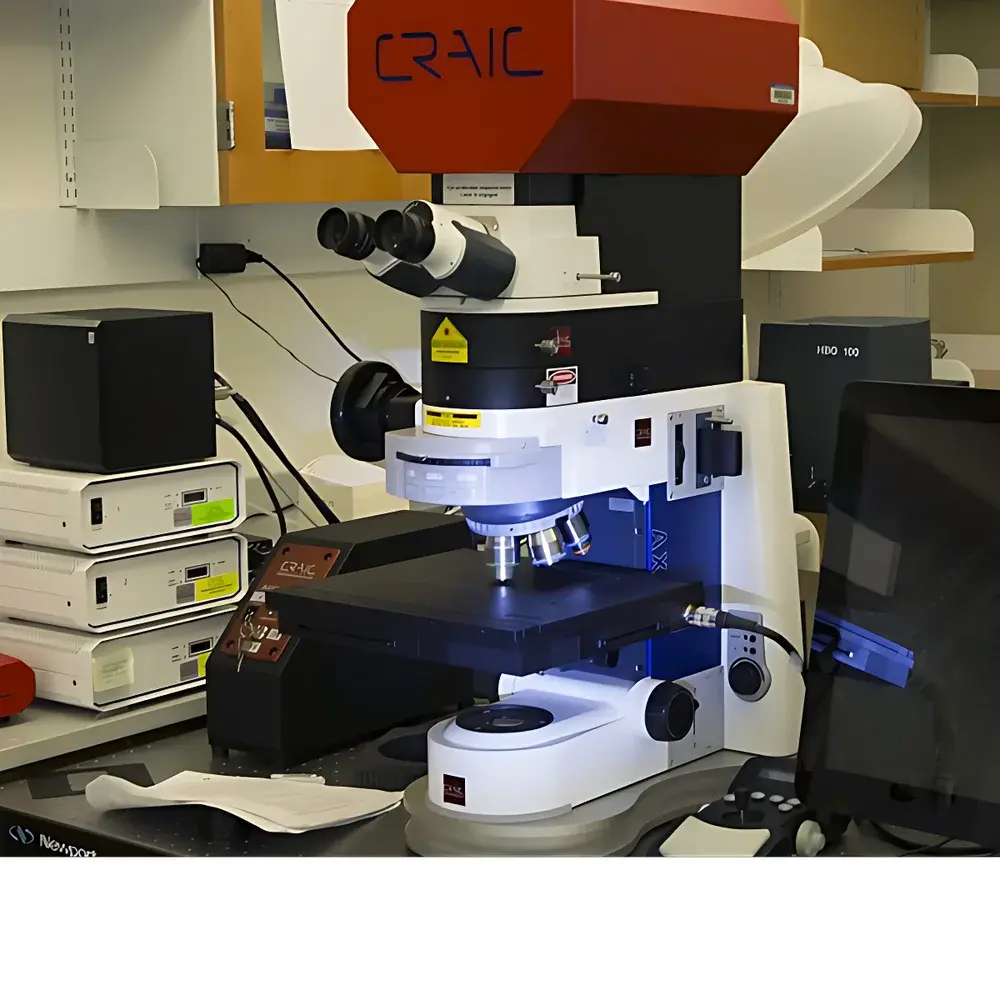
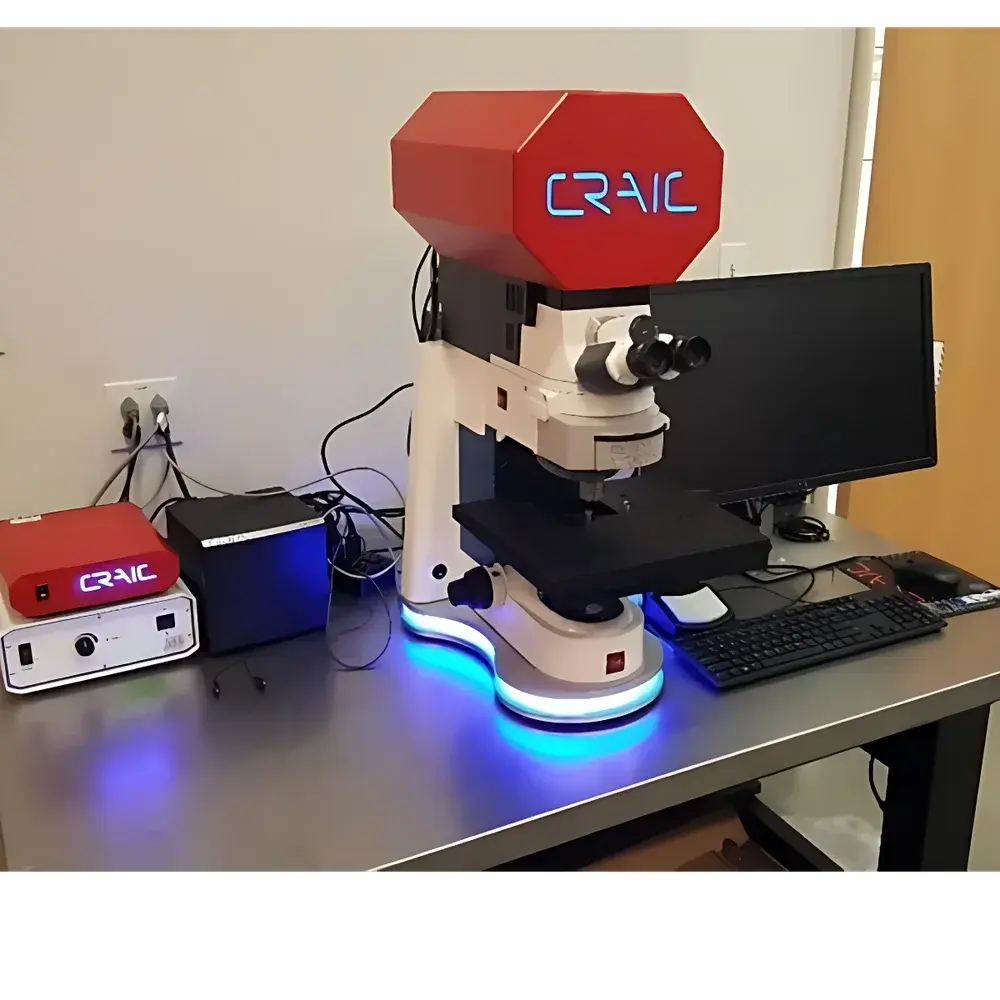
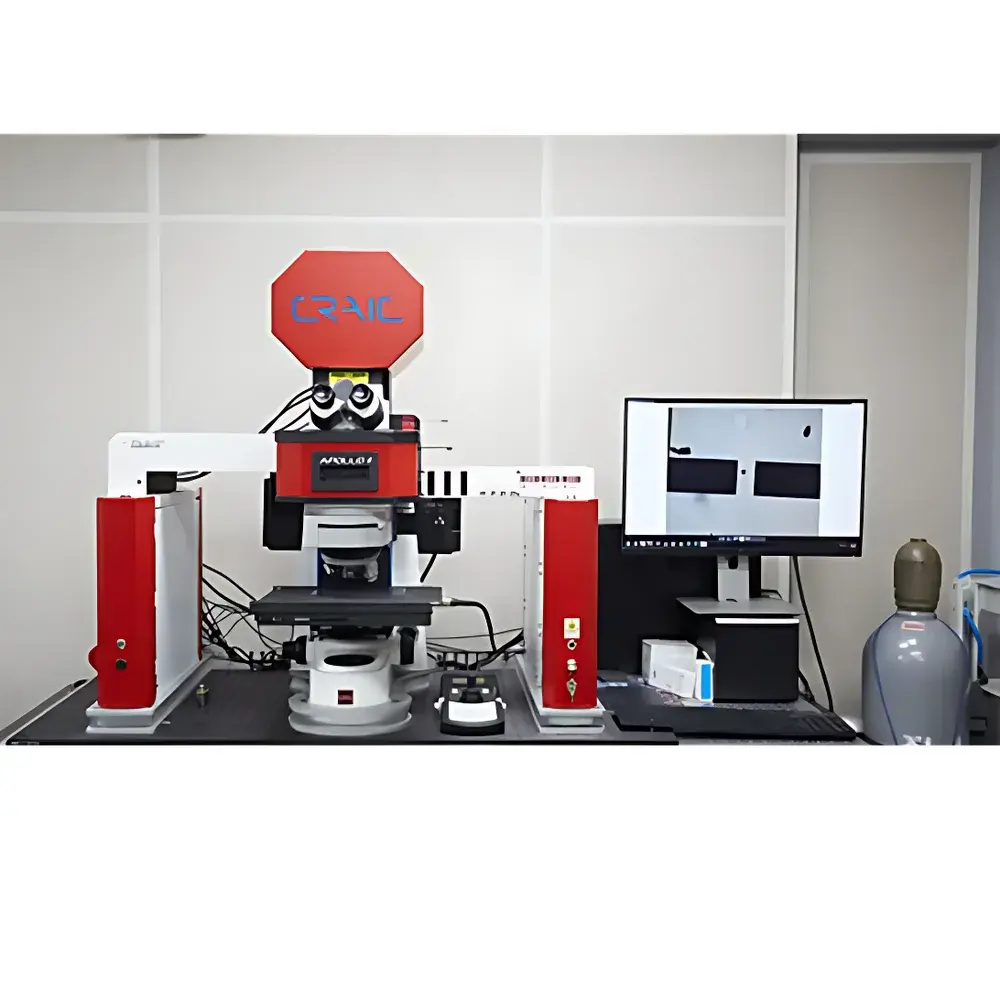
CRAIC Apollo II Confocal Raman Spectrometer
| Brand | CRAIC |
|---|---|
| Origin | USA |
| Manufacturer Type | Authorized Distributor |
| Origin Category | Imported |
| Model | Apollo II |
| Pricing | Upon Request |
| Laser Wavelengths | 405 nm, 532 nm, 633 nm, 785 nm, 830 nm |
| Spectral Resolution (at 1085 cm⁻¹, 50 µm slit) | 6.5–20.9 cm⁻¹ |
| Wavelength Range | 411–984 nm |
| Raman Shift Range | 87–5800 cm⁻¹ |
| 3D Depth Resolution (50×, NA 0.8, air) | < 1.0–1.4 µm |
| Lateral Spatial Resolution (50×, NA 0.8, air) | < 0.30–0.60 µm |
| Grating Options | 1200–2400 lines/mm |
Overview
The CRAIC Apollo II Confocal Raman Spectrometer is a research-grade, modular confocal micro-Raman system engineered for high spatial and spectral fidelity in heterogeneous sample analysis. It operates on the principle of inelastic scattering of monochromatic laser light—where incident photons interact with molecular vibrational modes, producing characteristic Stokes and anti-Stokes shifts proportional to bond energies and symmetry. Its confocal optical architecture enables diffraction-limited lateral resolution and sub-micron axial sectioning, making it ideal for depth-resolved chemical mapping of thin films, semiconductor heterostructures, biological tissues, and micro-inclusions within geological or pharmaceutical matrices. Unlike widefield Raman systems, the Apollo II integrates a precision XYZ motorized stage, high-numerical-aperture microscope optics, and spectrometer-coupled detection to deliver true 3D hyperspectral datasets—enabling quantitative layer-by-layer compositional profiling without physical sectioning.
Key Features
- Multi-laser excitation platform supporting five discrete wavelengths: 405 nm, 532 nm, 633 nm, 785 nm, and 830 nm—each optimized for specific material classes and fluorescence suppression strategies.
- Confocal pinhole alignment with real-time feedback ensures consistent optical sectioning across all laser lines; depth resolution remains < 1.4 µm (air, 50×, NA 0.8) and lateral resolution < 0.60 µm under optimal conditions.
- Interchangeable grating turret (1200–2400 lines/mm) allows dynamic trade-offs between spectral resolution (as low as 6.5 cm⁻¹ at 1085 cm⁻¹ with 50 µm slit) and spectral coverage (up to 5800 cm⁻¹ shift range).
- Thermoelectrically cooled, back-illuminated CCD detector with >90% quantum efficiency in the visible–NIR range minimizes dark current and maximizes signal-to-noise ratio for low-intensity Raman scattering.
- Integrated motorized filter wheel, automated laser line selection, and objective turret enable unattended multi-modal acquisition—including polarization-resolved, resonance-enhanced, and surface-enhanced Raman spectroscopy (SERS).
Sample Compatibility & Compliance
The Apollo II accommodates solid, liquid, and powder samples mounted on standard microscope slides or specialized substrates (e.g., SERS-active Au/Ag nanostructured wafers). Its non-destructive, label-free nature supports analysis under ambient, inert gas, or temperature-controlled stages (−196 °C to +600 °C with optional accessories). The system complies with ISO/IEC 17025 calibration traceability requirements for spectral wavelength accuracy and intensity linearity. When operated with audit-trail-enabled software (see Software & Data Management), it meets GLP and GMP documentation standards for regulated environments—including pharmaceutical raw material ID (USP ), polymer additive verification (ASTM E1840), and forensic trace evidence characterization (SWGMAT guidelines).
Software & Data Management
Acquisition and analysis are performed via CRAIC’s proprietary Lambda™ software, which provides full instrument control, real-time spectral preview, multivariate curve fitting (PCA, MCR-ALS), and automated peak identification against integrated databases (RRUFF, ICDD, NIST). All raw spectra, metadata (laser power, integration time, objective, grating, pinhole position), and processing history are stored in vendor-neutral HDF5 format. The software supports 21 CFR Part 11-compliant user authentication, electronic signatures, and immutable audit trails—ensuring data integrity for regulatory submissions. Batch processing scripts (Python API available) facilitate high-throughput screening of wafer maps or tissue sections.
Applications
- Semiconductor metrology: Strain mapping in SiGe channels, dopant distribution in FinFETs, and interfacial oxide thickness quantification via Si–O–Si Raman band deconvolution.
- Pharmaceutical development: Polymorph identification in active pharmaceutical ingredients (APIs), excipient compatibility assessment, and coating uniformity validation in controlled-release tablets.
- Materials science: Defect density estimation in CVD graphene (D/G ratio), carbon nanotube chirality assignment, and phase segregation in perovskite solar cell layers.
- Life sciences: Label-free lipid/protein distribution imaging in frozen-hydrated tissue sections, amyloid fibril conformational fingerprinting, and single-cell metabolic phenotyping via cytochrome c redox state monitoring.
- Geosciences & forensics: In situ mineral identification in fluid inclusions, pigment aging analysis in historical artworks, and explosive residue differentiation (e.g., RDX vs. PETN) based on symmetric NO₂ stretch modes.
FAQ
What laser wavelength should I select for organic polymer analysis?
For most organic and biological samples, 785 nm is recommended to suppress fluorescence while maintaining sufficient Raman cross-section and detector sensitivity. 532 nm may be used for highly symmetric inorganic crystals (e.g., TiO₂, SiC) where fluorescence is absent and higher signal intensity is required.
Can the Apollo II perform tip-enhanced Raman spectroscopy (TERS)?
Yes—the system is compatible with third-party TERS probes and nanopositioning stages. Its modular design allows integration of AFM/Raman hybrid configurations with sub-10 nm spatial resolution when coupled with plasmonically enhanced tips.
Is spectral calibration traceable to NIST standards?
Yes—each instrument ships with factory calibration using NIST-traceable neon and argon emission lamps. Users may perform routine recalibration using built-in reference standards or external certified Raman shift standards (e.g., silicon at 520.7 cm⁻¹).
Does the system support time-resolved or stimulated Raman measurements?
While the base configuration is optimized for spontaneous Raman, optional pulsed laser modules (e.g., picosecond 1064 nm) and gated ICCD detectors enable time-resolved measurements. CARS and SRS require external ultrafast laser systems and are supported via external beam coupling ports.
How is data security managed during multi-user operation?
Lambda™ software implements role-based access control (RBAC), encrypted local storage, and optional LDAP/Active Directory integration. All user actions—including spectrum acquisition, modification, and export—are logged with timestamps and operator IDs in accordance with 21 CFR Part 11 requirements.





