
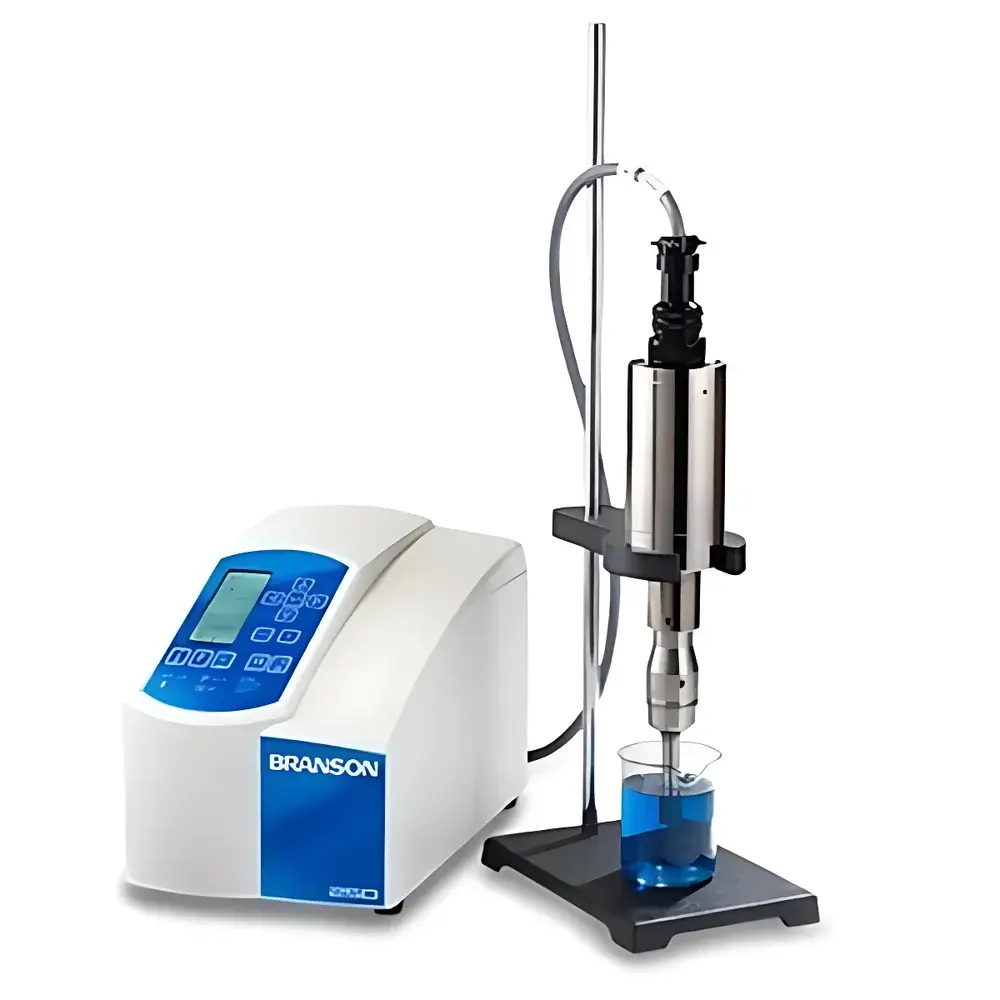
Branson SFX250 and SFX550 Ultrasonic Cell Disruptors
| Brand | Branson |
|---|---|
| Origin | USA |
| Model | SFX250 / SFX550 |
| Operating Frequency | 20 kHz (SFX250), 20 kHz (SFX550) |
| Output Power | 250 W (SFX250), 550 W (SFX550) |
| Energy Range | 1–999999 J |
| Pulse Energy | 1–9999 J |
| Run Time | 0.1 s – 99 h 59 min 59 s |
| Pulse Duration | 0.01 s – 59 min 59.99 s |
| Temperature Control Range | 0.0–100.0 °C (with optional temperature probe) |
| Standard Probe | 1/2″ (13 mm) titanium alloy (Grade 7–4) |
| Optional Probes | 3/4″ (19 mm), 1/8″ (3 mm) microtip |
| Input Voltage | AC 200–240 V, 50/60 Hz |
| Dimensions (L×W×H) | 348 × 203 × 242 mm |
| Weight | 6.5 kg |
Overview
The Branson SFX250 and SFX550 Ultrasonic Cell Disruptors are benchtop sonicators engineered for reproducible, scalable, and controllable lysis of biological cells and tissues in life science laboratories. These instruments operate on the principle of high-intensity ultrasonic cavitation—where rapid pressure fluctuations generated by piezoelectric transducers at 20 kHz induce transient microbubble formation, growth, and violent collapse within the liquid medium. This process delivers localized shear forces, microstreaming, and shockwaves sufficient to disrupt membranes, disintegrate organelles, solubilize inclusion bodies, and homogenize viscous or particulate suspensions without significant thermal degradation—provided appropriate duty cycles and cooling protocols are applied. Designed for mid-volume processing (typically 0.2–50 mL per run, depending on probe selection and sample viscosity), the SFX series bridges the gap between handheld microtip sonicators and industrial-scale ultrasonic processors, offering precision control essential for downstream applications such as protein extraction, nucleic acid isolation, nanoparticle dispersion, and vaccine development.
Key Features
- Programmable energy delivery: Precise control over total energy (J), pulse energy (J), run time (ms to hours), and pulse duration (10 ms to ~60 min) enables strict protocol adherence and inter-laboratory reproducibility.
- Dual operating modes: Continuous and pulsed (duty cycle) modes minimize sample heating and preserve labile biomolecules; pulse parameters are independently adjustable for optimization across cell types and matrices.
- Temperature monitoring interface: Compatible with optional PT100 or thermistor-based immersion probes, allowing real-time feedback and automated shutdown if user-defined thermal thresholds (0.0–100.0 °C) are exceeded—critical for GLP-compliant workflows and heat-sensitive targets (e.g., enzymes, RNA).
- Robust transducer architecture: Sealed, water-cooled titanium alloy (Grade 7–4) probes ensure mechanical durability, acoustic efficiency, and corrosion resistance in aqueous and mildly aggressive buffers (e.g., RIPA, Tris-EDTA, guanidine solutions).
- Intuitive touchscreen interface: Graphical LCD display with multilingual support (English, German, French, Chinese) provides immediate access to stored methods, real-time parameter visualization, and error diagnostics—including impedance mismatch alerts and overtemperature warnings.
- Modular probe compatibility: Standard 1/2″ (13 mm) probe optimized for volumes ≥5 mL; optional 3/4″ (19 mm) for higher throughput (>20 mL) and 1/8″ (3 mm) microtip for low-volume, high-shear applications (200 µL–10 mL), enabling method transfer across scale.
Sample Compatibility & Compliance
The SFX250/SFX550 accommodate a broad range of biological and synthetic samples—including mammalian and bacterial cell cultures, yeast, plant tissues, viral lysates, spores, liposomes, polymeric nanoparticles, and emulsions. Sample vessels include standard microcentrifuge tubes (1.5–2.0 mL), centrifuge tubes (15–50 mL), and custom jacketed reactors (with external chiller integration). All instruments comply with IEC 61000-6-3 (EMC emissions) and IEC 61010-1 (safety requirements for laboratory equipment). When configured with audit-trail-enabled software and temperature logging, systems support alignment with FDA 21 CFR Part 11 (electronic records/signatures), ISO/IEC 17025 (testing laboratory competence), and USP (analytical instrument qualification) frameworks—particularly when deployed in QC/QA environments for biopharmaceutical raw material testing or stability studies.
Software & Data Management
While standalone operation is fully functional via front-panel controls, optional Branson SonicsConnect™ PC software (Windows-compatible) extends functionality through method library management, remote instrument control, automated data export (CSV, PDF), and electronic signature capture. The software logs timestamped operational parameters—including actual delivered power (W), cumulative energy (J), probe tip amplitude (µm), bath temperature (°C), and fault events—for traceability in regulated settings. Audit trail features record user ID, method changes, and calibration adjustments, satisfying ALCOA+ (Attributable, Legible, Contemporaneous, Original, Accurate, Complete, Consistent, Enduring, Available) data integrity principles required under GxP.
Applications
- Cell lysis for recombinant protein purification (E. coli, Pichia, CHO)
- Chromatin shearing in ChIP-seq and ATAC-seq library prep
- Disruption of Gram-positive bacteria and fungal cell walls
- Preparation of subcellular fractions (mitochondria, nuclei, membrane vesicles)
- Nanoparticle deagglomeration and dispersion in drug delivery formulations
- Accelerated solvent extraction of phytochemicals from botanical matrices
- Cleaning and sterilization of microfluidic channels and capillary electrophoresis components
FAQ
What is the difference between the SFX250 and SFX550 models?
The SFX550 delivers higher maximum output power (550 W vs. 250 W) and supports larger probe diameters (up to 3/4″), enabling efficient processing of higher-viscosity samples and larger volumes—while maintaining identical control architecture, software compatibility, and physical footprint.
Can the SFX series be used for continuous flow processing?
No—these are batch-mode sonicators. For continuous processing, Branson offers the Sonifier® 450 or digital series with flow cell accessories; the SFX platform is optimized for discrete, programmable batch treatments.
Is probe calibration required before use?
Yes. Each probe must be calibrated using the built-in auto-tuning function prior to first use and after probe replacement or extended storage to ensure optimal acoustic coupling and energy transfer efficiency.
How does temperature control integrate with the system?
An external temperature probe connects to the rear I/O port; the controller reads the signal and can halt sonication automatically if the setpoint is exceeded—no internal cooling is provided, so users must employ ice baths or recirculating chillers for sustained low-temperature operation.
Are there regulatory documents available for IQ/OQ/PQ validation?
Branson provides standardized IQ/OQ protocols and factory calibration certificates; PQ execution requires user-defined acceptance criteria aligned with application-specific performance metrics (e.g., % lysis efficiency, protein yield consistency, DNA fragment size distribution).




