
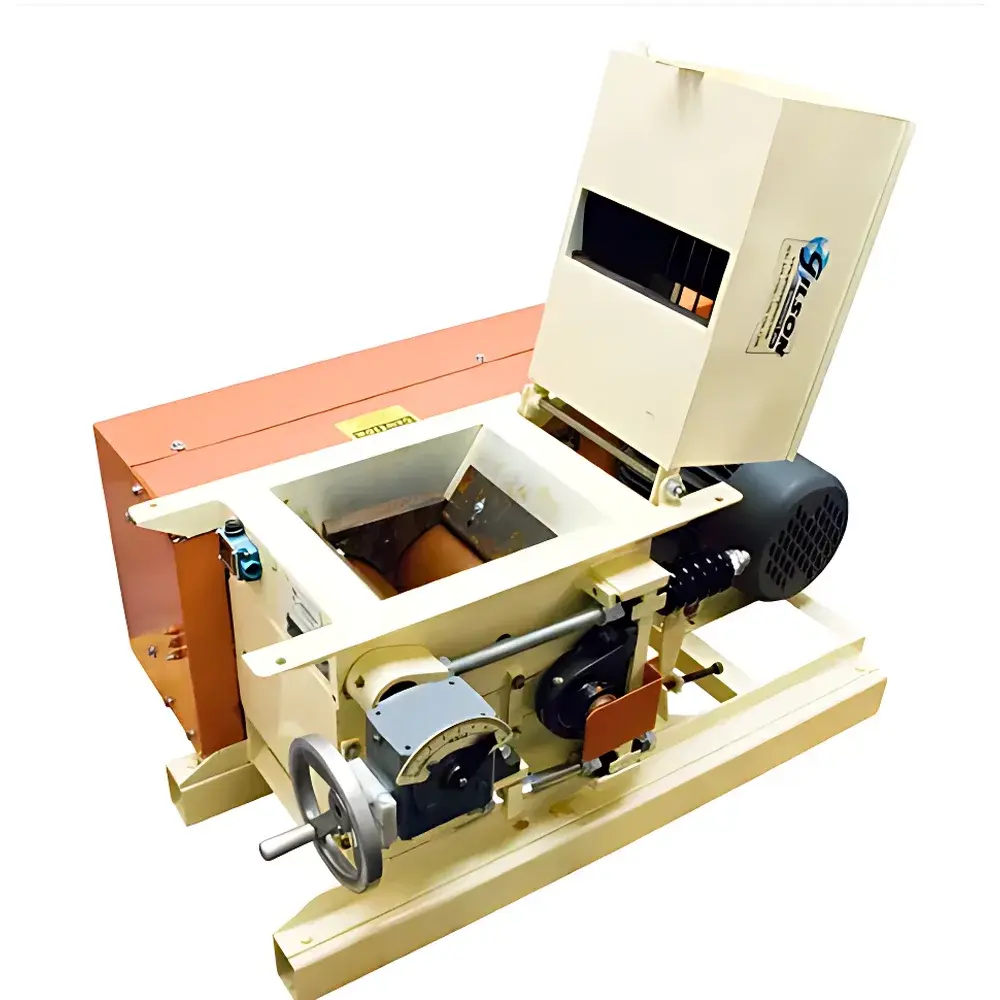
Marcy® LC-13 / LC-14 / LC-14F Double Roll Crusher
| Origin | USA |
|---|---|
| Manufacturer Type | Authorized Distributor |
| Origin Category | Imported |
| Models | LC-13, LC-14, LC-14F |
| Power Supply | LC-13 & LC-14 — 60 Hz, 230 V or 460 V |
| Motor | LC-13 — 2 hp TEFC |
| Roll Dimensions | LC-13 — 6.5" × 6" (165 mm × 153 mm) |
| Feed Size | ≤13 mm (½") |
| Output Size | Typically ≤2 mm (No. 10 mesh), adjustable via manual roll gap lever |
| Capacity | LC-13 — 1,361 kg/h |
| Roll Material | 304 stainless steel core with nickel-hard facing |
| Bearing Type | Heavy-duty pillow block bearings |
| Frame | Welded structural steel base with relief springs and safety guarding |
| Feed Hopper | Angled cast-steel hopper with electrical interlock (power cutoff when open) |
Overview
The Marcy® LC-13, LC-14, and LC-14F Double Roll Crushers are precision-engineered laboratory and pilot-scale reduction systems designed for controlled, single-pass size reduction of medium-to-hard brittle materials—including ores, rocks, slag, coal, limestone, and construction aggregates. Based on the classic compression principle of dual counter-rotating rolls, these crushers apply uniform compressive force across the material bed, minimizing over-grinding and preserving particle shape integrity. Unlike impact or hammer-based systems, roll crushers deliver consistent product gradation with low fines generation—making them ideal as primary or intermediate reduction units preceding downstream grinding (e.g., ball milling, rod milling) or analytical sample preparation (e.g., XRF, ICP-OES, sieve analysis). Each model is built to U.S.-sourced engineering standards and conforms to ANSI B11.1–2020 (American National Standard for Mechanical Power Transmission Apparatus) and OSHA 1910.212 (machine guarding requirements).
Key Features
- Robust welded-steel frame with integrated heavy-gauge base plate and calibrated relief springs to absorb shock loads during feed surges or tramp metal events
- Nickel-hard faced 304 stainless steel crushing rolls—resistant to abrasion, corrosion, and spalling under sustained mineral contact
- Precision-machined pillow block bearings with sealed-for-life lubrication, enabling >10,000 hours of continuous operation with minimal maintenance
- Manually adjustable roll gap via single-lever mechanism—providing repeatable output sizing from 1 mm to 10 mm without tools
- Angled feed hopper constructed from cast steel, featuring full-width access for cleaning and inspection, plus integrated electrical safety interlock that de-energizes the motor upon hopper opening
- Full perimeter guarding with polycarbonate viewing panels and hinged access doors compliant with ISO 13857 (safety distances) and ANSI B11.19 (safeguarding implementation)
- V-belt drive system delivering constant surface velocity across the full torque range—ensuring stable throughput and reduced belt slippage versus direct-drive alternatives
Sample Compatibility & Compliance
These crushers are validated for use with non-fibrous, non-sticky, dry or slightly damp feed materials having Mohs hardness ≤7 and moisture content <8%. They are routinely employed in geological survey labs, metallurgical testing facilities, and cement R&D centers for ASTM D4782 (standard test method for determination of particle size distribution of crushed rock), ISO 10835 (laboratory crushers for mineral processing), and USP & EP pharmacopeial sample prep where mechanical integrity must be preserved. All models meet CE machinery directive requirements (2006/42/EC) when supplied with appropriate voltage configuration and carry UL recognition for industrial control panels (UL 508A). Optional ATEX-certified variants (II 2G Ex db IIB T4 Gb) are available for hazardous location deployment.
Software & Data Management
While the LC-series operates as a standalone electromechanical unit without embedded digital controls, it is fully compatible with external process monitoring systems via its 4–20 mA analog output (optional) and dry-contact status signals (run/stop/fault). Integration with SCADA platforms (e.g., Ignition, Siemens WinCC) enables real-time throughput logging, motor current trending, and predictive maintenance alerts based on thermal and vibration signature analysis. For GLP/GMP environments, optional audit-trail-capable PLC controllers (IEC 62443-compliant) support 21 CFR Part 11 electronic record integrity through user authentication, electronic signatures, and immutable event logging.
Applications
- Primary size reduction of drill core samples prior to jaw crushing or pulverization
- Preparation of representative sub-samples for geochemical assay (e.g., fire assay, leach testing)
- Controlled comminution of refractory ores for liberation studies in mineral processing flowsheet development
- Consistent feed conditioning for bond work index testing (ASTM E2432)
- Aggregate grading compliance verification per ASTM C136 and EN 933-1
- Recycled concrete aggregate (RCA) sizing for civil engineering material qualification
FAQ
What is the recommended maintenance schedule for the Marcy® double roll crusher?
Routine inspection every 200 operating hours includes checking roll surface wear, bearing temperature (<85°C), belt tension, and interlock functionality. Lubrication of pillow block bearings is required only at 5,000-hour intervals using NLGI #2 lithium complex grease.
Can the LC-14F operate on 60 Hz power?
No—the LC-14F is specifically wound for 50 Hz operation. Using it on 60 Hz will cause overspeed, excessive current draw, and irreversible motor winding damage. Voltage selection (220 V / 380 V / 440 V) must match local grid specifications and transformer tap settings.
Is dust suppression integrated into the design?
The standard unit does not include active dust collection; however, it features threaded ports (NPT 1″) on the discharge chute and hopper flange for connection to third-party baghouse or cyclone systems meeting OSHA PEL and ACGIH TLV requirements.
How is calibration traceability maintained for output size consistency?
Roll gap is set mechanically using a certified depth gauge (±0.02 mm accuracy) referenced to NIST-traceable master gauges. Gap verification is documented per ISO/IEC 17025–compliant internal procedure, with records retained for ≥5 years.
Are replacement rolls available with alternative face materials?
Yes—custom roll configurations are offered with tungsten carbide-tipped, chrome-molybdenum alloy, or ceramic-coated surfaces for highly abrasive applications such as bauxite or silica sand processing. Lead time is typically 8–10 weeks from order confirmation.






