
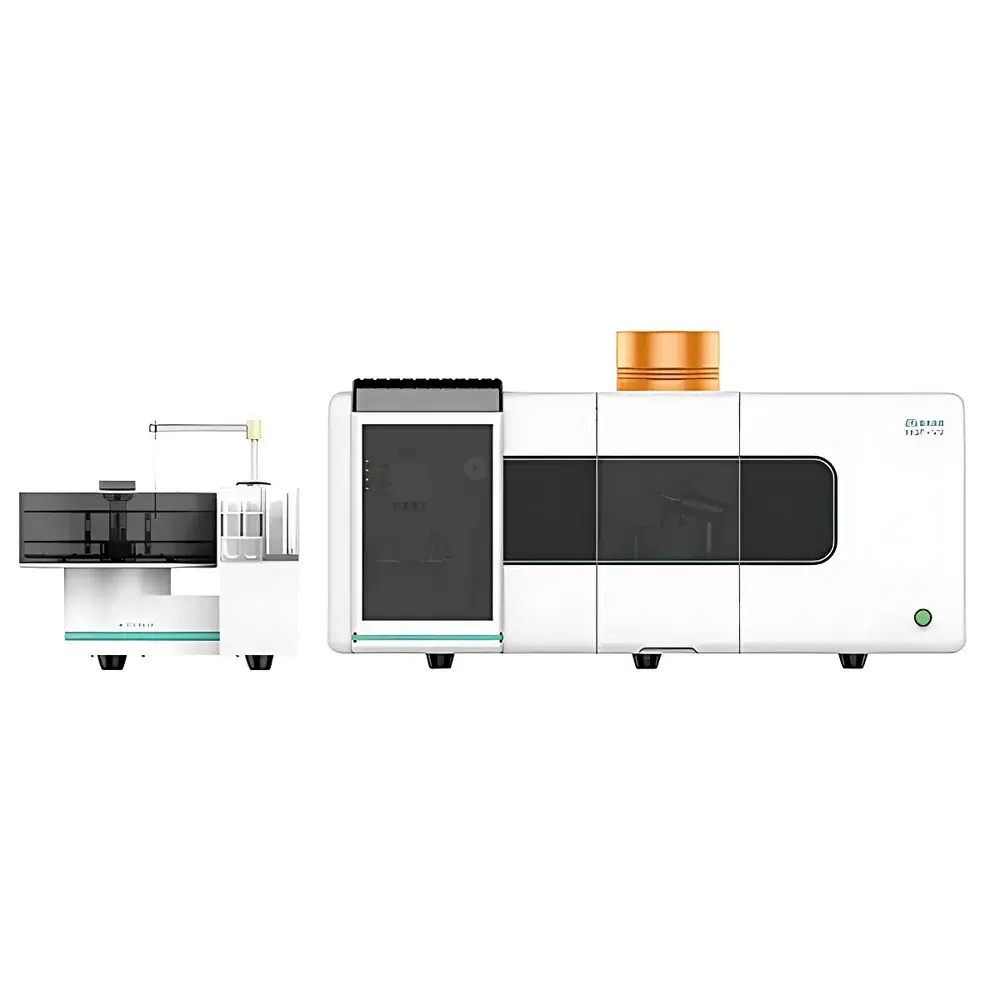
Haiguang HGF-V9 Atomic Fluorescence Spectrometer
| Brand | Haiguang Instrument |
|---|---|
| Origin | Beijing, China |
| Manufacturer Type | Authorized Distributor |
| Country of Origin | China |
| Model | HGF-V9 |
| Instrument Type | Multi-channel Atomic Fluorescence Spectrometer |
| Sample Introduction | Dual Sequential Injection Pump |
| Waste Disposal | Gravity-driven (Static) Drainage |
| Hydride Generation Mode | Vapor Generation / Hydride Generation |
| Gas Flow Control | Mass Flow Controllers (MFCs) |
| Detectable Elements | As, Se, Pb, Bi, Sb, Te, Sn, Hg, Cd, Ge, Zn, Au |
| Relative Standard Deviation (RSD) | < 0.6% |
| Linear Dynamic Range | > 3 orders of magnitude |
| Detection Limits (As, Se, Pb, Bi, Sb, Te, Sn) | < 0.01 µg/L |
| Photomultiplier Tube Wavelength Range | 160–320 nm |
| Atomizer Temperature Control Range | 50–450 °C |
Overview
The Haiguang HGF-V9 Atomic Fluorescence Spectrometer represents the fourth-generation advancement in atomic fluorescence technology (AFS 4.0), engineered for high-precision, trace-level elemental analysis of hydride-forming elements in complex environmental, food, clinical, and geological matrices. Based on the principle of atomic fluorescence spectroscopy—where analyte atoms, generated in a quartz atomizer via hydride/vapor generation, are excited by a high-intensity hollow cathode lamp (HCL) or electrodeless discharge lamp (EDL), emitting characteristic fluorescence photons detected by a low-noise photomultiplier tube—the HGF-V9 delivers exceptional sensitivity, stability, and operational robustness. Its design addresses long-standing challenges in conventional AFS systems, including memory effects, mercury carryover, lamp alignment drift, ignition reliability, and gas flow instability—making it suitable for routine compliance testing under regulated laboratory environments.
Key Features
- Multi-channel, multi-lamp turret system with automatic lamp selection and alignment-free operation, eliminating manual optical adjustment and ensuring consistent excitation intensity across sequential analyses.
- Optimized optical path incorporating internally blackened threaded components, asymmetric apertures, and proprietary light-absorbing coatings to suppress stray light—improving signal-to-noise ratio (SNR) by up to 40% compared to legacy AFS configurations.
- Three-dimensional integrated fluidic architecture minimizes tubing length and dead volume, significantly reducing mercury adsorption and cross-contamination between runs; validated for ≤0.1% memory effect after high-concentration Hg standards.
- Microliter-scale sequential injection system with no peristaltic pump tubing—fully maintenance-free, enabling automated sample introduction, standard calibration, reagent blanking, and post-run cleaning without consumable replacement.
- Triple-gas digital mass flow control system (carrier, auxiliary, and shielding gases), each independently regulated at milliliter-per-minute precision, ensuring reproducible atomization conditions over extended operation (>8 h continuous run).
- Self-regulating, water-cooled, overflow-type three-stage gas–liquid separator designed for high-organic-content samples (e.g., biological tissues, wastewater digests); features real-time foam suppression, moisture removal, and passive waste drainage.
- Dual-zone temperature-controlled quartz atomizer: carrier gas and shielding gas pathways maintain independent thermal profiles (50–450 °C range), stabilizing atom cloud geometry and enhancing atomization efficiency across diverse matrix viscosities.
- Spark-based ignition system rated for >1,000,000 ignitions without filament replacement—eliminating downtime associated with thermionic filament degradation or breakage.
- Real-time Hg lamp intensity stabilization algorithm, continuously correcting for spectral drift using reference photodiode feedback—critical for long-duration monitoring of mercury in drinking water or urine specimens.
- Integrated sensor suite including leak detection (liquid/gas), MFC status monitoring, ignition current telemetry, and optional atomization chamber video feed—accessible via embedded web interface for remote diagnostics.
Sample Compatibility & Compliance
The HGF-V9 is validated for use with acid-digested aqueous extracts, microwave-assisted digests (EPA Method 3052/3051A compatible), and direct hydride-generation-ready solutions. It meets performance criteria specified in major regulatory frameworks, including ISO/IEC 17025:2017 for testing laboratories, and supports audit-ready data handling aligned with FDA 21 CFR Part 11 requirements when deployed with compliant software configuration. The instrument complies with method-specific validation parameters outlined in GB 5009.11–2014, GB 5009.17–2021, HJ 694–2014, HJ 680–2013, and HJ 1133–2020, enabling accredited reporting for arsenic, mercury, selenium, antimony, bismuth, and related elements in food, soil, water, air particulates, and clinical biospecimens.
Software & Data Management
The HGF-V9 operates with Haiguang’s next-generation AFS Control Suite—a Windows-based application supporting LAN and Wi-Fi connectivity for centralized instrument management. The software provides full workflow automation: auto-calibration (linear/non-linear), QC check (spike recovery, duplicate analysis), electronic signature-enabled result review, and GLP-compliant audit trail logging (user actions, parameter changes, instrument events). Raw spectral data, peak integration logs, and diagnostic reports are stored in vendor-neutral formats (CSV, XML) for third-party LIMS integration. Optional 21 CFR Part 11 module enables role-based access control, electronic signatures, and immutable record retention.
Applications
The HGF-V9 serves as a core analytical platform in environmental monitoring labs (e.g., quantification of As and Sb in PM2.5 filters per HJ 1133–2020), food safety programs (inorganic As in rice per GB 5009.11–2014), public health surveillance (Hg in human urine per GBZ/T 302–2018), and geochemical exploration (total Hg and Se in sediment cores per HJ 702–2014). Its high tolerance for organic-rich digests also supports pharmaceutical excipient screening (Cd, Pb in APIs), cosmetics heavy metal screening (As, Hg in creams), and agricultural soil testing (total As, Pb per GB/T 22105–2008).
FAQ
What hydride-forming elements can the HGF-V9 quantify?
The system is optimized for As, Se, Pb, Bi, Sb, Te, Sn, Hg, Cd, Ge, Zn, and Au—covering all elements listed in major Chinese national standards and EPA-recommended AFS methods.
Is the instrument compatible with existing laboratory information management systems (LIMS)?
Yes—raw data export in CSV/XML format and optional OPC UA support enable seamless integration with enterprise LIMS platforms.
Does the HGF-V9 require annual recalibration by the manufacturer?
No—built-in lamp intensity correction, gas flow self-diagnosis, and atomizer thermal stability reduce need for external recalibration; user-performed performance verification per GB/T 27417–2017 is sufficient for routine QC.
Can the system analyze solid samples directly?
No—solid samples must undergo validated digestion (microwave or hot-block) prior to hydride generation; the HGF-V9 accepts only liquid-phase, acidified, reducing-agent-containing solutions.
What maintenance intervals are recommended for routine operation?
The system requires no scheduled consumable replacement; quarterly inspection of quartz atomizer integrity, MFC calibration verification, and optical window cleaning are advised per ISO/IEC 17025 preventive maintenance guidelines.





