
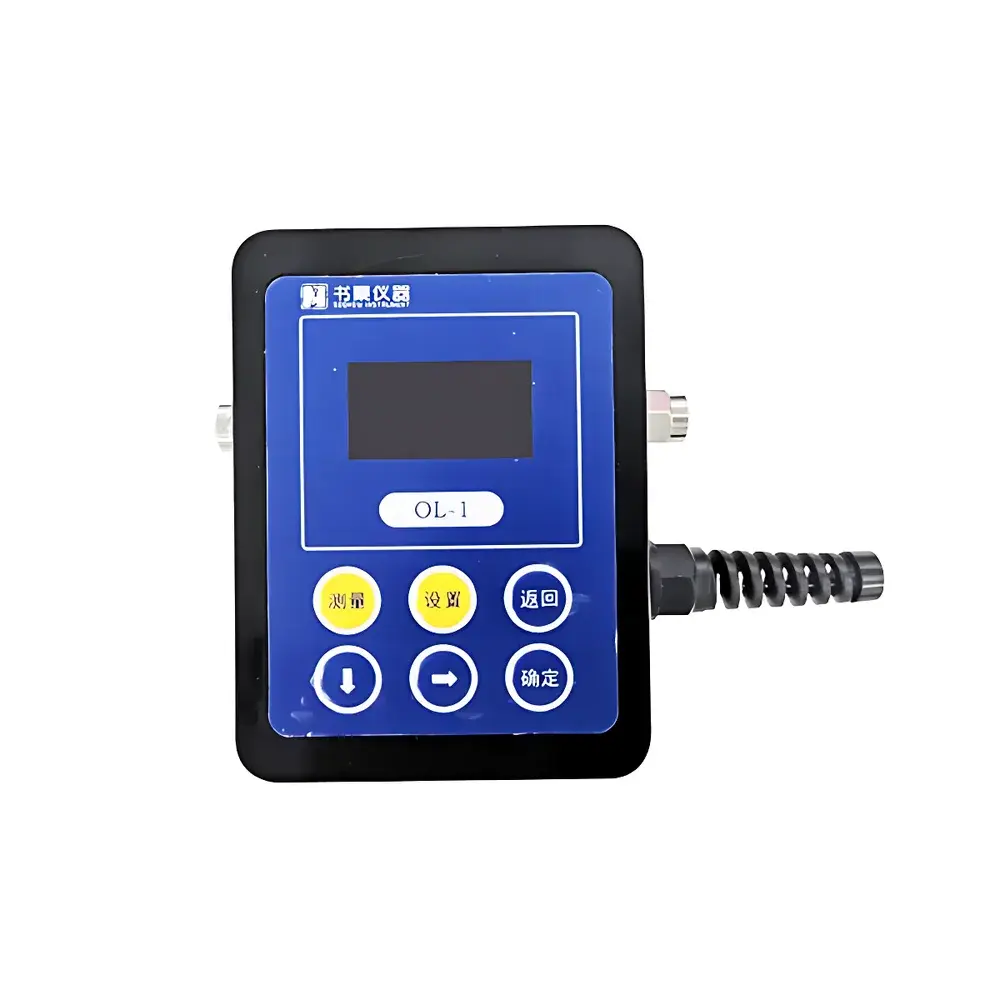
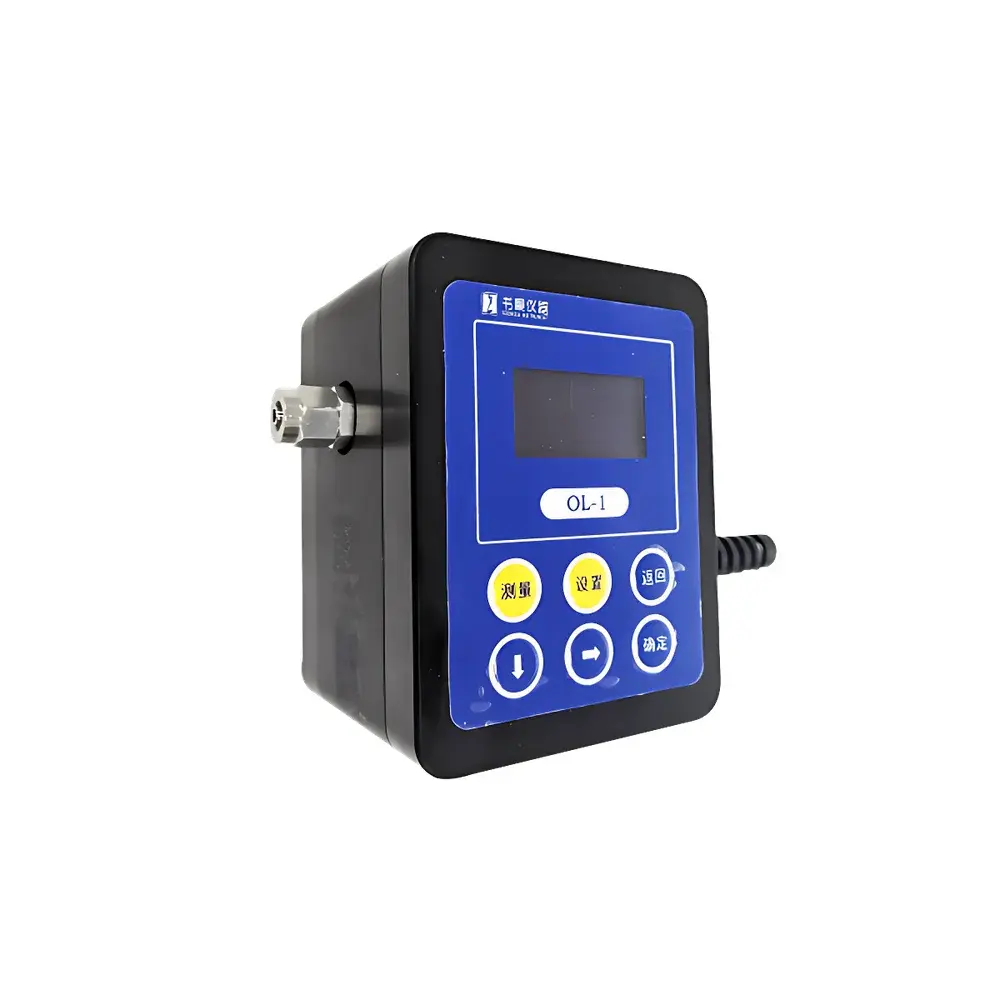
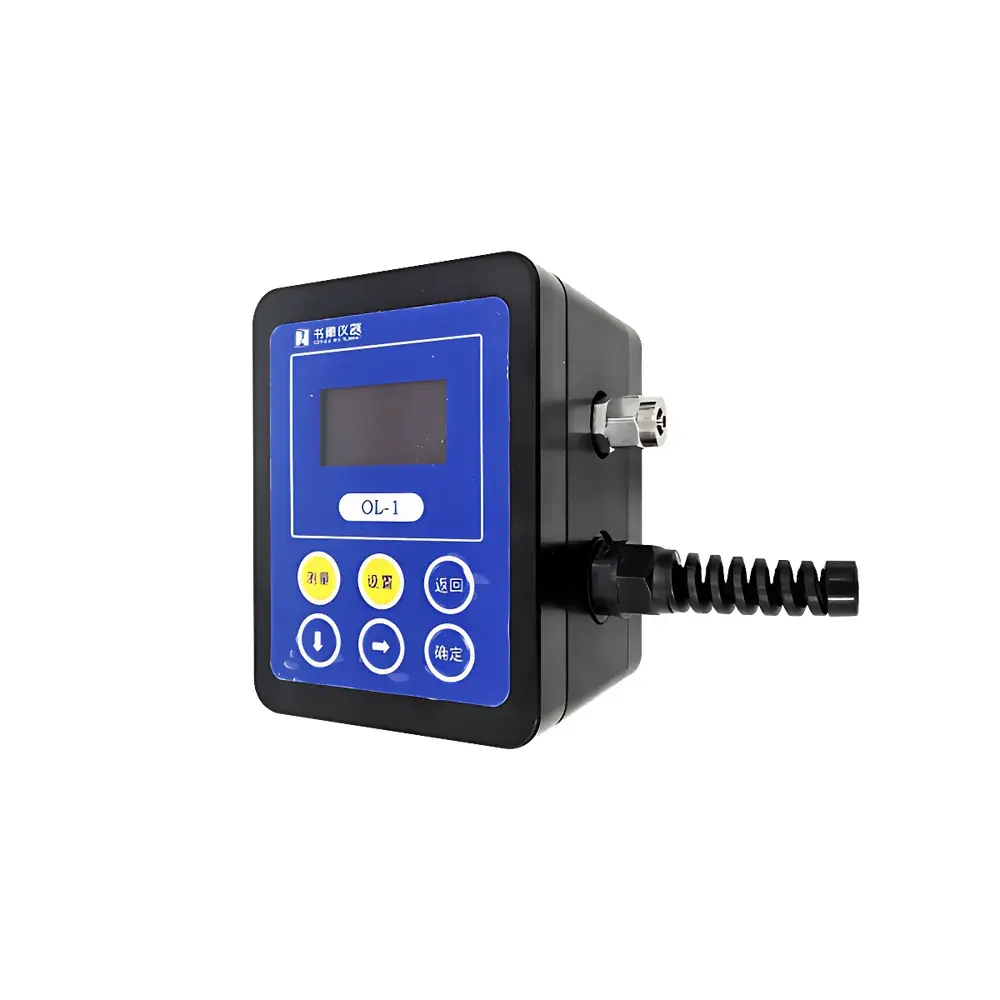
SOOHOW OL-1 Online Optical Particle Counter
| Brand | SOOHOW INSTRUMENT |
|---|---|
| Origin | Jiangsu, China |
| Manufacturer Type | Direct Manufacturer |
| Product Category | Domestic |
| Model | OL-1 Online Particle Counter |
| Price Range | USD 1,100 – 1,700 (FOB) |
| Instrument Type | Optical Blockage (Light Obscuration) Particle Counter |
| Display | OLED with Membrane Touch Keypad |
| Detection Channels | 8 |
| Predefined Calibration Sizes | 1, 2, 5, 10, 15, 25, 50, 100 µm OR 4(c), 4.6(c), 6(c), 10(c), 14(c), 21(c), 38(c), 70(c) µm |
| Flow Rate Range | 10–50 mL/min and 50–300 mL/min (dual-range pump) |
| Operating Pressure | 0.2–10 MPa (up to 40 MPa with optional pressure-reduction module) |
| Data Storage | USB flash drive interface |
| Dimensions | 100 × 75 × 70 mm |
| Net Weight | 1 kg |
| Light Source | Semiconductor Laser Diode |
| Particle Size Range | 1–600 µm (sensor-dependent) |
| Sensitivity | 1 µm (per ISO 4402) or 4 µm(c) (per GB/T 18854 & ISO 11171) |
| Sample Volume per Count | 10 mL |
| Counting Accuracy | ±1 contamination code level |
| Sample Temperature Range | 0–80 °C |
| Ambient Operating Temperature | −20–60 °C |
| Storage Temperature | −30–80 °C |
| Power Supply | DC 9 V or DC 12–36 V |
| Output Interfaces | RS-485, RS-232, and 4–20 mA analog output |
| Optional Add-on | Water Activity (aw) sensor for dissolved water detection in oil |
| Housing Material | Anodized Aluminum Alloy |
| Compliance Standards | ISO 4406, NAS 1638, GJB 420A/B, GB/T 14039, ROCT 17216, ISO 11171, ISO 4402, GB/T 18854-2002 |
Overview
The SOOHOW OL-1 Online Optical Particle Counter is an industrial-grade, real-time particle monitoring instrument engineered for continuous in-line assessment of particulate contamination in hydraulic fluids, lubricating oils, turbine oils, and other critical process liquids. It operates on the light obscuration (also known as optical blockage) principle: as particles suspended in a flowing liquid stream pass through a focused laser beam, they cast shadows proportional to their cross-sectional area. The photodetector captures these transient signal reductions, enabling classification and counting across eight user-selectable size thresholds. Unlike offline laboratory analyzers requiring manual sampling and dilution, the OL-1 integrates directly into pressurized fluid loops—enabling unattended, high-frequency measurement without flow interruption or sample degradation. Its compact form factor (100 × 75 × 70 mm), rugged anodized aluminum housing, and wide operating temperature range (−20 °C to +60 °C) support deployment in harsh environments including offshore platforms, power generation facilities, aerospace ground support systems, and heavy-duty mobile hydraulics.
Key Features
- Eight-channel optical detection with dual calibration sets: ISO 4402-compliant (1–100 µm) and ISO 11171-compliant (4(c)–70(c) µm), ensuring compatibility with both legacy and modern contamination grading protocols.
- Dual-range precision metering pump delivering stable flow rates of 10–50 mL/min (low-flow mode) or 50–300 mL/min (high-flow mode), optimized for viscosity ranges from ISO VG 10 to VG 680 oils.
- Integrated pressure tolerance up to 10 MPa standard; optional pressure-reduction module extends operational capability to 40 MPa for ultra-high-pressure servo and aviation hydraulic systems.
- OLED display with membrane touch keypad enables intuitive local operation, real-time histogram visualization, and on-device configuration without external software.
- Onboard storage via USB interface supports direct logging of time-stamped count data, contamination codes (e.g., ISO 4406 22/19/16), and system diagnostics to removable flash media.
- Multiple communication interfaces—including isolated RS-485 (Modbus RTU), RS-232, and 4–20 mA analog output—facilitate integration into SCADA, DCS, and predictive maintenance platforms.
- Built-in calibration verification routine traceable to ISO 11171 reference standards, supporting periodic in-situ validation without disassembly or third-party service.
Sample Compatibility & Compliance
The OL-1 is validated for use with mineral-based, synthetic, and bio-based hydraulic and lubricating oils meeting ASTM D4176, ISO 8502, and DIN 51524 specifications. It maintains accuracy across viscosities from 5 to 400 cSt at 40 °C and tolerates water content up to 1,000 ppm without optical interference. Regulatory alignment includes full support for reporting under ISO 4406:2017, NAS 1638 Class Code, GJB 420B (China MIL-STD), and GB/T 14039—enabling audit-ready documentation for ISO 9001, AS9100, and API Q1 quality management systems. Optional water activity (aw) sensing extends compliance with ASTM D6304 and ISO 15512 for moisture-related degradation monitoring.
Software & Data Management
While fully functional as a standalone instrument, the OL-1 supports PC-based configuration and historical analysis via SOOHOW’s proprietary DataLink Manager software (Windows 10/11 compatible). This application enables batch export to CSV and Excel, trend charting with configurable time windows, alarm threshold definition (per channel or cumulative), and automated report generation compliant with GLP/GMP data integrity requirements—including electronic signatures, audit trails, and 21 CFR Part 11–compatible user access controls. All raw pulse data and metadata are retained with UTC timestamps and instrument serial number embedding for forensic traceability.
Applications
- Real-time condition monitoring of turbine lube oil in thermal and hydroelectric power plants.
- In-service wear debris tracking in wind turbine gearboxes and pitch control hydraulics.
- Final-fill cleanliness verification for aerospace hydraulic components prior to installation.
- Continuous filtration efficiency validation in closed-loop test rigs per ISO 11171 Annex C.
- Preventive maintenance scheduling based on ISO 4406 code drift trends over time.
- Support for OEM equipment certification testing requiring NAS 1638 Level 5 or better.
FAQ
Does the OL-1 require periodic recalibration by an accredited lab?
No. The instrument features internal calibration verification using NIST-traceable latex sphere suspensions and supports user-performed alignment checks per ISO 11171 Annex B. External recalibration is recommended only after physical sensor replacement or mechanical impact.
Can the OL-1 be installed vertically or horizontally in a pipeline?
Yes. Its flow cell design is orientation-independent, though inlet/outlet orientation must maintain laminar flow and avoid air entrapment. Mounting brackets and custom flange adapters are available for DN10–DN25 pipe interfaces.
Is the 4–20 mA output linearly proportional to particle count or contamination code?
It is configurable: users may assign the analog output to represent total counts ≥4 µm(c), counts ≥6 µm(c), or the dominant ISO 4406 code level, with programmable scaling via Modbus register mapping.
What is the minimum detectable particle concentration?
At 10 mL sample volume and 50 mL/min flow rate, the lower limit of quantitation (LLOQ) is 100 particles/mL for ≥4 µm(c) particles, per ISO 21501-4 repeatability criteria.
How does the OL-1 handle air bubbles or water droplets in oil?
Advanced signal processing discriminates bubble-induced transients (short-duration, low-amplitude) from solid particles using pulse width and amplitude ratio algorithms. Water droplet interference is minimized via refractive index compensation and optional aw sensor correlation.



