
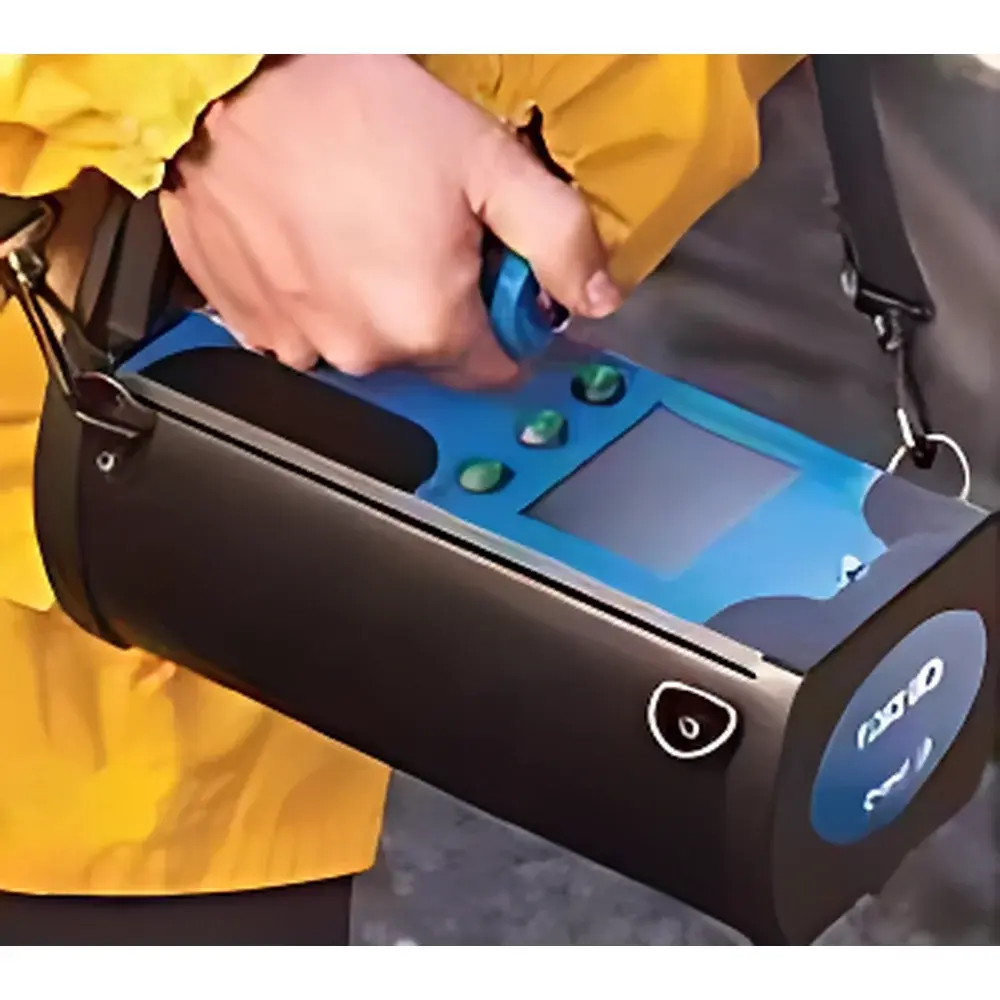
Handheld Radionuclide Identification Device rad-ID
| Origin | USA |
|---|---|
| Manufacturer Type | Distributor |
| Origin Category | Imported |
| Model | rad-ID |
| Pricing | Upon Request |
| Detector Types | CZT scintillator, NaI(Tl) scintillator, GM tube, He-3 tube |
| Display | High-resolution LCD |
| Data Transmission | Bluetooth |
| Response Time | <1 s |
Overview
The rad-ID is a field-deployable handheld radionuclide identification device engineered for rapid radiological emergency response, environmental surveying, and first-responder operations. It operates on the principle of gamma-ray and neutron spectroscopy—leveraging multi-detector coincidence and spectral deconvolution algorithms to perform real-time nuclide identification, activity estimation, and dose rate assessment. Unlike single-sensor radiation survey meters, the rad-ID integrates four complementary detection technologies—CZT (cadmium zinc telluride) for high-resolution gamma spectroscopy, NaI(Tl) for high-efficiency gamma detection, a Geiger-Müller (GM) tube for broad-range beta/gamma gross counting, and a helium-3 (He-3) proportional counter for thermal neutron detection. This hybrid architecture enables simultaneous acquisition of energy-dispersive spectra and count-rate data across multiple radiation modalities, ensuring reliable performance even in mixed-field environments with elevated ambient dose rates (>100 mSv/h). Its compact form factor, ruggedized IP67-rated enclosure, and battery-operated design support continuous operation for >8 hours under typical field conditions.
Key Features
- Multi-sensor fusion architecture: Concurrent operation of CZT, NaI(Tl), GM, and He-3 detectors enables cross-validated identification and reduces false-positive rates in complex radiation fields.
- Real-time nuclide identification: Onboard spectral analysis engine applies library-matching algorithms against an embedded nuclear reference library compliant with IAEA RS-G-1.9 and ANSI N42.34 standards.
- Dose rate measurement under high-field conditions: Compensated GM and NaI(Tl) channels maintain linearity and accuracy up to 1 Sv/h without saturation or dead-time distortion.
- Sub-second response latency: End-to-end signal processing—from photon interaction to display update—is completed in <1 second, critical for dynamic threat assessment during mobile surveys.
- High-resolution graphical LCD: Sunlight-readable 3.5-inch TFT display with touch-enabled interface supports intuitive navigation through spectra, isotope tables, and dose history logs.
- Wireless data telemetry: Bluetooth 5.0 module enables secure, low-latency transmission of spectral files (.cnf), dose reports, and GPS-tagged location metadata to command-center software or mobile tablets.
Sample Compatibility & Compliance
The rad-ID is designed for direct measurement of gamma-emitting radionuclides (e.g., 137Cs, 60Co, 131I, 241Am) and thermal neutrons from fissile or (α,n) sources (e.g., 235U, 239Pu, 252Cf). It does not require sample preparation or shielding—measurements are performed in situ on surfaces, air, or bulk materials. The instrument complies with IEC 62327:2017 (handheld radioisotope identifiers), meets MIL-STD-810G for shock/vibration resistance, and conforms to FCC Part 15 and CE RED directives. Firmware supports audit-trail logging per GLP/GMP requirements, with optional time-stamped, user-authenticated event records suitable for regulatory reporting.
Software & Data Management
The rad-ID interfaces with the rad-ID Desktop Suite—a Windows-based application supporting spectral calibration, library updates, report generation (PDF/CSV), and multi-instrument fleet management. All spectral data are stored in industry-standard .cnf format (ANSI N42.42-compliant), enabling interoperability with third-party analysis tools such as Genie 2000 or GammaVision. Bluetooth pairing supports encrypted session keys and role-based access control; data export includes full metadata (GPS coordinates, UTC timestamp, detector configuration, operator ID). Optional firmware upgrade path includes FDA 21 CFR Part 11–compliant electronic signature modules for regulated environments.
Applications
- First-response radiological incident assessment—including RDD (dirty bomb), lost source recovery, and transportation accidents.
- Environmental monitoring of legacy sites, nuclear facilities, and waste repositories per EPA Method 901.1 and ISO 11929.
- Border security and customs screening for illicit nuclear materials, consistent with IAEA Nuclear Security Series No. 11-T.
- Decommissioning and D&D (decontamination & decommissioning) support, including hot-spot mapping and clearance verification.
- Academic and training use in health physics laboratories where hands-on gamma/neutron spectroscopy education is required.
FAQ
Does the rad-ID require annual factory recalibration?
No—its CZT and NaI(Tl) detectors are factory-calibrated with traceable NIST sources; however, users are advised to perform daily check-source verification using 137Cs or 60Co before deployment.
Can it distinguish between medical isotopes and weapons-grade material?
Yes—its high-resolution CZT channel resolves closely spaced gamma peaks (e.g., 235U at 185.7 keV vs. 201Tl at 167.4 keV), and the He-3 neutron channel provides confirmatory fission-signature detection.
Is GPS integration standard or optional?
Integrated GPS is standard and synchronized with every spectrum acquisition; positional accuracy is ≤3 m CEP with SBAS augmentation.
What is the minimum detectable activity (MDA) for 137Cs at 1 meter?
Under typical background conditions (0.1 µSv/h), MDA is 3.7 kBq (0.1 µCi) at 1 m for a 10-second measurement—per ANSI N42.33 methodology.
Is the device compatible with existing emergency response communication protocols?
Yes—it supports NATO APP-6D symbol overlay export and can transmit alarm-triggered alerts via Bluetooth to TETRA or P25 radio gateways using standardized XML-RPC payloads.







