
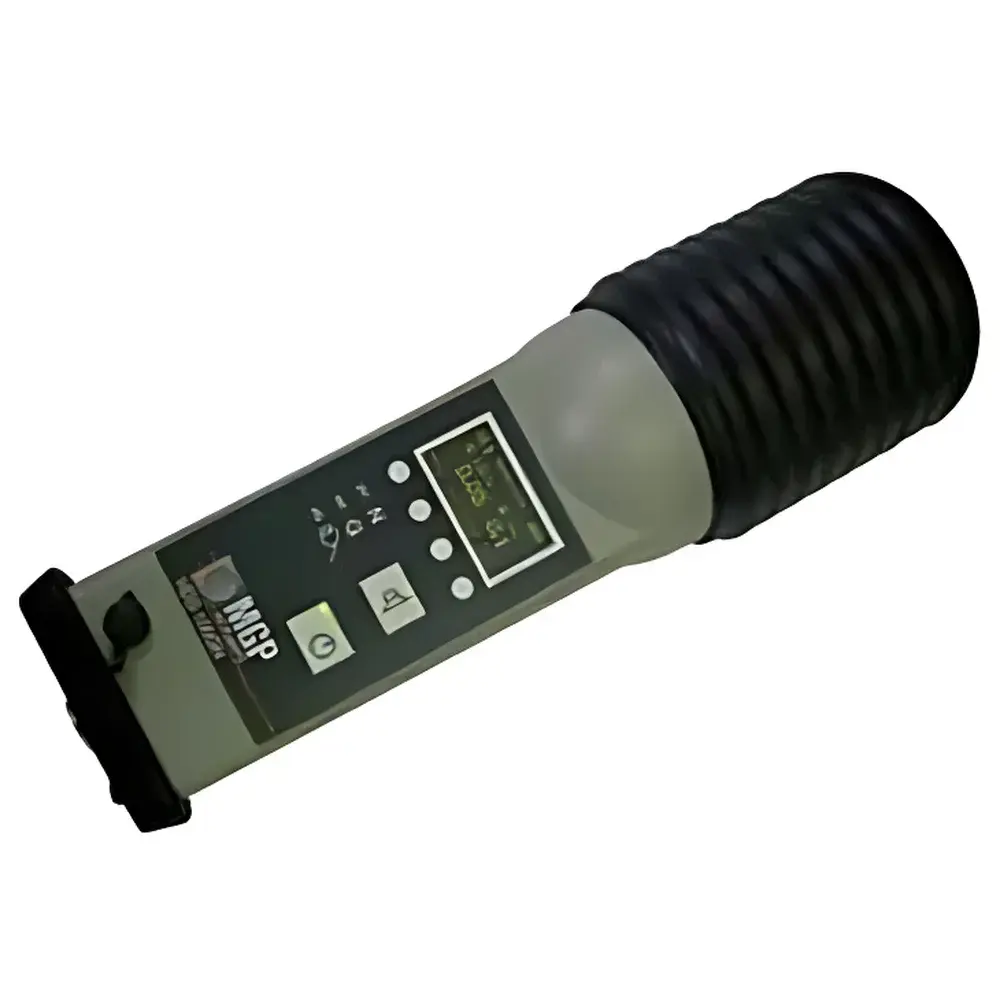
MGP HDS-100G/GN Portable Radionuclide Identification Device (RID)
| Origin | France |
|---|---|
| Manufacturer Type | Authorized Distributor |
| Origin Category | Imported |
| Model | HDS-100G / HDS-100GN |
| Instrument Type | Radiation Survey Meter & Nuclide Identifier |
| Detector | CsI(Tl) scintillator (γ), LiI(Eu) scintillator (neutron, GN version) |
| γ Energy Range | 30 keV – 3 MeV |
| Neutron Energy Range | 0.025 eV – 15 MeV |
| γ Dose Rate Range | 0.01 µSv/h – 10 mSv/h |
| Operating Modes | Search, Detection, Spectrum Acquisition |
| Alarm | Independent γ and neutron visual/audible alerts |
| Data Logging | >1,000 event-stamped records |
| Standards Compliance | ANSI N42.33-2021, IEC 62401:2022, IAEA TECDOC-1369 |
| Power | 6 × AA alkaline or Ni-MH rechargeable batteries |
| Battery Life | >24 h continuous operation |
| Dimensions | Ø78 mm × 280 mm |
| Weight | 1.5 kg (with batteries) |
| Operating Temperature | −20 °C to +50 °C |
| Environmental Rating | IP65 |
| EMI/EMC | MIL-STD-461G compliant |
| Mechanical Robustness | Drop-tested per IEC 60068-2-32 (1.2 m onto concrete) |
| Certifications | CE Marked (2014/30/EU, 2014/53/EU, 2011/65/EU) |
Overview
The MGP HDS-100G and HDS-100GN are field-deployable radionuclide identification devices engineered for rapid, reliable detection and isotopic characterization of gamma-emitting and neutron-emitting radioactive materials in operational environments where speed, accuracy, and operator safety are critical. Based on scintillation spectroscopy principles, the HDS-100G employs a thallium-doped cesium iodide [CsI(Tl)] detector optimized for high-resolution gamma-ray energy discrimination across 30 keV–3 MeV, while the HDS-100GN variant integrates an europium-doped lithium iodide [LiI(Eu)] thermal-to-fast neutron detector sensitive from 0.025 eV to 15 MeV—enabling dual-mode threat assessment without cross-channel interference. The instrument operates under the fundamental principle of pulse-height analysis: incident radiation generates light pulses proportional to deposited energy, which are digitized and processed using real-time multichannel scaling and library-matched spectral deconvolution algorithms. Designed for first-response scenarios—including radiological dispersal device (RDD) incidents, illicit nuclear material interdiction, and post-accident environmental surveys—the HDS-100 series delivers quantitative dose rate measurement (0.01 µSv/h–10 mSv/h), nuclide-specific identification (including SNM indicators such as 235U, 239Pu, and 60Co), and activity estimation—all within a single handheld platform meeting international technical requirements for nuclear security instrumentation.
Key Features
- Dual independent detection channels: Simultaneous, non-interfering gamma and neutron sensing with dedicated alarm indicators and energy calibration routines
- Automated natural background rejection: Embedded spectral filtering algorithms suppress false positives from ubiquitous 40K, 232Th, and 238U decay chain nuclides, as well as common medical isotopes (99mTc, 18F, 131I)
- Intuitive human-centered interface: Icon-driven menu navigation, context-sensitive prompts, and voice-guided operation requiring no prior radiological training
- Real-time spectral acquisition and library matching: Preloaded nuclide library with >120 isotopes; customizable user-defined libraries supported via PC software
- Robust mechanical and environmental design: IP65-rated enclosure; certified resistance to electromagnetic interference (MIL-STD-461G), mechanical shock (IEC 60068-2-27), and free-fall impact (1.2 m onto concrete)
- Secure wireless data exchange: Bluetooth 5.0 interface compliant with IEEE 802.15.1 for encrypted telemetry transmission to command tablets or central monitoring systems
Sample Compatibility & Compliance
The HDS-100G/GN is validated for direct measurement of unshielded and lightly shielded radioactive sources in air, soil, water surfaces, cargo containers, and urban infrastructure. It does not require sample preparation or laboratory preprocessing—measurements are performed in situ with minimal proximity constraints. Regulatory compliance is embedded at the architecture level: firmware and data handling routines conform to ANSI N42.33-2021 (Performance Criteria for Handheld Instruments for the Detection and Identification of Radionuclides) and IEC 62401:2022 (Radiation Protection Instrumentation — Spectrometry-Based Portable Instruments for Detection and Identification of Radionuclides). The device satisfies IAEA Nuclear Security Series No. 11 (Technical Guidance on Detection of Radioactive Material at Borders) and supports audit-ready documentation per ISO/IEC 17025:2017 clause 7.7 (Reporting of Results). All spectral logs include timestamp, GPS coordinates (when enabled), detector temperature, battery voltage, and calibration verification status—ensuring traceability required under national nuclear regulatory frameworks.
Software & Data Management
Data acquisition, analysis, and reporting are managed through the optional HDS Desktop Suite—a Windows-based application supporting spectral review, nuclide quantification, dose rate trend plotting, and export to CSV, XML, or IAEA-compliant RADIS format. The suite implements full audit trail functionality aligned with FDA 21 CFR Part 11 requirements: electronic signatures, role-based access control, and immutable record retention. Firmware updates are digitally signed and verified during installation. Field-collected spectra are automatically tagged with geolocation metadata (via integrated GNSS module), environmental sensor readings (temperature, pressure), and operator ID—facilitating integration into centralized CBRN command-and-control platforms such as NATO’s J-CBRN Defence COE standards or EU’s ECURIE notification system.
Applications
- First responder radiological emergency assessment (e.g., dirty bomb detection, lost source recovery)
- Border and customs radiation screening at ports of entry, airports, and land checkpoints
- On-site verification of nuclear facility perimeter security and spent fuel transport monitoring
- Environmental baseline surveys and post-incident contamination mapping
- Training and proficiency testing for civil defense, military CBRN units, and nuclear regulatory inspectors
- Support of IAEA safeguards inspections and peer-review missions under INFCIRC/153
FAQ
Does the HDS-100GN require periodic neutron source calibration?
No. The LiI(Eu) detector is factory-calibrated using 252Cf and Am-Be reference sources; field recalibration is not required under normal operating conditions. A built-in check source verifies detector stability before each use.
Can spectral data be exported for third-party analysis in GammaVision or Genie 2000?
Yes. Raw .SPE files and processed .CSV exports are fully compatible with ORTEC GammaVision v9+, Canberra Genie 2000 v5.2+, and open-source tools such as PyMCA and RadWare.
Is the device suitable for underwater or submerged deployment?
No. While IP65-rated for dust and low-pressure water jets, it is not submersible. For aquatic applications, MGP offers the HDS-Aqua accessory housing rated to 10 m depth.
How is firmware integrity ensured during over-the-air updates?
All firmware packages are cryptographically signed using RSA-2048 keys; the device validates signature authenticity and hash consistency prior to flash programming.
What is the minimum detectable activity (MDA) for 137Cs at 1 meter in search mode?
Under typical background conditions (0.1 µSv/h), MDA is ≤3.7 kBq (0.1 µCi) for a 10-second dwell time, per ANSI N42.33 Annex B test methodology.
Related Products







