
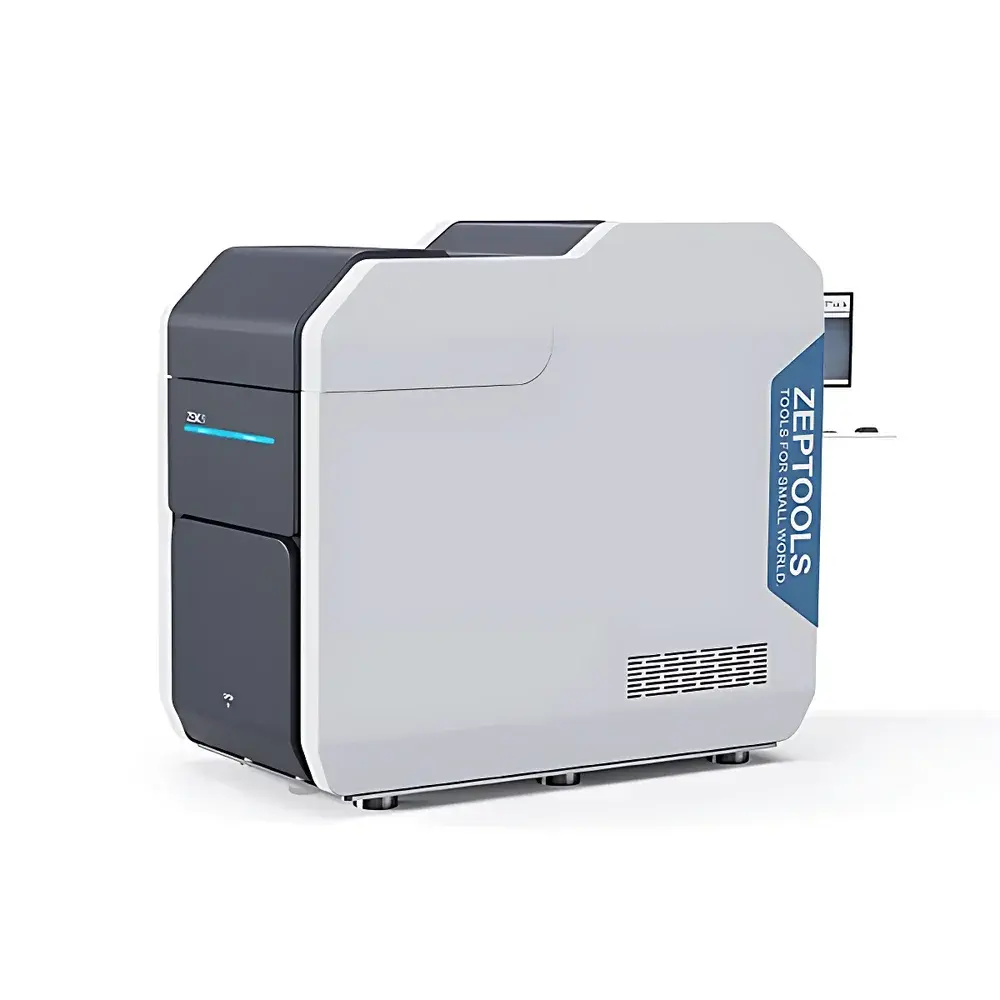
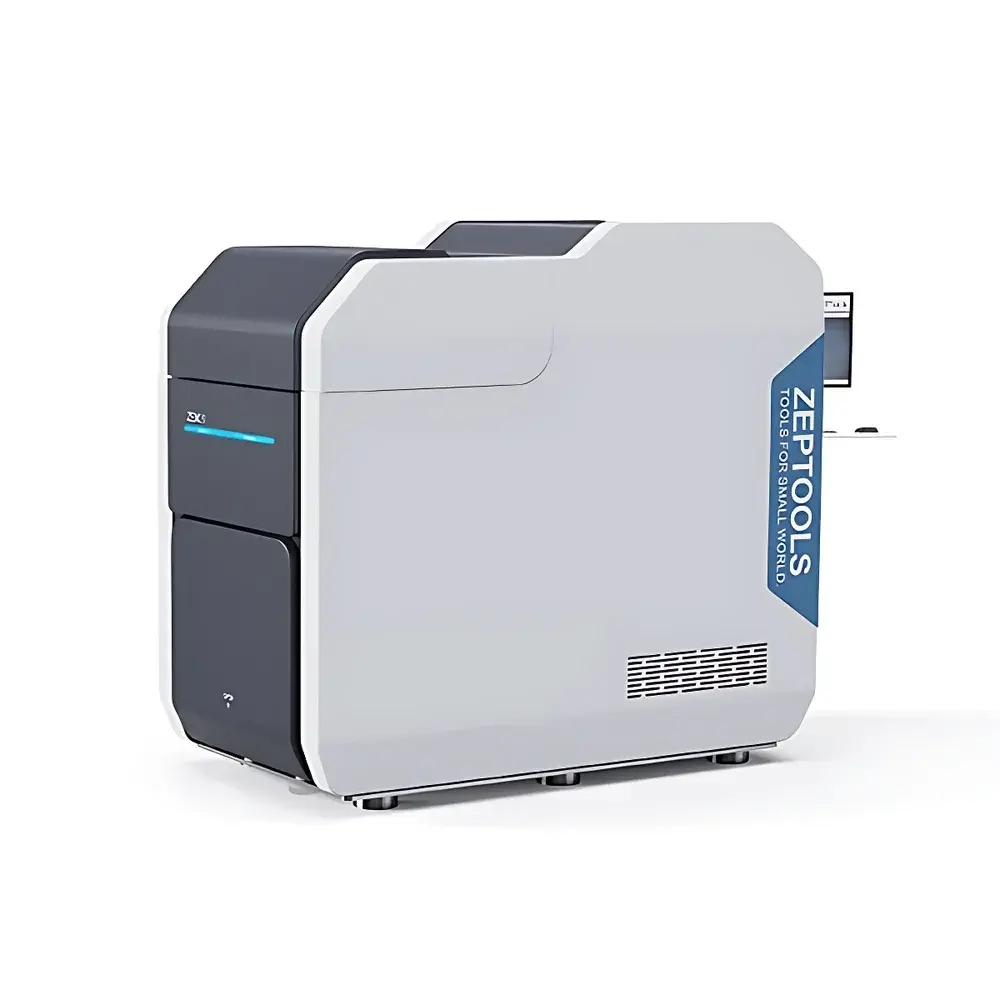
ZEPTOOLS ZEM20 Desktop Scanning Electron Microscope
| Brand | ZEPTOOLS |
|---|---|
| Origin | Anhui, China |
| Model | ZEM20 |
| Instrument Type | Desktop SEM |
| Electron Source | Pre-aligned Tungsten Filament |
| Maximum Accelerating Voltage | 20 kV |
| Resolution | <4 nm @ 20 kV |
| Maximum Magnification | 360,000× |
| Stage Options | 3-axis Standard / 5-axis Optional |
| Detector System | Standard BSE & SE Detectors |
| Vacuum Modes | High Vacuum / Low Vacuum (1–60 Pa, optional) |
| Sample Exchange Time | <60 s (typical 30 s) |
| Navigation | Integrated Optical Navigation Camera + In-Chamber HD Camera |
| Optional Add-ons | Beam Deceleration Mode, EDS Integration, In-situ Heating/Cooling/Electrical/Mechanical/Liquid/Gas Stages |
Overview
The ZEPTOOLS ZEM20 Desktop Scanning Electron Microscope is an engineered solution for high-resolution microstructural characterization in space-constrained and resource-sensitive laboratory environments. Operating on the principle of scanning electron–sample interaction, the ZEM20 generates high-fidelity secondary electron (SE) and backscattered electron (BSE) signals under a focused electron beam, enabling topographic, compositional, and crystallographic contrast imaging at sub-5 nm resolution. Its field-emission–compatible architecture—built around a pre-aligned tungsten thermionic source—delivers stable beam current and reproducible imaging performance without requiring ultra-high vacuum infrastructure or cryogenic cooling. Designed for routine use in academic core facilities, industrial QC labs, and pilot-scale R&D centers, the ZEM20 bridges the capability gap between benchtop accessibility and analytical rigor traditionally reserved for floor-standing systems.
Key Features
- Vacuum Segregation Architecture: Independent vacuum chambers for electron gun and specimen chamber enable rapid sample exchange (<60 s, typically ~30 s) without venting the entire column—critical for high-throughput workflows and multi-sample comparative studies.
- Optimized Imaging Performance: Achieves ≤4 nm resolution at 20 kV accelerating voltage with 360,000× maximum magnification, supporting nanoscale feature identification in ceramics, thin films, battery electrodes, and polymeric composites.
- Intuitive Dual-Navigation System: Combines an external optical macro-navigation camera with an in-chamber HD camera, allowing precise region-of-interest targeting and real-time monitoring during in-situ experiments.
- Flexible Vacuum Operation: Supports both high-vacuum mode (for conductive or metallized samples) and low-vacuum mode (1–60 Pa, optional), reducing charging artifacts on insulating or hydrated specimens without mandatory sputter coating.
- Beam Deceleration Option: Enables landing energy reduction while maintaining high incident beam energy—improving surface sensitivity and minimizing subsurface damage for delicate biological or soft-material samples.
Sample Compatibility & Compliance
The ZEM20 accommodates specimens up to Ø100 mm × 50 mm (height) in its enlarged chamber, compatible with standard SEM stubs, TEM grids, wafers, and custom-mount fixtures. Its low-vacuum and beam deceleration capabilities extend usability to non-conductive, beam-sensitive, or semi-hydrated samples—including polymers, pharmaceutical powders, plant tissues, and uncoated geological sections. The system supports compliance with ASTM E1558 (standard guide for SEM specimen preparation), ISO/IEC 17025 documentation requirements for measurement uncertainty reporting, and GLP-aligned audit trails when integrated with validated software modules. All vacuum components meet ISO 2859-1 sampling standards for leak integrity verification.
Software & Data Management
The proprietary ZEM-OS platform provides unified control across acquisition, annotation, measurement, and export. It includes calibrated scale bars, particle analysis (size, shape, distribution), EDS spectral overlay (when equipped), and batch-mode image acquisition with time-stamped metadata. Data files are saved in TIFF-based, vendor-neutral formats compliant with MIAME and FAIR principles. Software logs all parameter changes, user actions, and instrument status events—supporting 21 CFR Part 11–compliant electronic records when deployed with role-based access control and digital signature modules. Export options include CSV, HDF5, and OME-TIFF for interoperability with ImageJ/Fiji, MATLAB, and Python-based analysis pipelines.
Applications
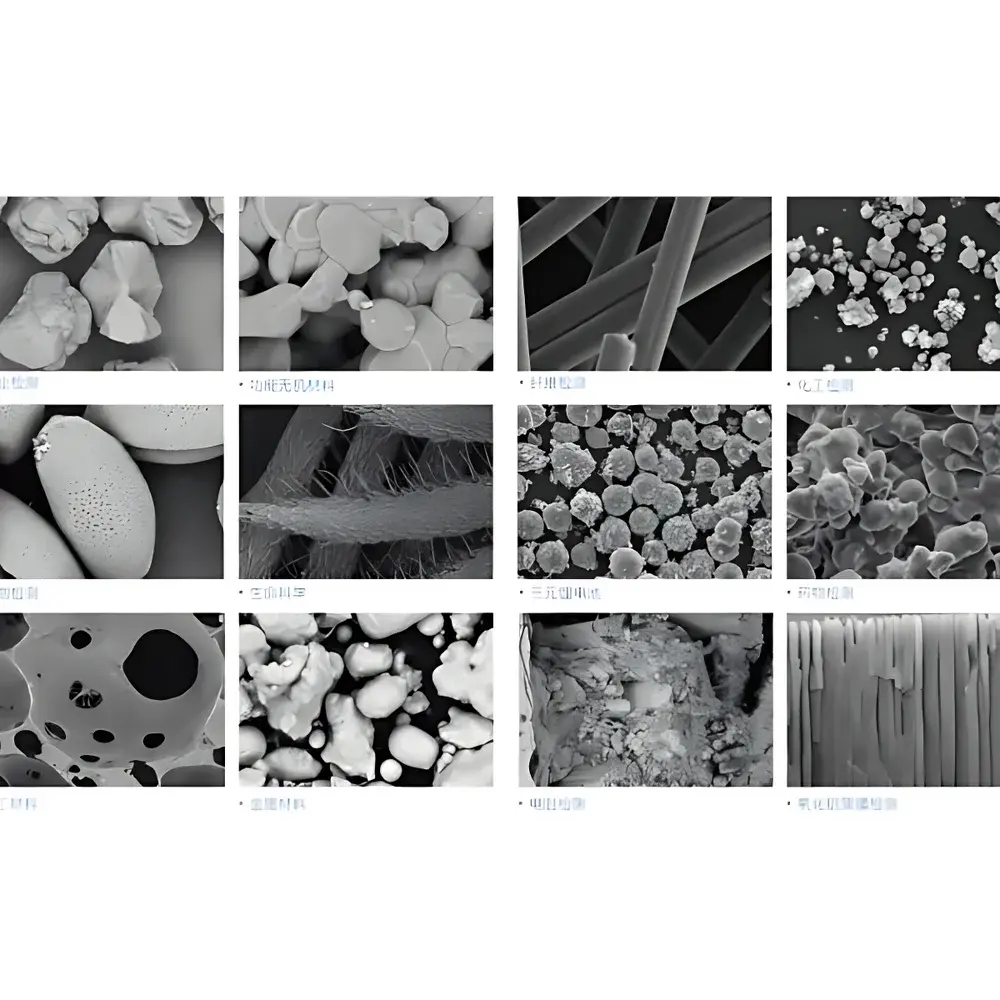
The ZEM20 serves as a primary imaging tool across disciplines requiring nanoscale morphological validation: materials science (grain boundary analysis in sintered oxides, pore network quantification in MOFs), semiconductor process control (via trench profile inspection and defect mapping), battery research (cathode cracking, SEI layer thickness estimation), life sciences (cell membrane topology, nanoparticle internalization), and geoscience (clay mineral stacking, fossil microstructure). Its modular design enables seamless integration with in-situ stages—including heating (up to 1000 °C), cooling (LN₂ or Peltier), electrochemical liquid cells, gas reaction chambers, mechanical tensile rigs, and electrical probe stations—enabling dynamic observation of structural evolution under operational conditions.
FAQ
What is the minimum required lab footprint for the ZEM20?
The system occupies less than 0.8 m² floor space and operates on standard 230 V / 50 Hz single-phase power; no external water chiller or compressed air supply is needed.
Can the ZEM20 be used for EDS elemental analysis?
Yes—when configured with an optional silicon drift detector (SDD) and spectrometer, it supports qualitative and semi-quantitative elemental mapping with spatial resolution aligned to the SE/BSE imaging plane.
Is remote operation supported?
The ZEM-OS platform includes secure TLS-encrypted remote desktop access and scheduled acquisition protocols, enabling unattended overnight runs and cross-site collaboration.
How is calibration traceability maintained?
Each instrument ships with NIST-traceable grating standards and automated calibration routines for magnification, brightness/contrast, and stage positioning—records archived per ISO/IEC 17025 requirements.
What training and service support is available internationally?
ZEPTOOLS provides on-site installation, operator certification, and annual preventive maintenance contracts through authorized regional partners; software updates and firmware patches are delivered via encrypted OTA channels.




