
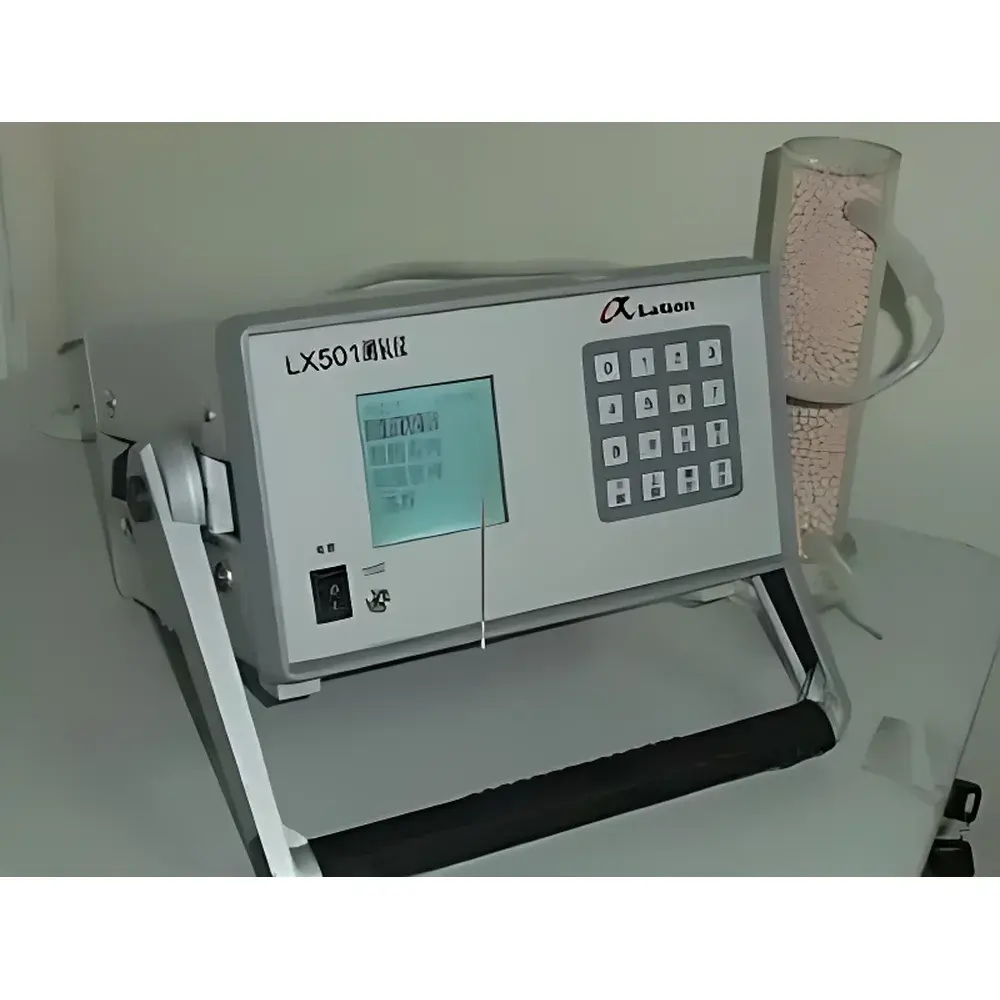
LX501 Radon Detector by Beijing-based Manufacturer
| Origin | Beijing, China |
|---|---|
| Manufacturer Type | Authorized Distributor |
| Origin Category | Domestic (China) |
| Model | LX501 |
| Pricing | Available Upon Request |
| Power Supply | 220 VAC / 12.6 VDC, 1 A adapter |
| Battery | 12 V / 3 Ah rechargeable Li-ion (up to 23 h continuous operation) |
| Detector | Φ30 mm Passivated Implanted Planar Silicon (PIPS) semiconductor detector |
| Display | 160 × 160 dot-matrix LCD with white backlight |
| Radon Concentration Range | 0–99,999 Bq·m⁻³ |
| Surface Exhalation Rate Range | 0.01–10,000 mBq·m⁻²·s⁻¹ |
| Measurement Uncertainty | ≤5% (at radon concentrations ≥200 Bq·m⁻³) |
| Sensitivity | 55 cpm per Bq·m⁻³ |
| Sampling Interval Options | 15 min or 60 min |
| Data Interface | RS-232 (9-pin D-sub), compatible with thermal microprinters |
| Memory | EEPROM non-volatile storage |
| Operating Environment | 0–40 °C, 0–90% RH (non-condensing) |
| Dimensions & Weight | 250 × 140 × 270 mm (W×H×D), 4.0 kg |
Overview
The LX501 Radon Detector is a field-deployable, alpha-spectrometric instrument engineered for quantitative measurement of Rn-222 activity concentration in ambient air, soil gas, water (via emanation extraction), and surface exhalation rates from building materials or geological substrates. It operates on the principle of electrostatic collection followed by alpha-particle spectroscopy using a passivated implanted planar silicon (PIPS) detector—a technology offering high energy resolution, low background noise, and excellent discrimination against interfering isotopes such as Po-218 and Po-214. Unlike passive diffusion-based charcoal canisters or track-etch detectors, the LX501 enables real-time, time-resolved monitoring with programmable sampling intervals, supporting both short-term diagnostics and long-term trend analysis required for regulatory compliance, indoor air quality (IAQ) assessment, and geophysical surveying.
Key Features
- High-resolution PIPS detector (Φ30 mm active area) optimized for alpha detection in the 5.49–7.69 MeV range, ensuring accurate identification and quantification of Rn-222 decay progeny.
- Dual-mode operational flexibility: continuous air sampling via integrated pump (flow rate calibrated to ISO 11665-2:2019 requirements) and sealed-chamber mode for soil gas or water emanation analysis.
- Configurable sampling cycles (15 min or 60 min) with automatic spectral acquisition, peak fitting, and background subtraction—enabling robust data integrity under variable environmental conditions.
- Onboard 160×160 pixel monochrome LCD with adjustable white backlight for legible field viewing; intuitive menu navigation supports multilingual UI (English default).
- Embedded EEPROM provides secure, non-volatile storage of up to 1,000 measurement records—including timestamp, raw spectrum, calculated concentration, exhalation rate, and environmental parameters (T/HR if external sensors connected).
- RS-232 serial interface compliant with EIA/TIA-232-F standards, enabling direct connection to portable thermal printers or host PCs for offline spectral review and QA/QC validation.
Sample Compatibility & Compliance
The LX501 accommodates diverse sampling matrices per internationally recognized protocols: ambient air (ISO 11665-1:2021), soil gas (ASTM D6222-20), water (via RAD7-style radon-in-water accessory or custom diffusion chamber), and surface exhalation (ISO 11665-3:2019). Its measurement uncertainty (≤5% at ≥200 Bq·m⁻³) meets the performance criteria specified in IAEA Technical Reports Series No. 472 and EU Council Directive 2013/59/Euratom Annex VIII. The instrument’s design supports GLP-compliant workflows, including user-accessible calibration log history, detector bias voltage monitoring, and firmware version traceability—critical for audit readiness in public health laboratories and environmental consultancies.
Software & Data Management
Data export is supported via ASCII-formatted RS-232 output, compatible with common spreadsheet and statistical analysis tools (e.g., Excel, R, Python pandas). While no proprietary software is bundled, the LX501 adheres to open communication protocols, allowing integration into enterprise LIMS platforms via serial-to-IP gateways. All stored spectra retain full energy-channel resolution (1024 channels), permitting retrospective reanalysis using validated spectral deconvolution algorithms. Audit trails—including operator ID input, calibration date stamps, and detector health metrics—are retained in EEPROM and exportable upon request, satisfying documentation requirements under ISO/IEC 17025:2017 Clause 7.7.
Applications
- Indoor radon screening in residential, educational, and healthcare facilities per national reference levels (e.g., US EPA 148 Bq·m⁻³ action level; WHO 100 Bq·m⁻³ guideline).
- Geological radon mapping for uranium prospecting, fault-line characterization, and volcanic activity monitoring.
- Building material certification (e.g., granite, concrete, phosphogypsum) via surface exhalation rate determination per GB 6566–2010 or EN 12885:2005.
- Validation of radon mitigation system efficacy before and after installation (e.g., sub-slab depressurization, HVAC filtration).
- Research-grade studies on radon progeny equilibrium ratios, aerosol attachment kinetics, and diurnal/seasonal variability in uncontrolled environments.
FAQ
What calibration standards are recommended for routine verification?
NIST-traceable 226Ra sources or certified radon reference chambers (e.g., PTB Braunschweig or NPL UK) are advised for annual full-spectrum calibration; daily zero checks using filtered air are performed automatically.
Is the LX501 suitable for outdoor deployment in high-humidity environments?
Yes—the instrument is rated for 0–90% RH (non-condensing); however, extended exposure above 80% RH requires periodic desiccant replacement in the inlet filter housing to prevent moisture-induced spectral degradation.
Can the detector be recalibrated in the field?
No—detector gain and energy calibration are factory-set and locked; only user-accessible parameters include sampling interval, display contrast, and alarm thresholds.
Does the LX501 comply with FDA 21 CFR Part 11 requirements?
It does not include electronic signature or audit trail modules required for Part 11; however, its EEPROM-stored metadata and time-stamped records support manual verification workflows aligned with GxP principles.
What maintenance is required beyond battery charging?
Annual inspection of the PIPS detector window integrity, inlet filter replacement, and verification of pump flow rate against ISO 11665-2 Annex C are recommended; no consumables other than filters are required.
Related Products







