
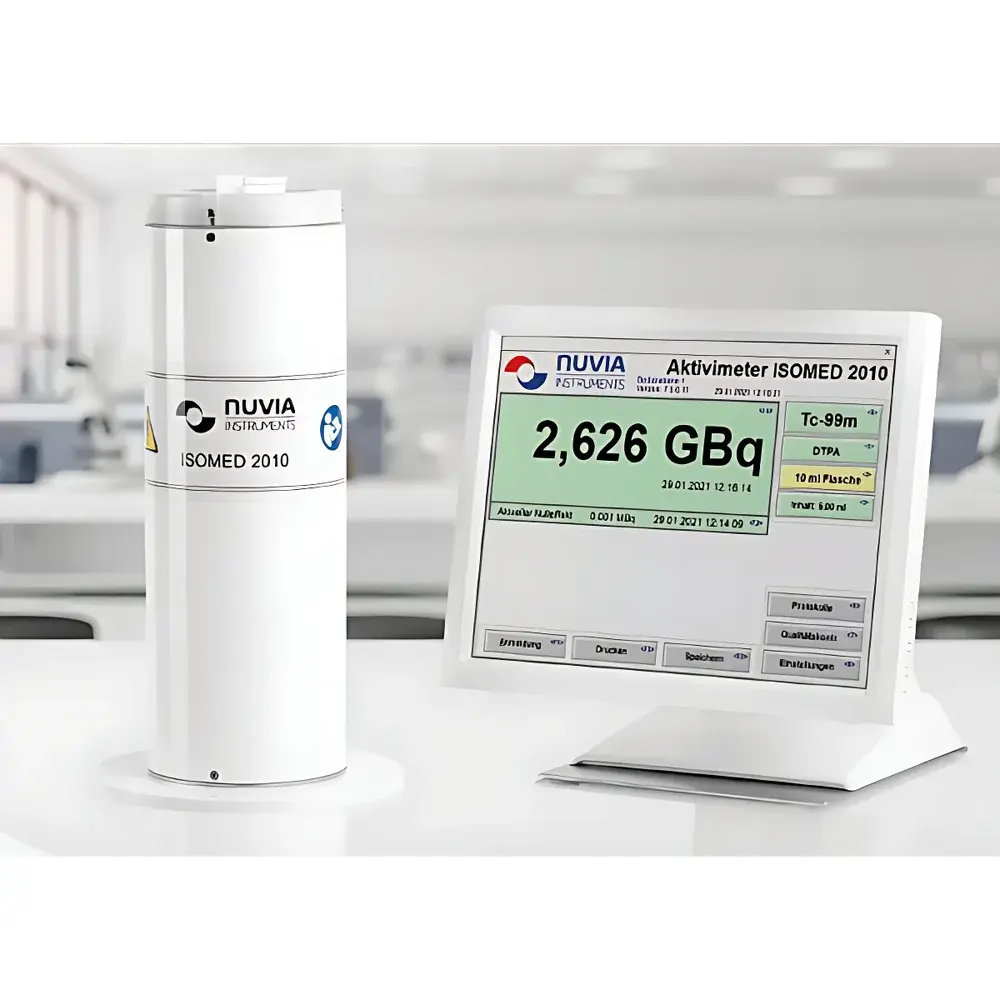
Nuvia ISOMED 2010 Laboratory Radionuclide Activity Meter (Ionization Chamber-Based)
| Brand | Nuvia |
|---|---|
| Origin | Germany |
| Manufacturer Type | Authorized Distributor |
| Origin Category | Imported |
| Model | ISOMED 2010 |
| Instrument Type | Laboratory Activity Meter (Dose Calibrator) |
| Measured Medium | Gaseous Radionuclides |
| Detector Type | Pressurized Ionization Chamber |
| Energy Range | 25 keV – 3 MeV |
| Application Focus | Nuclear Medicine, Radiopharmaceutical Quality Control, Radioisotope Production Facilities |
Overview
The Nuvia ISOMED 2010 is a precision laboratory-grade radionuclide activity meter engineered for quantitative measurement of radioactive gas-phase samples in nuclear medicine, radiopharmaceutical manufacturing, and radioisotope research environments. It operates on the fundamental principle of ionization chamber dosimetry: incident gamma and X-ray photons interact with the fill gas (typically argon or nitrogen at elevated pressure), generating ion pairs proportional to radiation energy deposition. The resulting current is converted into activity (Bq or Ci) using nuclide-specific calibration coefficients traceable to national metrology institutes (e.g., PTB, NIST). Unlike scintillation-based systems, the pressurized ionization chamber architecture provides exceptional long-term stability, linearity across wide activity ranges, and minimal energy dependence—critical for accurate quantification of short-lived therapeutic and diagnostic isotopes such as 177Lu, 99mTc, and 99Mo in gaseous or volatile forms (e.g., 133Xe, 85Kr, or aerosolized 99mTc-HMPAO).
Key Features
- Pressurized ionization chamber detector with active volume optimized for gaseous sample geometry and low-energy photon sensitivity down to 25 keV
- Automated internal reference source (e.g., 241Am or 133Ba) for routine system constancy verification; configurable recalibration interval with audible/visual alerts and timestamped audit trail
- Preloaded nuclide library covering >60 radionuclides relevant to nuclear medicine, including 177Lu, 99mTc, 99Mo, 18F, 131I, and 68Ga—with decay-corrected activity calculation and half-life compensation
- Container-specific correction factors embedded per vial type (e.g., glass vs. polymer), volume (1–50 mL), and chemical matrix (e.g., saline, DTPA, EDTA), minimizing geometry- and attenuation-related uncertainty
- Modular hardware platform supporting three configurations: Standard (for routine QC), Wide-Range (extended dynamic range up to 4 GBq), and Mini (compact footprint for glove-box integration)
Sample Compatibility & Compliance
The ISOMED 2010 is validated for direct measurement of sealed gaseous radionuclide sources and volatile radiopharmaceuticals in standard ISO-certified vials, syringes, and gas-tight sampling flasks. Its chamber geometry and wall composition comply with IEC 61675-1:2017 requirements for dose calibrators used in nuclear medicine. All calibration protocols adhere to ASTM D3648 (Standard Test Methods for Measurement of Radioactivity) and are compatible with GLP/GMP documentation workflows. Full traceability to PTB (Physikalisch-Technische Bundesanstalt) reference standards is maintained through factory-installed calibration certificates. The instrument meets electromagnetic compatibility (EMC) requirements per EN 61326-1 and safety standards per EN 61010-1.
Software & Data Management
Control and analysis software is built on Microsoft Windows 10/11 (64-bit) with native .NET Framework support, ensuring compatibility with modern hospital IT infrastructure and LIMS integration via HL7 or ASTM E1384 interfaces. Audit trails record all user actions—including calibration events, measurement parameters, operator ID, and timestamp—with write-protection enabled per FDA 21 CFR Part 11 requirements. Raw data export is supported in CSV, XML, and PDF formats; custom report templates can be configured for departmental QA documentation. Software architecture allows secure remote firmware updates and third-party API access for automated workflow orchestration in centralized radiopharmacy production lines.
Applications
- Final activity release testing of gaseous radiopharmaceuticals prior to patient administration (e.g., 133Xe ventilation studies)
- Quality control of generator-eluted 99mTc in volatile form or after labeling with gaseous precursors
- Decay-corrected yield assessment in cyclotron-produced 18F-FDG synthesis modules where residual carrier gas requires activity monitoring
- Leak testing and contamination screening of shielded gas-handling systems in hot cells and fume hoods
- Research applications involving positron-emitting noble gases (82Rb, 68Ga-gas complexes) requiring high-precision, low-background quantification
FAQ
Is the ISOMED 2010 suitable for measuring liquid radiopharmaceuticals?
No—it is specifically engineered and calibrated for gaseous and volatile radionuclide forms. Liquid measurements require dedicated vial-based configurations with different chamber geometries and attenuation corrections.
Does the system support automatic decay correction for multi-isotope mixtures?
Yes—software applies independent half-life decay algorithms per selected nuclide during sequential or simultaneous measurement modes, with user-defined start time and elapsed time inputs.
How frequently must the internal reference source be replaced?
The sealed reference source (typically 241Am, t1/2 = 432 years) is designed for the instrument’s operational lifetime; no replacement is required under normal use conditions.
Can the device be integrated into an automated radiopharmacy production line?
Yes—via Ethernet TCP/IP communication and programmable logic controller (PLC) interface, enabling trigger-based measurement, pass/fail feedback, and real-time data streaming to MES or SCADA systems.
What regulatory documentation is provided with delivery?
Each unit ships with a Factory Calibration Certificate (traceable to PTB), EU Declaration of Conformity (CE), IEC 61675-1 test report, and 21 CFR Part 11 compliance statement for electronic records and signatures.
Related Products







