
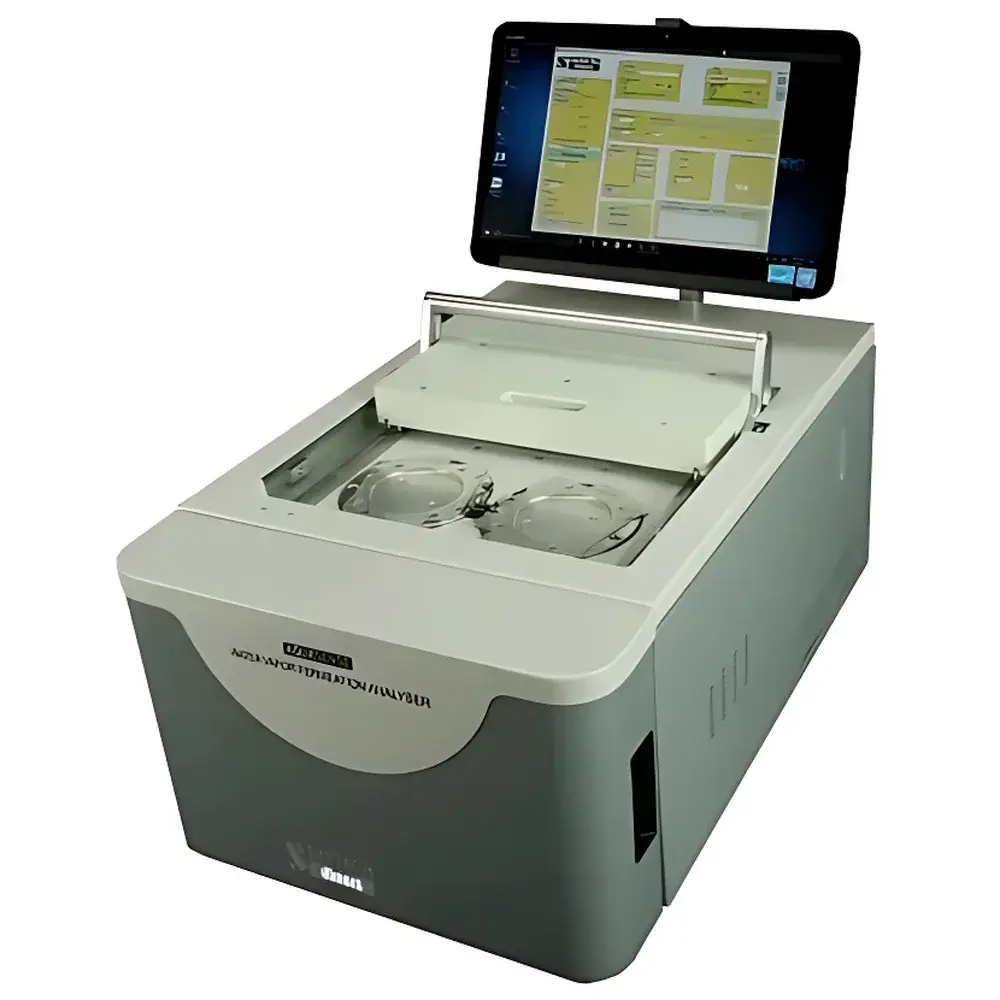
Systech Illinois AquaSense Model 7100 Water Vapor Transmission Rate Analyzer
| Brand | Systech |
|---|---|
| Origin | United Kingdom |
| Manufacturer Type | Authorized Distributor |
| Origin Category | Imported |
| Model | AquaSense Model 7100 |
| Pricing | Upon Request |
| Measurement Range (unmasked) | 0.002–70 g/m²/day |
| Measurement Range (masked) | 0.02–1000 g/m²/day |
| Temperature Range | 10–40 °C |
| Relative Humidity Range | 20–90 %RH |
| Sample Area | 50 cm² |
| Compliance | ASTM F3299-18, ISO 15105-2, ISO 15106-3, DIN 53122-2, GB/T 21529, YBB 00092003-2015 |
| Key Feature | Coulometric Sensor, TCM™ Test Condition Matrix, Q-Seal™ Sample Loading, Expandable to 32 Test Stations |
Overview
The Systech Illinois AquaSense Model 7100 is a precision-engineered water vapor transmission rate (WVTR) analyzer designed for high-reliability permeation testing of flexible packaging materials, pharmaceutical blister foils, barrier films, and laminates. It employs a coulometric detection principle—based on the quantitative electrolysis of water vapor transported across a test specimen—ensuring trace-level sensitivity, long-term stability, and intrinsic calibration independence. Unlike gravimetric or infrared-based systems, the coulometric sensor delivers direct, real-time measurement of water vapor flux without reliance on reference standards or periodic recalibration. The instrument is engineered for controlled-environment operation in ISO 17025-accredited laboratories and supports regulatory-compliant data integrity through hardware-synchronized environmental control and audit-ready software logging.
Key Features
- Coulometric sensor technology with inherent zero-drift stability and no routine calibration requirement
- Q-Seal™ sample loading system enabling rapid, leak-tight chamber sealing with minimal operator intervention
- Integrated environmental control delivering precise, independent regulation of temperature (10–40 °C ±0.1 °C) and relative humidity (20–90 %RH ±1 %RH)
- Test Condition Matrix (TCM™) functionality allowing sequential or concurrent evaluation of up to ten distinct temperature/humidity combinations within a single test cycle
- Modular architecture supporting expansion from a base configuration to up to 32 parallel test stations—enabling high-throughput screening while maintaining per-channel metrological independence
- 7-inch capacitive touchscreen interface with intuitive workflow navigation, real-time graphing, and on-device result review
Sample Compatibility & Compliance
The AquaSense Model 7100 accommodates standard circular specimens of 50 cm² area, compatible with common packaging substrates including PET/Alu/PE laminates, SiOx-coated PET, PVDC-coated films, aluminum foil composites, and pharmaceutical-grade cold-forming foils. All test protocols adhere to internationally recognized permeation standards: ASTM F3299-18 (standard practice for WVTR measurement using coulometric sensors), ISO 15105-2 (gas and vapor transmission—part 2: coulometric method), ISO 15106-3 (water vapor transmission—part 3: modulated infrared detection, used for cross-validation), DIN 53122-2 (German standard for water vapor permeability), as well as Chinese national standard GB/T 21529 and pharmaceutical packaging standard YBB 00092003-2015. Instrument validation documentation supports GLP and GMP environments, including IQ/OQ/PQ templates and 21 CFR Part 11-compliant electronic signature capability when paired with optional software modules.
Software & Data Management
The AquaSense Control Suite provides full instrument orchestration, method definition, and raw data export in CSV and PDF formats. Each test record includes timestamped environmental parameters, sensor response curves, calculated WVTR values with statistical uncertainty (n ≥ 3 replicates), and pass/fail status against user-defined specification limits. Audit trails capture all user actions—including method edits, result overrides, and calibration events—with immutable timestamps and operator IDs. Data files are structured to align with LIMS integration requirements and support automated report generation for internal quality reviews or regulatory submissions. Optional cloud-enabled remote monitoring allows secure access to instrument status and queued test progress via authenticated web interface.
Applications
This analyzer serves critical quality assurance functions across multiple regulated sectors. In pharmaceutical packaging development, it verifies moisture barrier performance of blister packs, sachets, and vial stoppers to ensure drug stability under accelerated aging conditions. For food packaging R&D, it quantifies shelf-life limiting factors in retort pouches, snack wrappers, and modified-atmosphere packaging films. In electronics encapsulation, it evaluates desiccant-integrated barriers for OLED displays and MEMS devices. Additionally, it supports sustainability initiatives by characterizing WVTR in bio-based and compostable films, enabling comparative life-cycle analysis of alternative packaging solutions.
FAQ
Does the coulometric sensor require periodic recalibration?
No—the sensor operates on a fundamental electrochemical principle; its output is intrinsically proportional to water vapor mole flux. Routine calibration is not required, though annual verification using NIST-traceable humidity generators is recommended for ISO 17025 compliance.
Can the instrument operate unattended overnight?
Yes—fully programmable test sequences, automatic shutdown after completion, and integrated fault detection (e.g., seal integrity monitoring, sensor saturation alerts) enable extended unattended operation.
Is method transfer possible between different AquaSense units?
Yes—identical hardware architecture, firmware versioning, and standardized test condition definitions ensure method equivalence across instruments, facilitating multi-site QC alignment.
What sample thickness limitations apply?
The Q-Seal™ system accommodates specimens up to 3 mm thick; however, optimal seal integrity is achieved with flat, rigid-to-semirigid materials. Foil-laminates and metallized films demonstrate best reproducibility.
How is data integrity ensured for FDA submission?
When configured with the 21 CFR Part 11 option, the system enforces role-based access control, electronic signatures, and tamper-evident audit logs—meeting ALCOA+ data governance principles for regulated submissions.




