
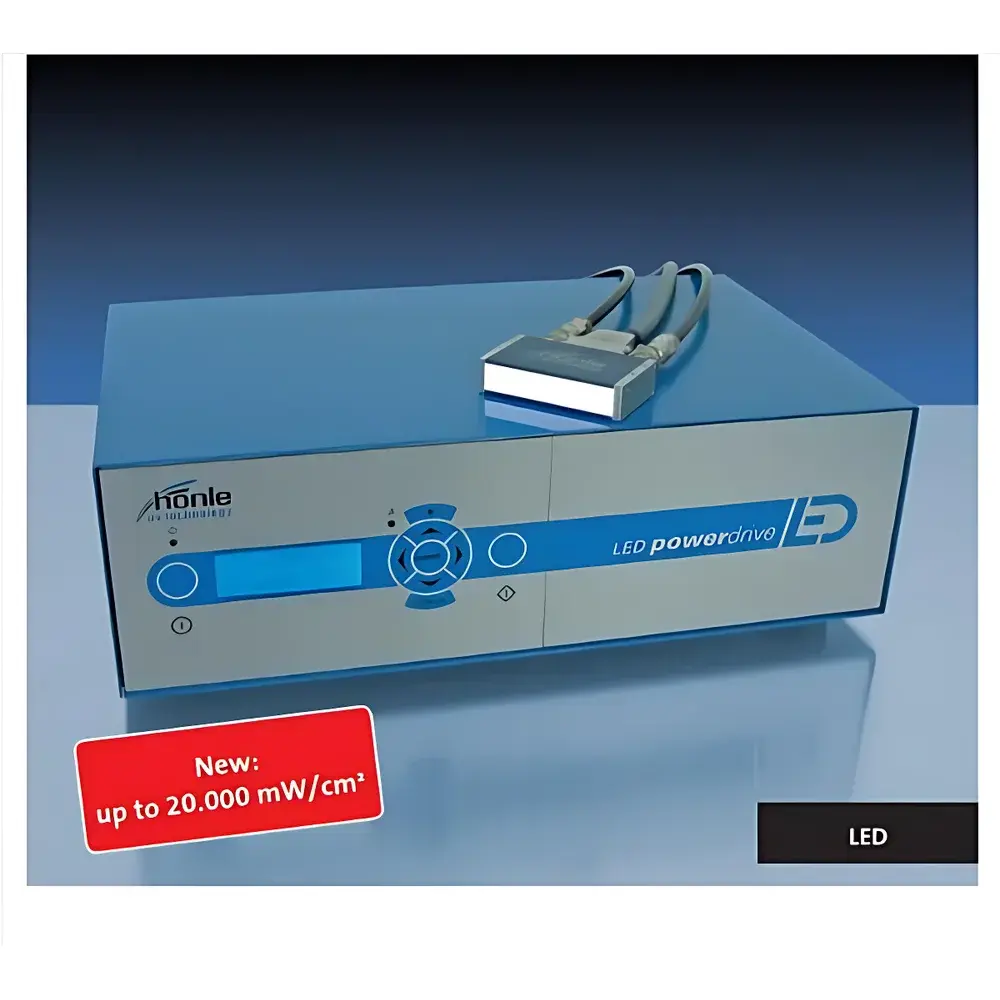
Hönle LED Powerline LC & LED Powerdrive Desktop Controller System
| Brand | Hönle |
|---|---|
| Origin | Germany |
| Product Type | LED UV Curing Power Supply and Drive Controller System |
| Model | LED Powerline LC & LED Powerdrive with Hönle Desktop Interface |
| Operating Modes | Timed (0.01–99.99 s / 0.1–999.9 s / 1–9999 s) or Continuous |
| Irradiance Control Range | 2–100% in 1% increments |
| Minimum Pulse Duration | 0.01 s |
| LED Segment Support | Powerline LC supports 2-segment LED modules (e.g., LED Powerline 80) |
| Real-time Monitoring | LED status, heatsink temperature, elapsed irradiation time, cumulative operating hours |
| Compliance | Designed for industrial UV curing integration per IEC 61000-6-2/6-4, CE-marked, RoHS-compliant |
Overview
The Hönle LED Powerline LC and LED Powerdrive Desktop Controller System is an engineered solution for precise, repeatable, and traceable UV-LED curing in packaging line environments. Unlike broad-spectrum mercury arc systems, this dual-controller platform delivers stable, narrow-band UV output (typically 365 nm, 385 nm, or 395 nm) via solid-state LED arrays, enabling energy-efficient, cold-cure processes essential for heat-sensitive substrates such as flexible films, laminated foils, and coated cardboard. The system operates on the principle of regulated constant-current drive with real-time thermal feedback—ensuring optical power stability despite ambient fluctuations or extended duty cycles. It is not a standalone lamp but a tightly integrated power management and timing interface designed exclusively for Hönle’s modular LED Powerline series, supporting both laboratory-scale validation and inline OEM integration.
Key Features
- High-resolution timing control: Selectable irradiation durations from 0.01 s to 9999 s across three ranges (0.01–99.99 s, 0.1–999.9 s, 1–9999 s), plus continuous mode for process development or pre-cure conditioning.
- Granular irradiance regulation: Output intensity adjustable in 1% increments from 2% to 100% of nominal LED power—enabling fine-tuned dose delivery without hardware reconfiguration.
- Dual-segment vs. triple-segment compatibility: LED Powerline LC controller interfaces with 2-segment LED modules (e.g., Powerline 80), while LED Powerdrive supports 3-segment configurations (e.g., Powerline 120), allowing scalable irradiation profiles across wider web widths or multi-zone applications.
- Embedded thermal intelligence: Integrated heatsink temperature monitoring with automatic current derating to maintain LED junction temperature within manufacturer-specified limits—preserving spectral output consistency and extending diode lifetime beyond 20,000 hours at rated power.
- Operational transparency: Backlit LCD display shows real-time LED status (ON/OFF/fault), heatsink temperature (°C), active irradiation timer, and total accumulated LED operating hours—critical for preventive maintenance scheduling and GLP-aligned logkeeping.
- Service diagnostics: Dedicated service menu provides firmware version, error history, calibration flags, and driver health indicators—facilitating rapid troubleshooting and audit-ready documentation.
Sample Compatibility & Compliance
This controller system is compatible only with Hönle-certified LED Powerline modules and requires mechanical and electrical alignment per Hönle’s mounting specifications (e.g., standardized M4 mounting holes, 24 V DC input, RS-485 Modbus RTU communication interface). It is intended for use with UV-curable inks, coatings, adhesives, and overprint varnishes compliant with ISO 12099:2017 (graphic technology — UV-curable materials) and ASTM D4459 (standard practice for xenon-arc exposure of plastics). The unit bears CE marking under the EU Machinery Directive 2006/42/EC and EMC Directive 2014/30/EU, and conforms to EN 61000-6-2 (immunity) and EN 61000-6-4 (emission) standards. While not FDA-cleared as a medical device, its design supports GMP-aligned manufacturing environments where electronic record integrity and operational traceability are required.
Software & Data Management
The desktop controller operates autonomously without PC dependency; however, optional Hönle UV-Link software (Windows-based) enables remote parameter configuration, batch logging of irradiation events, and export of CSV-formatted operation logs—including timestamp, setpoint, actual irradiance %, duration, and thermal deviation. All logged data includes immutable timestamps and can be configured to meet ALCOA+ principles (Attributable, Legible, Contemporaneous, Original, Accurate, Complete, Consistent, Enduring, Available) for regulated packaging QC workflows. Audit trail functionality—tracking user login, parameter changes, and system resets—is available when paired with UV-Link v3.2 or later, satisfying baseline requirements for 21 CFR Part 11 compliance in pharmaceutical packaging validation contexts.
Applications
- Flexographic and gravure printing: Precise spot-curing of UV inks on PET, OPP, and aluminum foil laminates without thermal distortion.
- Label converting: Edge-seal activation of pressure-sensitive adhesives and top-coat crosslinking on facestock materials.
- Blister packaging: Low-heat curing of UV lacquers on PVC/PVDC thermoformed cavities.
- R&D prototyping: Dose-response mapping for new photoinitiator systems using programmable pulse sequences and intensity gradients.
- OEM integration: Modular control architecture supports PLC-triggered start/stop via digital I/O or Modbus commands—enabling synchronization with conveyor speed, registration marks, or vision inspection systems.
FAQ
Can the LED Powerline LC controller operate the LED Powerline 120 module?
No. The LED Powerline LC is electrically and firmware-locked to 2-segment LED modules (e.g., Powerline 80). The LED Powerline 120 requires the dedicated LED Powerdrive controller due to higher current demand and segment addressing logic.
Is external cooling required for continuous operation?
Yes—continuous-mode operation at ≥80% output necessitates forced-air cooling per Hönle Technical Note TN-UV-LED-04. Ambient temperature must remain ≤25 °C, and heatsink surface temperature must not exceed 65 °C as monitored via the controller display.
Does the system support analog 0–10 V intensity control?
No. Intensity is digitally controlled via front-panel keypad or Modbus RTU commands. Analog input is not supported to ensure immunity from signal drift and EMI in industrial settings.
How is calibration maintained over time?
Hönle recommends annual verification using a NIST-traceable UV radiometer (e.g., International Light ILT2400 with SEL-UVF detector). The controller itself does not self-calibrate; calibration constants are stored in non-volatile memory and preserved during firmware updates.
What happens during a thermal fault event?
The controller immediately halts irradiation, displays “TEMP ERROR”, logs the event with timestamp, and locks output until manual reset—preventing uncontrolled LED degradation or spectral shift.





