
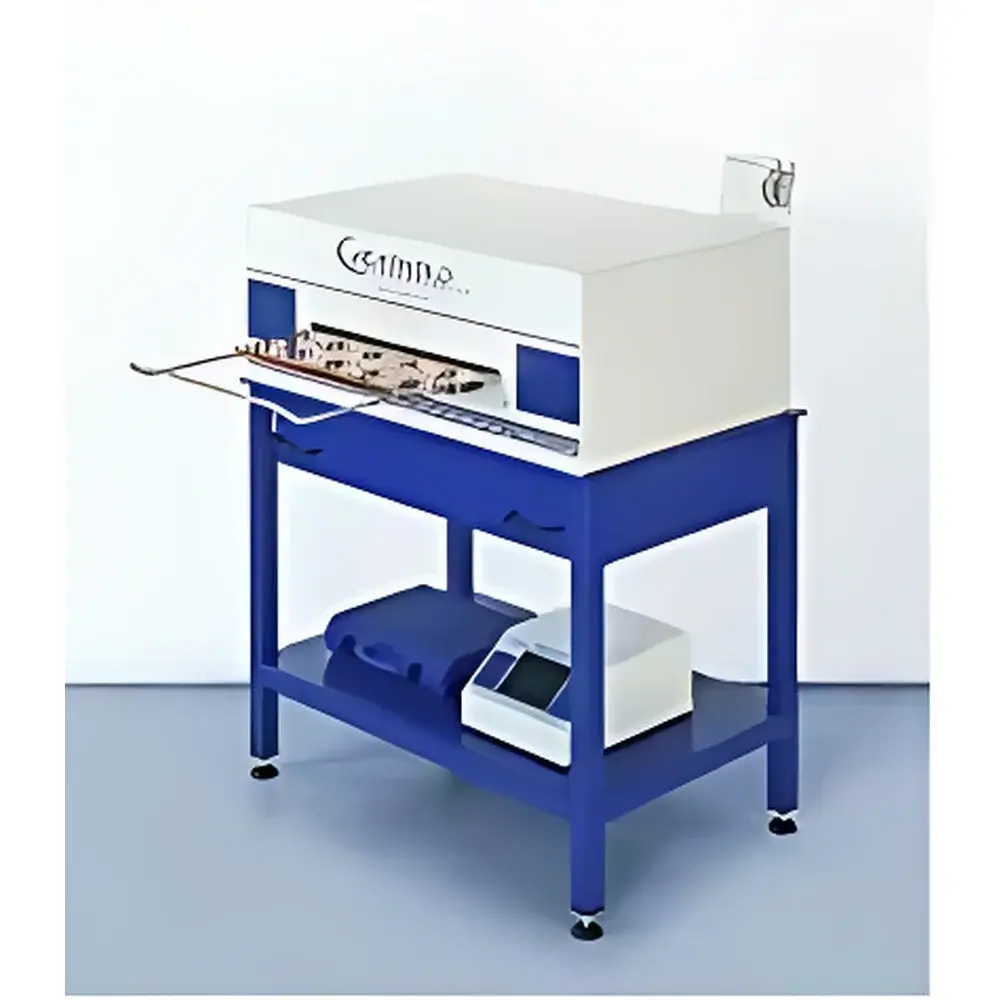
LB790 Ten-Channel Low-Background Alpha/Beta Counter
| Origin | USA |
|---|---|
| Manufacturer Type | Authorized Distributor |
| Origin Category | Imported |
| Model | LB790 |
| Pricing | Available Upon Request |
Overview
The LB790 Ten-Channel Low-Background Alpha/Beta Counter is a high-sensitivity, multi-detector radiation measurement system engineered for ultra-low-background quantitative analysis of alpha- and beta-emitting radionuclides in environmental, regulatory, and nuclear safeguards laboratories. It operates on the principle of gas-filled proportional counting—specifically using flow-through P-10 gas (90% Ar + 10% CH₄) within ten independent cylindrical proportional counters—enabling simultaneous, channel-isolated detection of both alpha and beta particles from solid or filter-based samples. Its design incorporates active cosmic-ray suppression via a surrounding anti-coincidence plastic scintillator detector, coupled with a 10 cm lead shield providing full 4π geometry shielding to minimize external gamma and cosmic-induced background. This architecture ensures sustained low-background operation essential for compliance with ISO 8523, ASTM D3648, and EPA Method 900, particularly in trace-level radioactivity monitoring of air filters, water evaporates, soil extracts, and swipe samples.
Key Features
- Ten independent flow-through proportional counting channels—each equipped with a replaceable aluminum entrance window (0.5–1.0 mg/cm² thickness) optimized for high transmission of low-energy alpha particles (e.g., Po-210, Am-241) and medium-energy beta emitters (e.g., C-14, Cl-36, Sr-90/Y-90).
- Integrated active anti-coincidence veto system utilizing a large-area plastic scintillator to detect and electronically reject cosmic-ray muons and secondary shower particles, reducing background by >90% compared to passive shielding alone.
- Robust 10 cm low-activity lead shielding (pre-screened for U/Th/K contamination) with graded inner lining of copper and cadmium to attenuate characteristic X-rays and bremsstrahlung.
- Real-time background monitoring per channel with automated background subtraction and dead-time correction algorithms compliant with IEC 61452 and ANSI N42.22 standards.
- Modular electronics architecture supporting individual HV supply, pulse shaping, and digital signal processing per channel—ensuring channel-to-channel independence and minimizing crosstalk.
Sample Compatibility & Compliance
The LB790 accommodates standard 47 mm or 55 mm circular planchets, membrane filters (cellulose ester, polycarbonate), and ashed environmental samples mounted on stainless-steel sample holders. Each chamber maintains stable gas flow (20–30 mL/min) and pressure control to ensure consistent gain and energy resolution across extended counting periods (up to 72 hours). The system meets requirements for GLP-compliant environmental radioactivity testing under 40 CFR Part 136 and supports audit-ready documentation for FDA 21 CFR Part 11–compliant data integrity when integrated with validated LIMS interfaces. All calibration protocols align with ISO/IEC 17025:2017 accreditation criteria for radiochemical testing laboratories.
Software & Data Management
Control and analysis are performed via LB-Soft v5.x—a Windows-based application certified for IEC 62304 Class B medical device software safety and validated for 21 CFR Part 11 compliance. The software provides spectral display per channel, automatic peak identification (using region-of-interest integration), efficiency calibration curves (via NIST-traceable reference sources), and statistical uncertainty propagation per ISO/IEC Guide 98-3 (GUM). Raw event timestamps, HV settings, gas flow logs, and environmental sensor data (temperature, pressure, humidity) are stored in encrypted SQLite databases with immutable audit trails, including user login history, method versioning, and electronic signature workflows.
Applications
- Regulatory monitoring of airborne alpha emitters (e.g., U-238, Pu-239) in nuclear facility stack emissions per EPA Method 900.
- Drinking water compliance testing for gross alpha/beta activity (40 CFR 141.25–141.27) and specific nuclides (e.g., Ra-226, Sr-90).
- Decommissioning and site remediation surveys requiring rapid, high-precision screening of soil and sediment samples.
- Reference material certification and inter-laboratory comparison studies coordinated by IAEA and NPL.
- Research applications in geochronology (e.g., C-14 dating support), nuclear forensics, and low-background physics experiments.
FAQ
What is the typical background count rate for alpha and beta detection?
Alpha background is ≤0.1 counts per minute (CPM); beta background is ≤1.0 CPM—measured under standard operating conditions with sealed chambers and continuous anti-coincidence veto enabled.
Which calibration standards are recommended for efficiency verification?
NIST-traceable point sources including Am-241 (alpha), Pu-238 (alpha), C-14 (beta), and Cl-36 (beta) are used; certificates of calibration must include uncertainty budgets per ISO/IEC 17025.
Can the LB790 be integrated into an existing laboratory information management system (LIMS)?
Yes—via secure ODBC or RESTful API interfaces supporting structured data export in CSV, XML, or ASTM E1382-compliant formats.
Is remote operation and diagnostics supported?
Fully supported through TLS-encrypted VNC and diagnostic telemetry; firmware updates and configuration backups are managed via role-based web console.
What maintenance intervals are required for optimal performance?
Aluminum windows should be inspected quarterly and replaced if pitted or contaminated; gas lines and regulators require annual leak testing per CGA G-4.1; full system performance verification is recommended every six months using reference sources.
Related Products







