
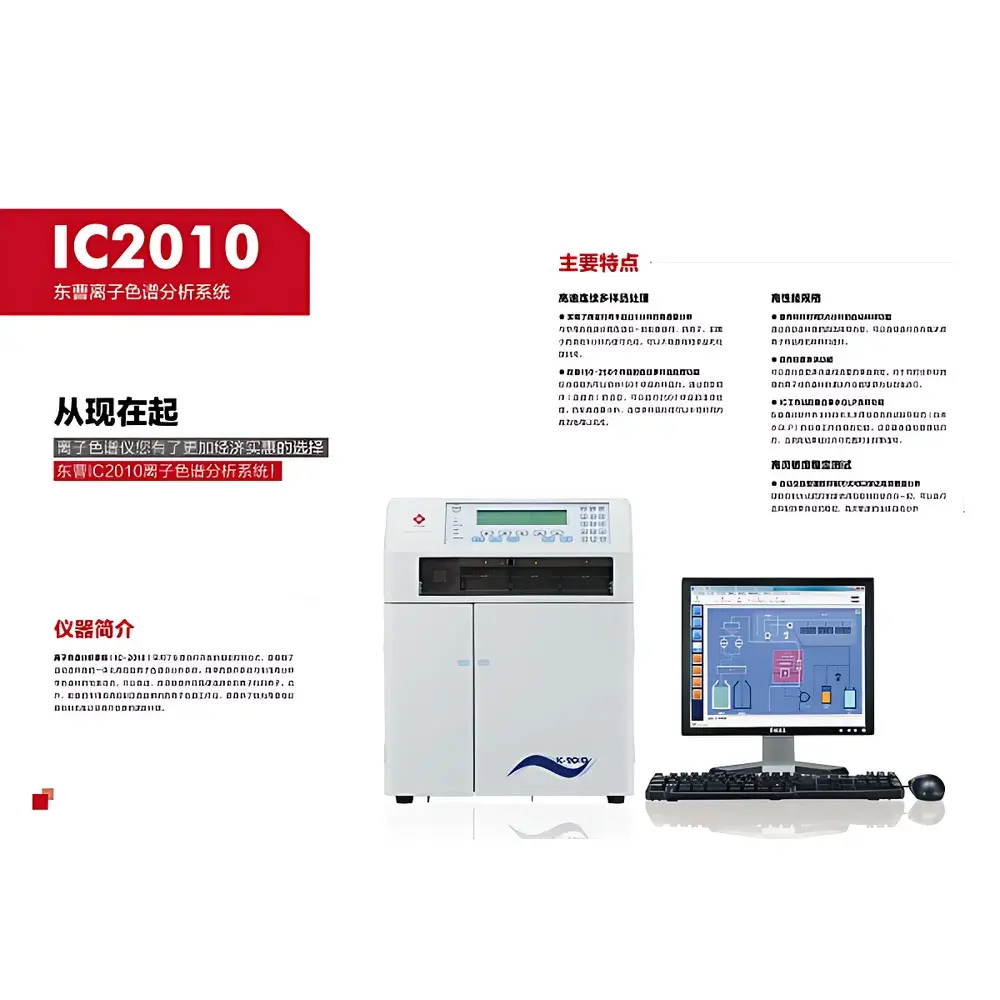
TOSOH IC-2010 High-Throughput Ion Chromatograph
| Brand | TOSOH |
|---|---|
| Origin | Japan |
| Model | IC-2010 |
| Instrument Type | Laboratory Benchtop Ion Chromatograph |
| Pump Pressure Range | 0–35 MPa |
| Flow Rate Range | 0.00–5.00 mL/min |
| Eluent Flow Rate | 0.1–30.0 mL/min |
| Maximum Operating Pressure | 3000 psi |
| Column Oven Temperature Range | 30–60 °C |
| Eluent Concentration Range | 0.1–100 mM |
| Detection Mode | Suppressed Conductivity Detection |
| System Configuration | Dual-channel (anion/cation) capable |
Overview
The TOSOH IC-2010 is a high-performance, benchtop ion chromatography system engineered for rapid, high-resolution separation and quantitative analysis of inorganic anions and cations in complex aqueous matrices. Based on suppressed conductivity detection and optimized eluent generation principles, the IC-2010 employs advanced column technology—including high-efficiency, low-backpressure ion-exchange columns—to achieve sub-5-minute complete separations for both anion and cation species under standardized conditions. Its modular architecture integrates a precision dual-piston reciprocating pump, thermally stabilized column oven, electrochemical suppressor module, and digitally controlled conductivity detector—ensuring reproducible retention times, baseline stability, and picogram-level detection sensitivity. Designed specifically for regulated laboratory environments, the system meets fundamental operational requirements for method validation per ISO 17025 and supports routine compliance with USP , ASTM D4327, and EPA Methods 300.0, 317.0, and 321.8.
Key Features
- High-throughput analytical capability: Full anion or cation chromatograms acquired in ≤5 minutes using optimized gradient or isocratic methods
- Dual-channel configuration option: Independent anion and cation modules operable simultaneously from a single PC interface
- Integrated auto-sampler with 108-position capacity and programmable injection volume (1–100 µL), supporting unattended overnight operation
- Electrolytic chemical suppression: Membrane-based suppressor with real-time regeneration ensures long-term baseline stability and minimal carryover
- On-board auto-dilution function: Enables linear dynamic range extension up to 1000-fold without manual re-preparation of standards or samples
- Gradient elution capability: Programmable multi-step gradients (up to 8 segments) for resolving co-eluting species in environmental, pharmaceutical, or food extracts
- Pump system rated to 35 MPa (5075 psi) with pulse-free flow delivery and ≤0.1% RSD flow precision across 0.1–5.0 mL/min range
- Column oven with ±0.2 °C temperature uniformity over 30–60 °C operating range, minimizing retention time drift
Sample Compatibility & Compliance
The IC-2010 accommodates a broad spectrum of sample types—including drinking water, wastewater, semiconductor process chemicals, pharmaceutical excipients, battery electrolytes, and biological fluids—following appropriate filtration (0.22 µm nylon) and dilution protocols. All wetted components are chemically resistant (PEEK, PTFE, and inert stainless-steel alloys), ensuring compatibility with carbonate/bicarbonate, methanesulfonic acid, and hydroxide-based eluents across 0.1–100 mM concentration ranges. The system adheres to GLP documentation standards through its dedicated IC workstation, which provides full electronic signatures, user access control (role-based permissions), audit trail logging (per FDA 21 CFR Part 11), and raw data immutability. Routine performance qualification includes system suitability testing (SST) per ICH Q2(R2) guidelines, with documented resolution (Rs ≥ 2.0), tailing factor (<2.0), and %RSD of peak area (<3.0%) for certified reference materials.
Software & Data Management
The proprietary IC Navigator software delivers comprehensive instrument control, sequence management, peak integration, and report generation—all within a validated, 21 CFR Part 11-compliant framework. It features embedded method templates for EPA, ISO, and pharmacopeial applications; customizable calibration curve models (linear, quadratic, weighted); and automated QC flagging based on user-defined acceptance criteria. Raw chromatographic data (including detector voltage, pressure logs, and temperature profiles) are stored in vendor-neutral .cdf format. Audit trail records capture operator ID, timestamp, parameter changes, integration edits, and report exports—with cryptographic hashing to prevent tampering. Network deployment supports centralized data archiving via LIMS integration (HL7, ASTM E1384) and scheduled backup to secure NAS or cloud repositories.
Applications
- Environmental monitoring: Quantification of F⁻, Cl⁻, NO₂⁻, Br⁻, NO₃⁻, PO₄³⁻, SO₄²⁻, Li⁺, Na⁺, NH₄⁺, K⁺, Mg²⁺, Ca²⁺ in surface water, groundwater, and effluent per EPA Method 300.0
- Pharmaceutical quality control: Counter-ion profiling in APIs, residual acetate/chloride in biologics, and sulfate quantitation in heparin sodium per USP
- Food & beverage safety: Nitrate/nitrite in infant formula, iodide in dairy, and organic acids (acetate, citrate) in beverages
- Electronics grade chemical certification: Trace chloride, fluoride, and sulfate in ultrapure water and photoresist solvents (SEMI F57)
- Academic research: Speciation studies of metal complexes, redox-active ions, and small-molecule metabolites in physiological buffers
FAQ
What eluent types are compatible with the IC-2010?
The system supports potassium hydroxide, sodium carbonate/bicarbonate, methanesulfonic acid, and other common IC eluents—delivered via isocratic or gradient programming across 0.1–100 mM concentration ranges.
Can the IC-2010 perform simultaneous anion and cation analysis?
Yes—using the optional dual-system configuration, two independent IC modules (anion and cation) can be operated in parallel under synchronized method control from one workstation instance.
Is the software compliant with FDA 21 CFR Part 11?
Yes—the IC Navigator software includes electronic signatures, audit trail with immutable records, role-based access control, and full data integrity safeguards required for regulated GMP/GLP environments.
What maintenance is required for the electrolytic suppressor?
The membrane-based suppressor operates continuously without consumable replacement; routine maintenance consists of monthly cleaning with recommended regenerant solutions and annual performance verification using standard test mixtures.
Does the system support method transfer from legacy TOSOH platforms?
Yes—method parameters (flow rate, gradient profile, column temperature, detection settings) are backward-compatible with IC-2000 and IC-2001 systems, enabling seamless migration of validated procedures.






