
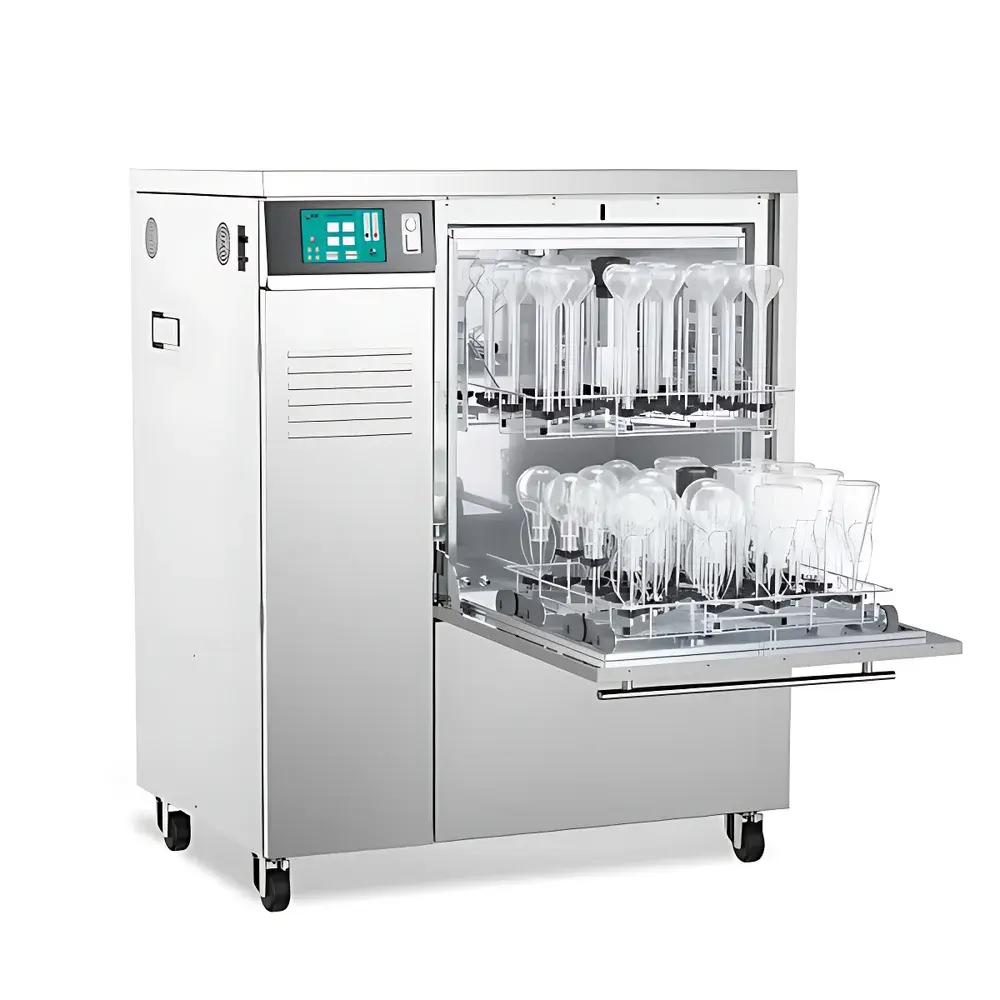
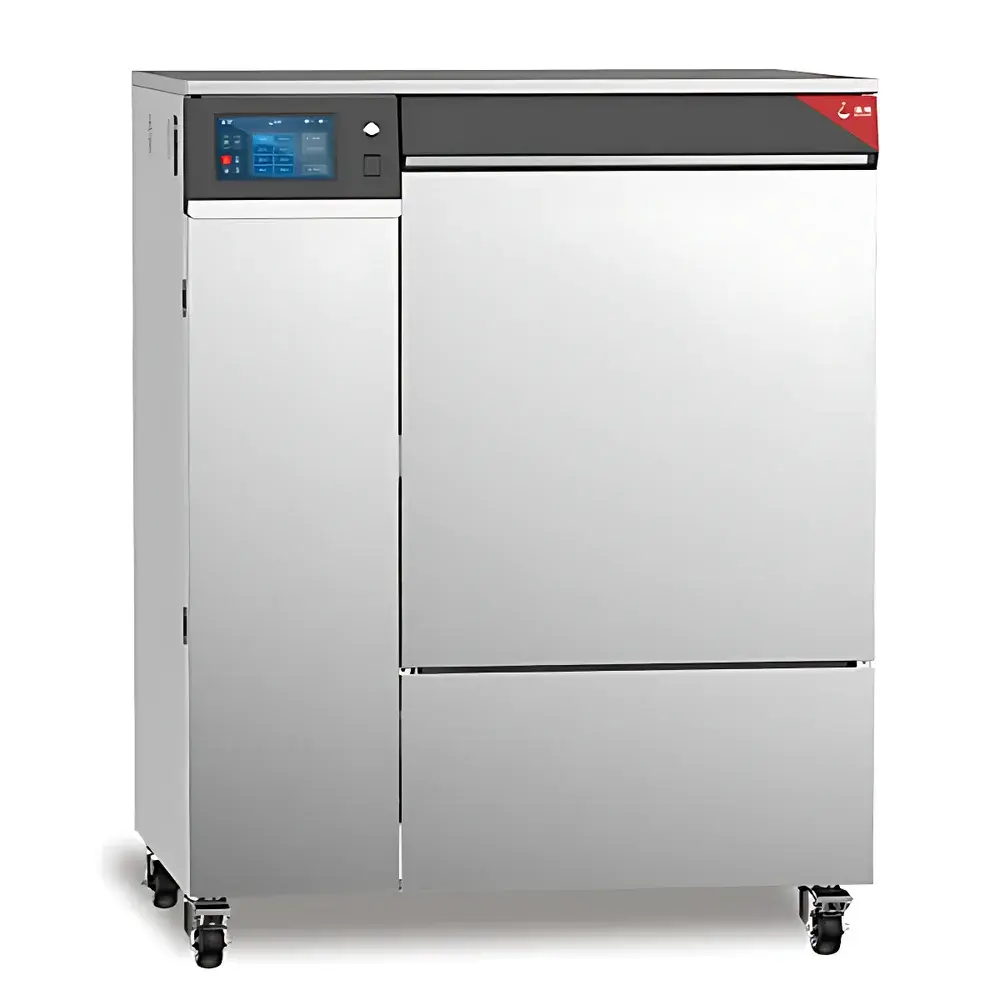
EURPING Q750 Bottle Washer
| Brand | EURPING |
|---|---|
| Origin | Tianjin, China |
| Manufacturer Type | Direct Manufacturer |
| Product Category | Domestic (China-made) |
| Model | Q750 Bottle Washer |
| Chamber Volume | 193 L |
| Heating Power | 9 kW |
| Maximum Wash Temperature | 93 °C |
| Circulation Pump Flow Rate | 0–600 L/min |
| Cleaning Agent Compatibility | Liquid Detergents & Neutralizers |
| External Dimensions (L×W×D) | 1015 × 779 × 1206 mm |
| Electrical Supply | 380 V, 50 Hz |
| Programmability | 120 Predefined + 30 User-Defined Cycles |
| Water Systems | Integrated Softener with Salt-Level Monitoring |
| Rinse Capability | Deionized / Ultrapure Water Delivery via Dedicated Pump |
| Dosing System | Peristaltic Pumps for Precise Detergent & Neutralizer Dispensing |
| Safety Features | Optical Isolation Control Architecture, Electronic Interlocked Door, Dual Thermal Protection (Pump & Chamber), High-Accuracy Overflow Detection Sensor |
| Regulatory Support | IQ/OQ/PQ Documentation Package Available for GMP/GLP Environments |
Overview
The EURPING Q750 Bottle Washer is an industrial-grade, programmable laboratory bottle cleaning system engineered for reproducible, traceable, and validation-ready operation in regulated environments. Designed according to the operational principles of high-flow, temperature-controlled, multi-stage aqueous cleaning—comprising pre-rinse, alkaline wash, acid neutralization, final rinse, and thermal drying—the Q750 delivers consistent removal of organic residues, particulates, and adsorbed analytes from glass and polymeric labware including volumetric flasks, sample bottles, HPLC vials, ICP-MS containers, and process sampling vessels. Its architecture integrates fluid dynamics optimization, closed-loop thermal management, and fail-safe hardware interlocks to ensure compliance with core laboratory quality requirements, particularly where residue carryover or cross-contamination poses analytical or regulatory risk.
Key Features
- 193-liter stainless-steel washing chamber with reinforced double-walled insulation and full-view tempered glass door for real-time process monitoring
- 9 kW heating system enabling rapid ramp-up to 93 °C wash temperature, maintained within ±1.5 °C stability during cycle execution
- High-capacity circulation pump delivering up to 600 L/min flow rate at peak pressure—optimized for turbulent flow conditions that enhance mechanical soil removal from complex geometries
- Dual peristaltic dosing modules for independent, metered delivery of alkaline detergents and acidic neutralizers, calibrated to ISO 15190-compliant accuracy
- Integrated water softening unit with automated salt-level detection and audible/visual low-salt alert; compatible with feed water hardness up to 15°dH
- Dedicated deionized (DI) or ultrapure water delivery circuit, isolated from main supply, supporting conductivity ≤0.1 µS/cm final rinse specifications
- Optically isolated PLC-based control system with CE-marked safety circuitry, conforming to EN 61000-6-2 (EMC immunity) and EN 61000-6-4 (EMC emission)
- Electronic safety interlock prevents door opening during active wash, rinse, or heating phases; automatic power cutoff upon forced breach
- Comprehensive thermal protection suite: main pump overtemperature shutdown, chamber overtemperature cutout, dry-run prevention logic, and precision hydrostatic overflow sensing
Sample Compatibility & Compliance
The Q750 accommodates a broad spectrum of container types and sizes—including 10 mL to 2 L glass bottles, narrow-neck vials, wide-mouth jars, and irregularly shaped sampling canisters—via configurable rack systems and adjustable spray arm positioning. It meets fundamental design and performance criteria aligned with ASTM E3018–21 (Standard Guide for Validation of Laboratory Glassware Washing Equipment), supports GLP/GMP documentation workflows, and provides full audit-trail capability for critical parameters (temperature, flow, time, detergent volume, rinse conductivity). EURPING supplies IQ/OQ/PQ protocols compliant with FDA 21 CFR Part 11 electronic records requirements, including electronic signatures, user access controls, and immutable event logging.
Software & Data Management
The embedded HMI features a 10.1-inch capacitive touchscreen with multilingual interface (English, German, Chinese), intuitive cycle navigation, and password-protected administrator mode. All 120 factory-loaded programs—including dedicated cycles for antibiotic residue removal, carotenoid (e.g., capsanthin) extraction vessel cleaning, and petroleum hydrocarbon sampling bottle decontamination—are fully editable. Users may create, store, and version-control up to 30 custom protocols with parameter locking, step-by-step validation prompts, and cycle-specific metadata tagging. Raw sensor data (temperature, pressure, conductivity, flow) is timestamped and exportable via USB or Ethernet to CSV or PDF formats. Optional Ethernet/IP integration enables centralized fleet monitoring and remote diagnostics through validated SCADA interfaces.
Applications
The Q750 serves as a primary cleaning platform in pharmaceutical QC labs performing residual solvent analysis (ICH Q5C), food safety testing (AOAC 995.15), environmental monitoring (EPA Method 502.2), and petrochemical QA/QC (ASTM D7097). Its validated performance supports cleaning verification studies for chromatographic sample preparation, elemental analysis (ICP-OES/MS), and microbiological assay containers. Notably, its ability to deliver ultrapure final rinses and thermally stable wash profiles makes it suitable for cleaning trace-metal analysis vessels requiring sub-ppt contamination thresholds.
FAQ
Does the Q750 support regulatory validation documentation?
Yes—EURPING provides complete IQ/OQ/PQ documentation packages, including test scripts, acceptance criteria, raw data templates, and summary reports aligned with FDA, EMA, and WHO GMP expectations.
Can the Q750 handle highly viscous or pigment-laden residues such as chili red extract?
Yes—its high-flow recirculation system, elevated wash temperature, and dual-detergent dosing enable effective removal of carotenoid-based stains and polymerized organic films when paired with validated cycle parameters.
Is remote monitoring or integration with LIMS possible?
The Q750 supports Modbus TCP and OPC UA communication protocols; optional middleware enables seamless integration with major LIMS and MES platforms for automated cycle logging and electronic batch record linkage.
What maintenance intervals are recommended for routine operation?
Daily visual inspection of filters and seals; monthly calibration check of temperature sensors and flow meters; annual preventive maintenance including pump seal replacement, softener resin regeneration, and control system firmware update.
How does the Q750 ensure water conservation and energy efficiency?
It employs intelligent load-sensing algorithms that modulate pump speed and heater output based on chamber fill level and soil load; average water consumption per standard cycle is 42–58 L, with heat recovery options available for facility-wide steam integration.



