
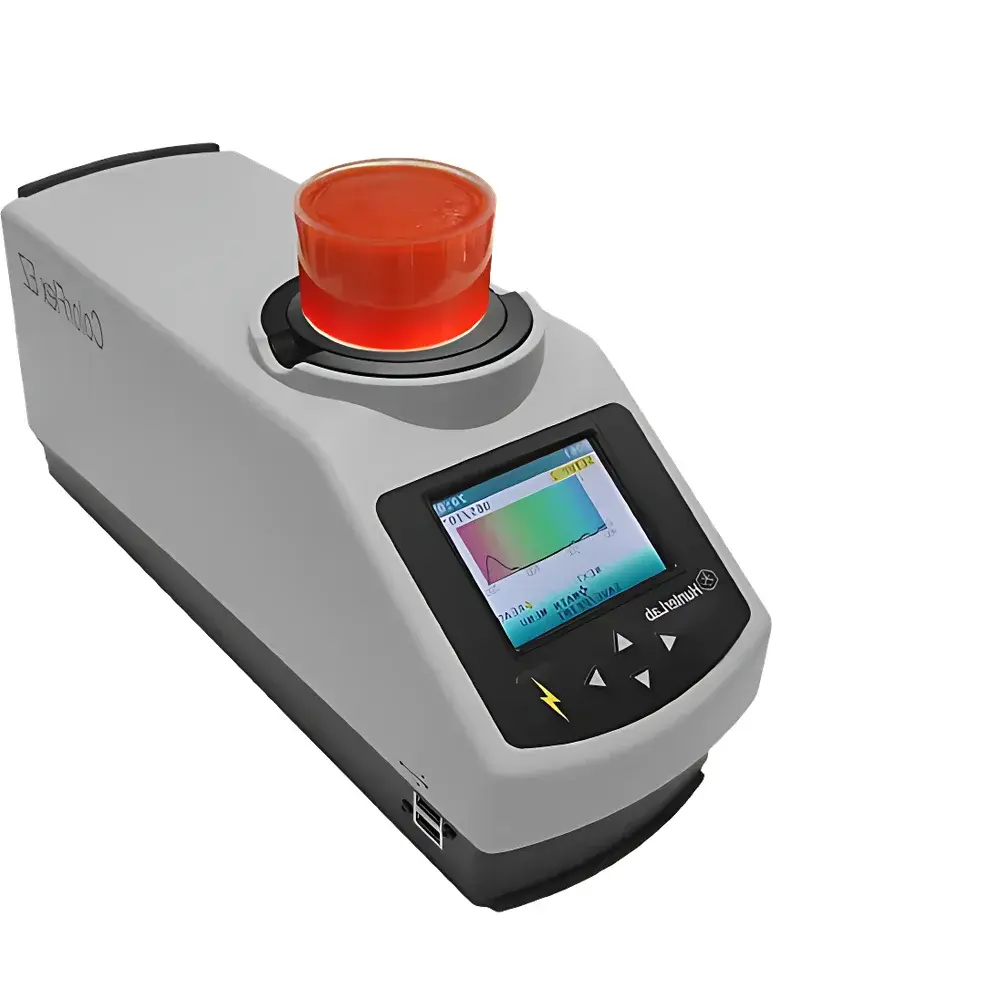
HunterLab ColorFlex EZ Tomato Color Spectrophotometer
| Brand | HunterLab |
|---|---|
| Origin | USA |
| Model | ColorFlex EZ Tomato |
| Product Type | Color Difference Meter |
| Instrument Type | Benchtop (not online) |
| Optical Geometry | 45°/0° Integrating Sphere |
| Spectral Range | 400–700 nm (visible spectrum) |
| Repeatability | ≤0.08 ΔE*ab (for white tile, 10 readings) |
| Compliance | USDA-licensed color standards, ASTM D2244, ISO 11664-4, CIE No. 15:2018 |
| Software Compatibility | EasyMatch QC v5.x or later, supports FDA 21 CFR Part 11 audit trail and electronic signatures |
Overview
The HunterLab ColorFlex EZ Tomato is a benchtop 45°/0° geometry spectrophotometer engineered specifically for objective, repeatable color measurement of tomato-based products across the full range of physical states — from fresh whole fruit and diced tomatoes to viscous pastes, sauces, juices, and powdered concentrates. Unlike general-purpose colorimeters, this instrument implements a dedicated optical path and spectral calibration optimized for the characteristic absorption profile of lycopene and other carotenoid pigments dominant in tomato matrices. Its 45°/0° illumination geometry eliminates directional reflectance artifacts common in textured or semi-opaque samples, ensuring high reproducibility for both surface and bulk color assessment. Designed for integration into quality control laboratories, R&D facilities, and production environments within tomato processing plants, the ColorFlex EZ Tomato delivers traceable, standardized color data aligned with industry-specific metrics defined by USDA, AOAC, and international food standards bodies.
Key Features
- USDA-licensed tomato-specific color scales: Tomato Paste Score (TPS), Tomato Sauce Score (TSS), Tomato Condiment Score (TCS), Tomato Juice Score (TJS), a/b ratio, and Fresh Tomato Color Index (FTCI)
- Dedicated lycopene index calculation derived from spectral reflectance at 450–510 nm and 560–590 nm bands, enabling quantitative pigment estimation without chemical extraction
- Integrated 45°/0° optical configuration with 100 mm integrating sphere and tungsten-halogen light source, compliant with CIE 15:2018 and ASTM D2244 for reflectance measurement
- High-stability solid-state detector array (31-channel silicon photodiode) with 10 nm nominal bandwidth and 1 nm data interval interpolation
- Built-in diagnostic and calibration verification tools including NIST-traceable white tile, black trap, and proprietary HunterLab Tomato Standard Tiles
- Compact footprint (24 × 20 × 22 cm) with rugged anodized aluminum housing rated IP52 for lab and controlled production floor use
Sample Compatibility & Compliance
The ColorFlex EZ Tomato accommodates diverse sample forms via standardized accessories: dual-walled glass sample cups (for liquids and suspensions), opaque lids with integrated light traps, and custom aperture inserts for semi-solids and powders. It meets GLP/GMP documentation requirements through automatic timestamping, operator ID logging, and configurable pass/fail tolerance limits per product specification. All tomato-specific indices are validated against USDA reference methods and referenced in AOAC Official Method 2012.01 for tomato paste color evaluation. Instrument firmware and EasyMatch QC software support 21 CFR Part 11 compliance, including electronic signature capture, audit trail generation, and role-based access control.
Software & Data Management
Controlled exclusively via HunterLab’s EasyMatch QC v5.5+ software, the ColorFlex EZ Tomato enables method-driven workflows, statistical process control (SPC) charting, and multi-instrument network synchronization. Raw spectral data (380–780 nm, 10 nm intervals) is stored in vendor-neutral .qtx format and exportable to CSV, Excel, or LIMS-compatible XML. The software includes built-in reporting templates aligned with ISO/IEC 17025 laboratory accreditation requirements, with customizable certificate-of-analysis outputs. All color calculations — including Hunter L,a,b; CIE L*a*b*; CMC(2:1); and ΔE00 — are performed using CIE-standard observer functions (2° and 10°) and illuminants (D65, A, C). Audit trails record every parameter change, calibration event, and result modification with user attribution and ISO 8601 timestamps.
Applications
- Quantitative grading of fresh tomato lots based on FTCI for harvest timing and sorting decisions
- In-process monitoring of thermal degradation during sauce concentration and canning, tracked via TPS and lycopene index drift
- Batch-to-batch consistency verification of ketchup, salsa, and pizza sauce against TSS/TCS specifications
- Stability testing of tomato powder reconstitution color under varying pH and temperature conditions
- Raw material qualification of tomato paste suppliers using USDA-accepted TPS thresholds
- Cross-product comparison (e.g., organic vs. conventional, heirloom vs. hybrid) using multivariate spectral clustering
FAQ
Is the ColorFlex EZ Tomato suitable for inline or continuous process measurement?
No — it is a benchtop instrument designed for discrete sample analysis. For real-time process monitoring, consider HunterLab’s MiniScan EZ or LabScan EZ with fiber-optic probe options.
Does the instrument require annual recalibration by HunterLab service engineers?
While factory recalibration is recommended every 24 months, daily verification using included standards satisfies ISO/IEC 17025 interim verification requirements.
Can non-tomato samples be measured with the same accuracy?
Yes — all standard color spaces (L*a*b*, L*C*h°, Yellowness Index, Whiteness Index) remain fully functional; only tomato-specific indices are disabled outside designated tomato mode.
What sample preparation is required for fresh tomato measurement?
Whole fruit requires cross-sectional slicing to expose uniform flesh; diced or pureed samples must be homogenized and placed in standard glass cups with opaque lids to eliminate ambient light interference.
Is spectral data accessible for third-party chemometric modeling?
Yes — full reflectance spectra (380–780 nm) are exportable in ASCII format and compatible with MATLAB, Python (NumPy/Pandas), and Unscrambler X for PCA, PLS, or ML-based pigment prediction models.





