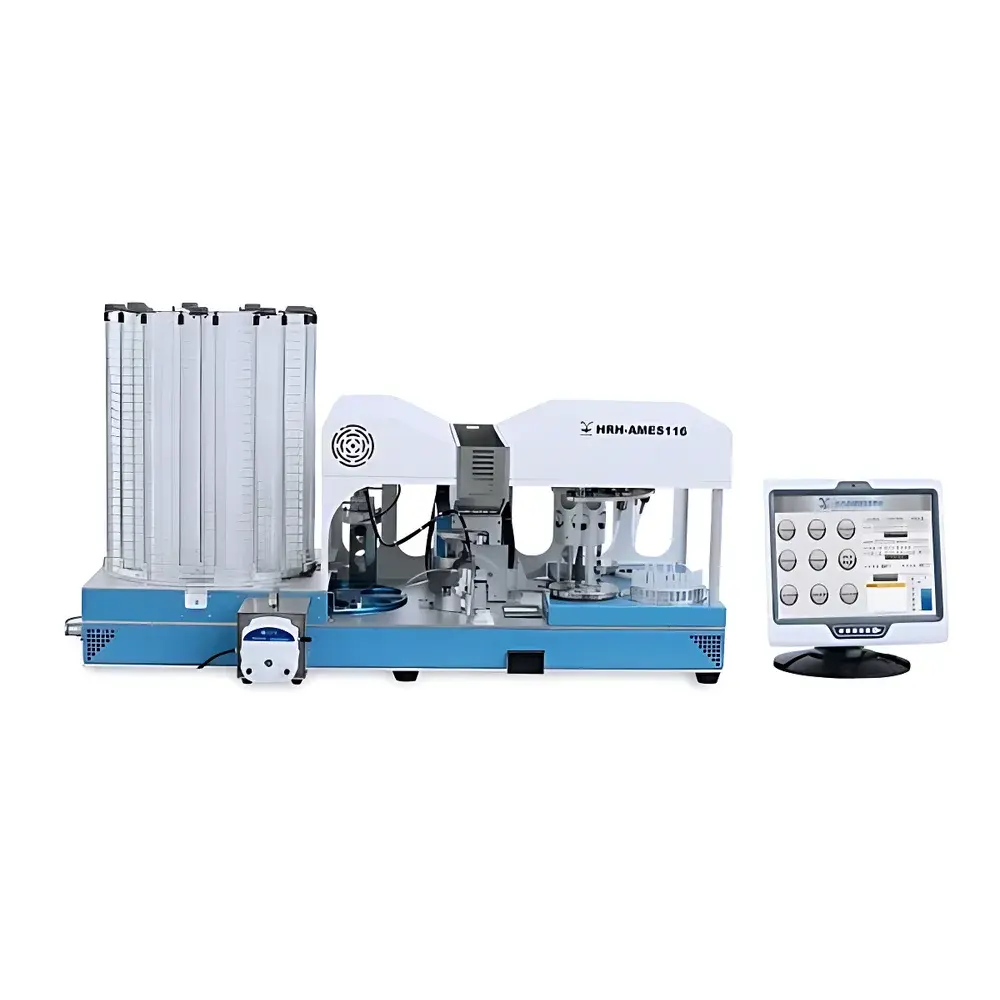
HRH-AMES116 Automated Ames Test System
| Brand | Huironghe |
|---|---|
| Origin | Beijing, China |
| Manufacturer Type | Authorized Distributor |
| Country of Origin | China |
| Model | HRH-AMES116 |
| Price Range | USD 70,000 – 140,000 |
| Throughput | 240 Petri Dishes per Run |
| Top Agar Dispensing Accuracy | ±0.3 mL |
| Sample Dispensing Accuracy | ±0.01 mL |
| Temperature Control Range | 0–80 °C |
| Temperature Stability | ±0.5 °C |
| Air Supply Requirement | ≥5 bar, dry and oil-free |
| Power Supply | 220 V / 50 Hz |
| Dimensions (W×D×H) | 1300 × 500 × 600 mm |
| Net Weight | 55 kg |
| Compliance | GB 15193.4–2014, YY/T 0127.10–2009 |
Overview
The HRH-AMES116 Automated Ames Test System is an integrated, walk-away instrumentation platform engineered for standardized bacterial reverse mutation assays (Ames tests) in regulatory toxicology and preclinical safety assessment. Based on the internationally recognized Salmonella typhimurium and Escherichia coli strain panel—specifically strains TA98, TA100, TA1535, TA1537, and WP2uvrA—the system automates the complete workflow defined by OECD Guideline 471, ISO 10993-3, and harmonized pharmacopoeial methods (USP , EP 2.2.27). It implements precise liquid handling, thermally controlled agar dispensing, vortex-assisted suspension homogenization, and traceable plate labeling to eliminate manual variability inherent in traditional Ames protocols. Unlike semi-automated or benchtop pipetting solutions, the HRH-AMES116 performs sequential top agar preparation, bacterial suspension mixing, dose-series dilution, solvent/positive control integration, and uniform plate pouring—all within a single unattended run. Its architecture supports GLP-compliant study execution through hardware-level audit trails, electronic signature-capable software, and full parameter logging aligned with FDA 21 CFR Part 11 requirements.
Key Features
- Full end-to-end automation of the Ames assay: including top agar melting and temperature maintenance (up to 45 °C), S9 mix refrigeration (4–10 °C), bacterial cell suspension preparation, serial dilution across five test concentrations, dual solvent controls, and six independent positive control placements.
- Vortex-based homogenization module ensures rapid and reproducible suspension of bacterial cells and test compounds prior to plating—minimizing sedimentation artifacts and improving colony distribution uniformity.
- Independent disposable tip handling per sample: each gradient concentration, control, and replicate uses a dedicated sterile tip; used tips are physically segregated from fresh tip racks to prevent cross-contamination.
- Programmable thermal management system with dual-zone capability: one zone maintains molten top agar at user-defined temperatures (±0.5 °C stability), while a second zone actively cools S9 metabolic activation mixtures to preserve enzymatic activity.
- Petri dish identification via non-contact dot-matrix marking: each plate receives a unique positional code during dispensing; post-run digital mapping generates a traceable reference table linking physical plates to experimental conditions and dosing parameters.
- High-throughput capacity: 240 Petri dishes per automated cycle (e.g., 5 concentrations × 2 replicates × 24 plates = 240); continuous operation enabled via manual plate stack replacement without interrupting software-controlled protocol sequencing.
Sample Compatibility & Compliance
The HRH-AMES116 accommodates standard 90-mm and 100-mm Petri dishes and accepts common top agar formulations (e.g., 0.6% noble agar in minimal glucose medium) as well as S9 liver homogenate preparations from rat or hamster sources. It supports all validated Salmonella tester strains (TA97a, TA98, TA100, TA1535, TA1537) and E. coli WP2uvrA, enabling both base-pair substitution and frameshift mutagen detection. The system conforms to national and international regulatory frameworks including GB 15193.4–2014 (China National Food Safety Standard for Bacterial Reverse Mutation Test), YY/T 0127.10–2009 (Biological Evaluation of Dental Devices), and ISO 10993-3:2014 (Biological evaluation of medical devices — Part 3: Tests for genotoxicity, carcinogenicity and reproductive toxicity). All temperature, volume, and timing parameters are logged with timestamped metadata to support audit readiness under GLP and GMP environments.
Software & Data Management
The proprietary control software—certified under Chinese Software Copyright Registration No. 2023SR0882154—provides role-based access control, method library management, and real-time monitoring of instrument status (temperature zones, air pressure, tip inventory, plate position). Protocols are defined using a visual workflow editor compliant with ICH M7 principles for mutagenic impurity assessment. Raw data—including dispense volumes, mixing durations, thermal profiles, and plate IDs—are exported in CSV and PDF formats compatible with LIMS integration. Audit trail functionality records all user actions, parameter changes, and system events with immutable timestamps, satisfying FDA 21 CFR Part 11 Subpart C requirements for electronic records and signatures.
Applications
- Regulatory submission support for pharmaceuticals, biologics, and excipients under ICH M7 and FDA guidance on mutagenic impurities.
- Safety screening of food additives, dietary supplements, cosmetic ingredients, and agrochemicals per EFSA and JECFA evaluation frameworks.
- Early-stage compound prioritization in medicinal chemistry programs to eliminate structural alerts before costly in vivo studies.
- Quality control of raw materials and intermediates in API manufacturing where genotoxic risk must be ruled out.
- Academic and contract research organization (CRO) laboratories requiring high-reproducibility, auditable Ames testing infrastructure aligned with OECD Test Guideline 471.
FAQ
What bacterial strains are supported by the HRH-AMES116?
The system is validated for use with standard Salmonella typhimurium strains TA98, TA100, TA1535, TA1537, and E. coli WP2uvrA, as specified in GB 15193.4–2014 and ISO 10993-3.
Does the system support metabolic activation with S9 fraction?
Yes—the integrated refrigerated compartment maintains S9 mix at 4–10 °C during assay setup and allows timed addition to bacterial suspensions immediately prior to plating.
Can the instrument be integrated into an existing LIMS environment?
Yes—data export in CSV and PDF formats, along with Ethernet-based communication, enables seamless interoperability with major laboratory information management systems.
Is the software compliant with FDA 21 CFR Part 11?
Yes—the software includes electronic signature capability, audit trail logging, and user authentication mechanisms required for regulated environments.
What maintenance is required for long-term operational reliability?
Routine calibration of dispensing modules (performed annually or after 500 runs), tip rack inspection, and verification of thermal zone accuracy using NIST-traceable probes are recommended per the manufacturer’s maintenance schedule.
Related Products