
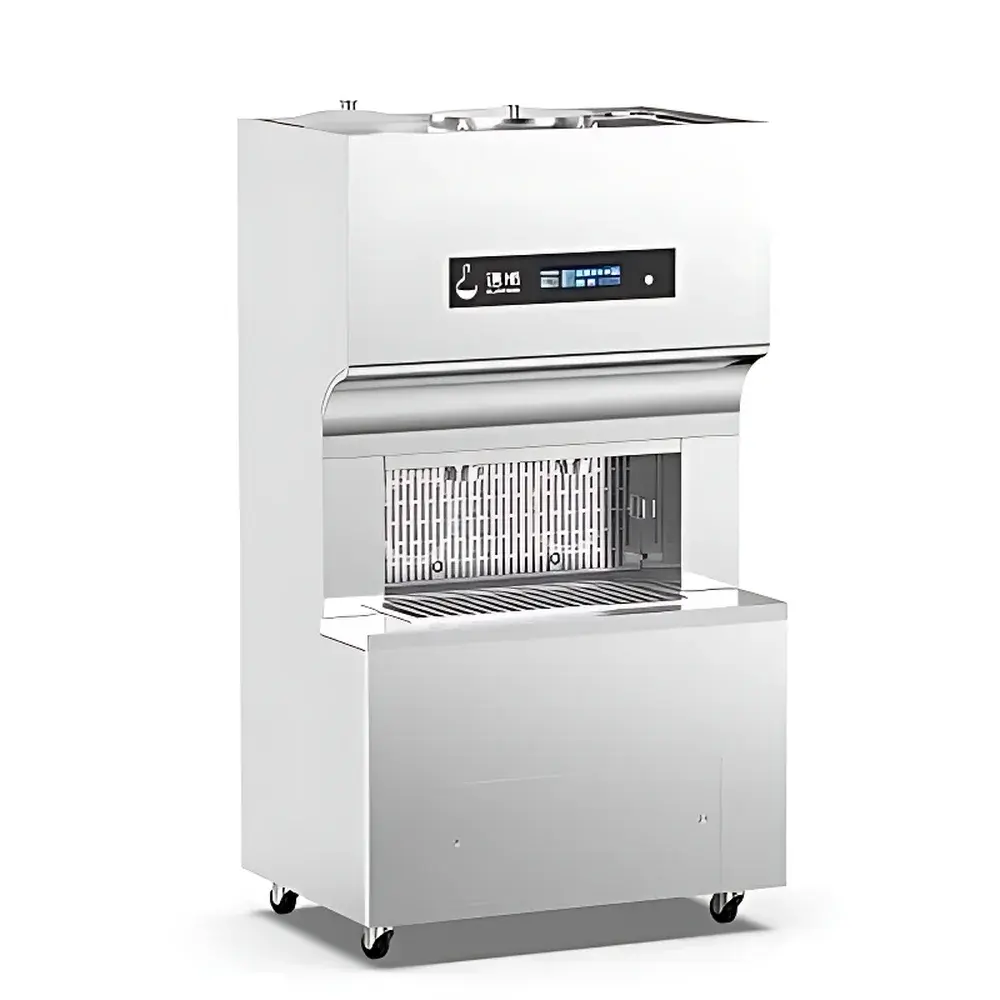
EURPING IVC800 Fully Automatic Bedding Dispensing System
| Brand | EURPING |
|---|---|
| Origin | Tianjin, China |
| Manufacturer Type | Direct Manufacturer |
| Country of Origin | China |
| Model | IVC800 |
| External Dimensions (L×W×H) | 1118 × 781 × 1970 mm |
| Power Supply | 380 V AC, 3 kW |
| Operating Height | 810 mm |
| Bedding Feed Rate | 30–40 mouse cages/min |
| Bedding Lift Capacity | 50 L/min |
| Dispensing Accuracy | < ±5% |
| Control Interface | 4.3-inch full-color TFT touch panel with PLC-based control system |
| Filtration | H13 HEPA vacuum filtration (1 pre-filter + 2 H13 filters) |
| Safety Systems | Low-bedding alarm, motor/fan overload protection, vacuum pressure monitoring, cage presence detection interlock |
Overview
The EURPING IVC800 Fully Automatic Bedding Dispensing System is an engineered solution designed specifically for high-throughput, standardized bedding delivery in Individually Ventilated Cage (IVC) animal housing facilities. It operates on a closed-loop pneumatic conveying principle, integrating volumetric dosing, real-time vacuum-based dust extraction, and programmable logic control to ensure consistent, repeatable, and contamination-controlled bedding application across standardized rodent cages. Unlike manual or semi-automated systems, the IVC800 eliminates operator variability in fill volume, minimizes airborne particulate generation during dispensing, and supports compliance with institutional animal care protocols requiring environmental consistency and personnel exposure reduction. Its architecture is optimized for integration into centralized vivarium workflows—particularly where daily cage changing volumes exceed 200 cages—and aligns with facility requirements for ergonomic operation (810 mm working height), electrical safety (IEC 61000-compliant 380 V/3 kW supply), and ISO 14644-1 Class 8 cleanroom-compatible particulate control.
Key Features
- PLC-based automation with intuitive 4.3-inch color touch interface for parameter configuration, cycle monitoring, and fault diagnostics.
- Dual-feed station design enables simultaneous handling of two cage lines, supporting throughput of 30–40 standard mouse cages per minute.
- Integrated high-vacuum lifting system (50 L/min capacity) transfers bedding material from lower storage bin to upper dispensing reservoir using pressure-differential conveyance—no mechanical augers or belts to wear or contaminate.
- Real-time bridging prevention via low-shear agitator located above the discharge hopper, ensuring uniform flow of granular or flaked bedding substrates (e.g., aspen shavings, corn cob, paper-based bedding).
- Programmable volumetric dispensing algorithm calculates required bedding mass per cage based on user-defined cage type, bedding density, and target fill depth—eliminating manual calibration.
- H13-class HEPA filtration (EN 1822-1 compliant) integrated into negative-pressure dust extraction circuit; suction ports positioned at rear of dispensing nozzle capture airborne particles at source; fan remains active post-cycle for residual dust clearance.
- Multi-layer safety interlocks: cage presence detection halts dispensing when no cage is detected; low-bedding level sensor triggers audible/visual alarm; motor/fan thermal overload and vacuum pressure drop are continuously monitored and logged.
Sample Compatibility & Compliance
The IVC800 accommodates common IVC cage formats including Tecniplast Green Line, Allentown EVC, and Lab Products IVC systems (cage footprints up to 300 × 180 mm). It accepts dry, free-flowing bedding materials with particle size distributions ranging from 0.5 mm to 8 mm—validated for use with cellulose fiber, virgin wood pulp, and low-dust processed corncob substrates. The system meets structural and operational requirements outlined in AAALAC International accreditation standards for automated husbandry equipment, and its dust suppression performance complies with OSHA PEL (Permissible Exposure Limit) thresholds for respirable particulates (< 5 mg/m³ TWA). Electrical design conforms to GB/T 14048.1 (equivalent to IEC 60947-1) for low-voltage switchgear and controlgear.
Software & Data Management
The embedded PLC firmware supports audit-ready event logging—including cycle count, dispensing duration, alarm history, and filter usage time—with timestamped records exportable via USB port. While the system does not feature network connectivity or cloud integration, its local log structure satisfies GLP-aligned documentation needs for routine maintenance tracking and deviation investigation. Filter replacement intervals are tracked automatically based on cumulative runtime and vacuum differential readings; alerts prompt scheduled servicing before H13 efficiency degrades below 99.95% @ 0.3 µm. All operational parameters are password-protected and support role-based access (Operator / Technician / Administrator).
Applications
- Standardized bedding replenishment in academic and contract research organization (CRO) rodent vivaria.
- Supporting longitudinal studies requiring strict environmental consistency—especially neurobehavioral, immunological, and toxicology models sensitive to bedding-derived volatile organic compounds (VOCs) or particulate load.
- Reducing occupational exposure risk for animal care staff during high-volume cage change operations.
- Enabling reproducible substrate presentation in phenotyping pipelines where bedding depth influences nesting behavior, thermoregulation, or microbiome transfer dynamics.
- Integration with automated cage washer-dryer lines (e.g., Eurping WDS series) for end-to-end IVC processing workflows.
FAQ
What types of bedding materials are compatible with the IVC800?
The system is validated for dry, non-clumping, free-flowing substrates with bulk density between 0.08–0.25 g/cm³ and median particle size >1 mm—such as aspen shavings, processed paper bedding, and pelleted corncob. Hygroscopic or electrostatic-prone materials (e.g., untreated sawdust) are not recommended.
Does the IVC800 require compressed air or external vacuum sources?
No. It incorporates an integrated high-efficiency vacuum blower (rated for continuous duty at ≥22 kPa static pressure) and requires only a dedicated 380 V/3 kW power feed.
How is dispensing accuracy maintained over time?
Accuracy relies on calibrated volumetric displacement, real-time hopper level feedback, and periodic verification using gravimetric spot-checks against NIST-traceable scales—recommended every 200 operating hours or per institutional SOP.
Can the system be validated for GMP-regulated preclinical studies?
Yes. Its deterministic control logic, alarm logging, and filter integrity monitoring support IQ/OQ documentation per ASTM E2500 and EU Annex 15 guidelines—though formal PQ must be performed in situ under actual facility conditions.
What maintenance is required for the H13 filtration system?
Pre-filters should be replaced every 3 months; H13 filters are rated for 6–12 months depending on bedding dust load and are monitored via differential pressure sensors—replacement triggered automatically when ΔP exceeds 350 Pa.



