
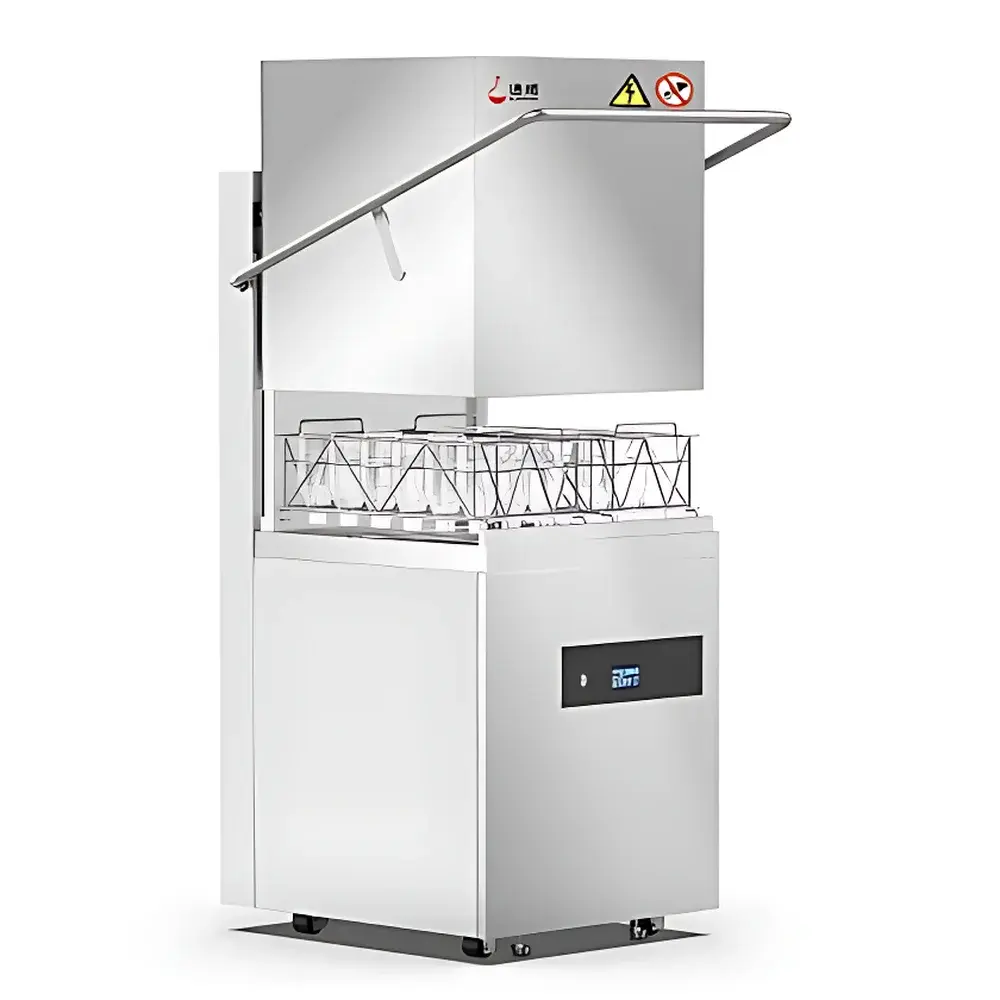
EURPING IVC500 Fully Automated Drinking Bottle Washer
| Brand | EURPING |
|---|---|
| Origin | Tianjin, China |
| Manufacturer Type | Direct Manufacturer |
| Product Origin | Domestic (China) |
| Model | IVC500 |
| Price Range | USD 7,000 – 14,000 |
| Heating Power | 9 kW (Preheat Tank) / 6 kW (Rinse Tank) |
| Adjustable Cleaning Temperature | 30–75 °C |
| Compatible Cleaning Agents | Acidic & Alkaline Solutions |
| External Dimensions (L×W×D) | 650 × 753 × 1465 mm |
| Main Circulation Pump Flow Rate | 500 L/min |
| Rinse Pump Flow Rate | 100 L/min |
| Cleaning Agent Pumps | 2 × precision dosing pumps |
| Cycle Time | 3–4 min (programmable) |
| Capacity | 36 drinking bottles per cycle (2 baskets × 18 bottles) |
| Door Type | Top-hinged lid |
| Water System | Softened water only |
| Energy Recovery | Integrated heat recovery from final rinse water |
| Control System | PLC-based with 4.3″ color touchscreen (Chinese GUI) |
Overview
The EURPING IVC500 Fully Automated Drinking Bottle Washer is a purpose-engineered laboratory cleaning system designed specifically for high-throughput, repeatable, and validation-ready cleaning of polycarbonate or glass drinking bottles used in preclinical research, laboratory animal science, and vivarium operations. It operates on the principle of controlled thermal-mechanical cleaning: heated softened water is delivered at high flow rates (500 L/min) via precision-engineered nozzles—each aligned one-to-one with an individual bottle mouth—to ensure complete internal and external surface coverage. The process integrates three distinct phases: pre-rinse, alkaline/acidic detergent wash, and multi-stage deionized or softened-water rinsing—including a final low-conductivity rinse optimized for residue removal. With a typical cycle duration of 3–4 minutes and capacity for 36 bottles per run, the IVC500 meets stringent throughput demands while maintaining full traceability potential through its programmable PLC architecture.
Key Features
- One-to-one nozzle alignment ensures targeted, non-turbulent impingement on each bottle interior—eliminating shadow zones and maximizing soil removal efficiency.
- Dual independent water circuits: a 500 L/min main wash loop and a dedicated 100 L/min rinse loop, both driven by industrial-grade imported circulation pumps.
- Modular thermal management: 9 kW preheat tank and 6 kW rinse tank enable rapid temperature stabilization across 30–75 °C range; adjustable setpoints support method development per ISO 15883-1 and ASTM E2582.
- Integrated energy recovery system captures residual heat from final rinse effluent to preheat incoming wash water—reducing net energy consumption by up to 25% per cycle.
- Top-hinged door design allows unobstructed basket loading and accommodates future integration into automated cage-wash conveyance lines.
- Two independent chemical dosing pumps deliver precise, programmable volumes of acidic and alkaline detergents—compatible with common lab-grade enzymatic, caustic, and chelating formulations.
- PLC-based control core with 4.3″ TFT touchscreen interface (Chinese language default); firmware supports optional upgrade to 21 CFR Part 11–compliant electronic records, including operator log-in authentication, parameter change history, and cycle signature archiving.
Sample Compatibility & Compliance
The IVC500 is validated for use with standard rodent and primate drinking bottles (e.g., 125 mL–500 mL polycarbonate or borosilicate glass), including those with integrated sipper tubes or valve mechanisms. Its cleaning efficacy has been verified against AAMI ST34 and ISO 15883-4 benchmarks for medical device reprocessing, adapted for laboratory animal husbandry applications. The system requires softened water input (<10 ppm CaCO₃) to prevent scale formation and ensure consistent thermal transfer. All wetted components are constructed from 316L stainless steel and FDA-compliant polymers. While not classified as a medical device washer under EU MDR or FDA 510(k), the IVC500 supports GLP/GMP-aligned workflows when paired with documented SOPs, routine performance qualification (PQ), and preventive maintenance logs.
Software & Data Management
The embedded control system stores up to 1,000 completed cycle records locally, including timestamps, temperature profiles, pump runtime, detergent dispense volumes, and door open/close events. USB export enables CSV-formatted data transfer for external review. Optional firmware upgrade adds electronic audit trail functionality compliant with 21 CFR Part 11 requirements: digitally signed cycle reports, immutable event logging, and hierarchical user permissions (Administrator, Technician, Operator). No cloud connectivity is included by default—data remains fully on-device unless explicitly enabled via secure local network configuration.
Applications
- Routine cleaning and decontamination of drinking bottles in AAALAC-accredited animal facilities.
- Removal of organic residues (e.g., milk proteins, sucrose solutions, drug suspensions) and inorganic deposits (e.g., mineral scale, feed particulates) from reusable labware.
- Supporting ISO/IEC 17025-accredited testing laboratories requiring documented cleaning validation prior to analytical sample preparation.
- Integration into centralized vivarium utility corridors where space-constrained, high-cycle-rate cleaning is critical.
- Method development for detergent selection, temperature optimization, and cycle time reduction under controlled environmental conditions.
FAQ
What types of drinking bottles are compatible with the IVC500?
Standard cylindrical polycarbonate or glass bottles ranging from 125 mL to 500 mL, including models with integrated stainless steel sipper tubes or ball-valve assemblies—provided they fit within the defined basket geometry (max height: 280 mm; max diameter: 85 mm).
Is purified water required for operation?
Softened water (≤10 ppm hardness) is mandatory; deionized or reverse-osmosis water is recommended for final rinse stages to minimize spotting and conductivity-related residue.
Can the IVC500 be validated for GxP environments?
Yes—when operated with documented IQ/OQ/PQ protocols, calibrated temperature sensors, and traceable detergent lots, the system supports ALCOA+ data integrity principles and can be incorporated into GLP or GMP quality systems.
Does the unit include a built-in water softener?
No—the IVC500 requires connection to an external softened water supply; integration with facility-wide softening infrastructure is recommended.
What maintenance intervals are specified for the circulation pumps and heaters?
Main pump service is recommended every 1,500 operating hours; heater element resistance checks should occur quarterly; all maintenance actions are logged automatically in the system’s service history module.



