
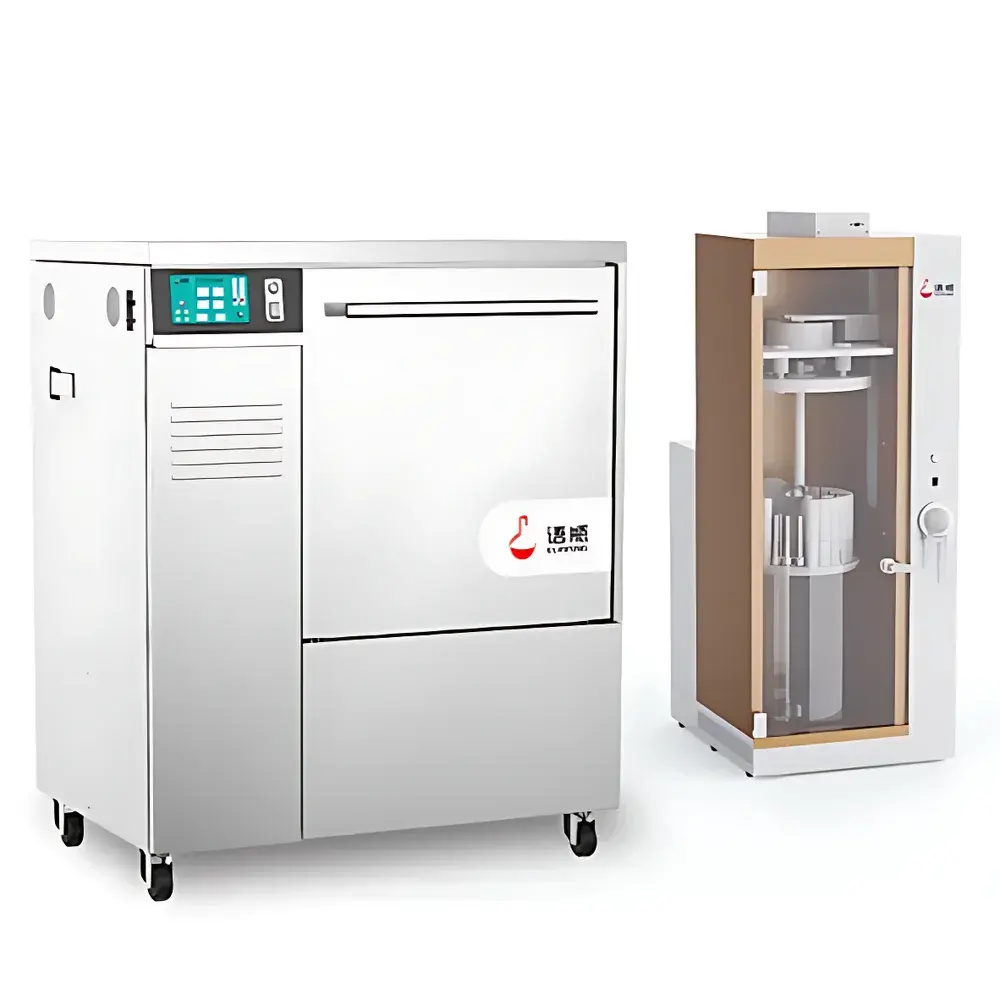
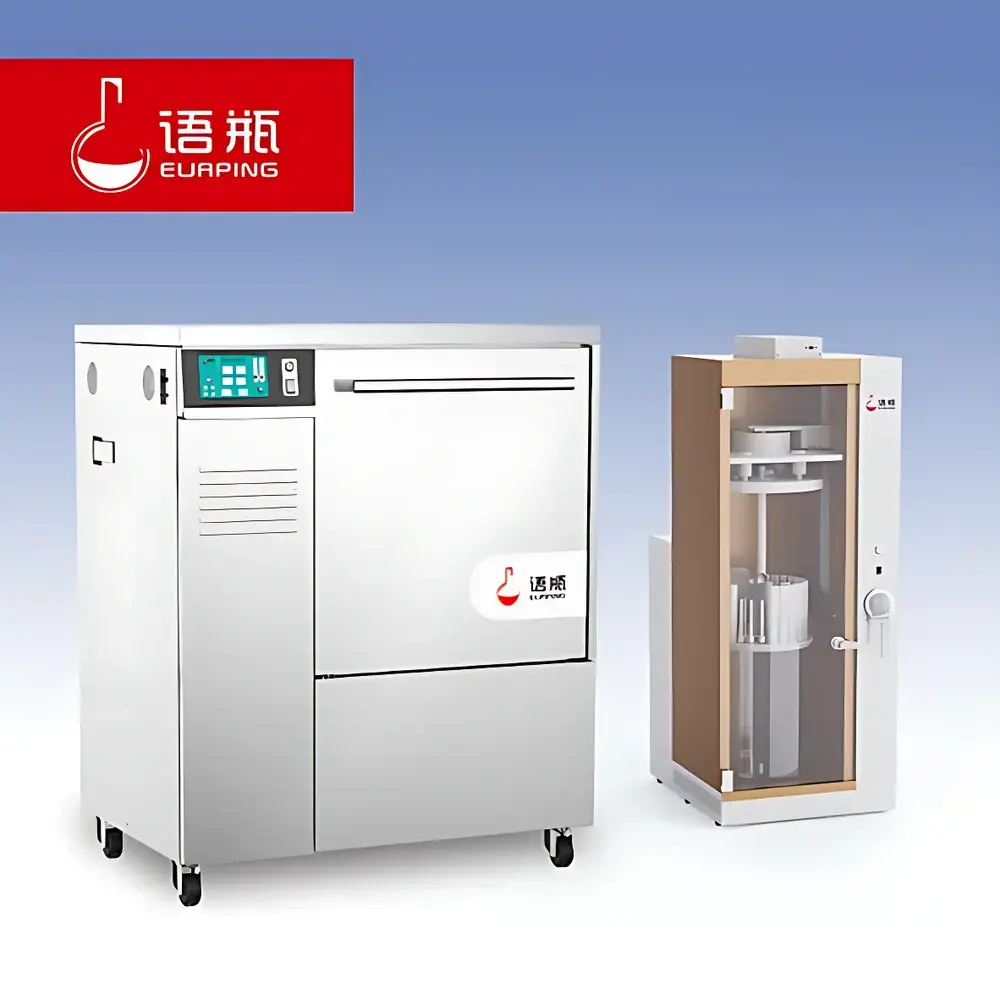
EURPING TC7100 Fully Automated Trace-Cleaning System for Laboratory Glassware
| Brand | EURPING |
|---|---|
| Origin | Tianjin, China |
| Manufacturer | EURPING (OEM/ODM Capable) |
| Country of Origin | China |
| Model | TC7100 |
| Price Range | USD 42,000 – 70,000 (FOB Tianjin) |
| Chamber Volume | 210 L |
| Heating Power | 4 kW |
| Maximum Wash Temperature | 93 °C |
| Compatible Cleaning Agents | Acidic and Alkaline Solutions (e.g., HNO₃, HCl, NaOH) |
| External Dimensions (L×W×D) | 1015 × 779 × 1206 mm |
Overview
The EURPING TC7100 Fully Automated Trace-Cleaning System is an engineered solution designed to meet stringent cleanliness requirements in analytical, pharmaceutical, environmental, and clinical laboratories. It operates on a validated multi-stage cycle—pre-rinse, alkaline or acidic wash, intermediate rinse, final ultra-pure water rinse, thermal disinfection, and forced-air drying—optimized for trace-level residue removal from glassware used in elemental analysis (e.g., ICP-MS, AAS), organic residue testing, microbiological assays, and regulated bioanalysis. Unlike manual cleaning or standard lab washers, the TC7100 employs controlled acid/alkali vapor-phase cleaning and precisely regulated high-temperature thermal treatment (up to 93 °C), ensuring consistent decontamination of volumetric flasks, digestion vessels, pipettes, burettes, distillation apparatus, and other complex-shape laboratory glassware. Its architecture complies with fundamental principles of cleaning validation per ISO 13485, ASTM E3067, and USP Analytical Instrument Qualification frameworks—supporting IQ/OQ/PQ execution with documented process parameters and reproducible outcomes.
Key Features
- 210-liter stainless-steel chamber with reinforced double-wall insulation and corrosion-resistant interior lining (316L SS contact surfaces)
- Dual-mode chemical delivery system supporting both liquid injection and controlled vapor-phase acid/alkali treatment (e.g., nitric acid vapor for trace metal removal)
- Precise temperature control (±1 °C) across full wash cycle; 93 °C thermal hold phase meets EN ISO 15883-1 requirements for thermally assisted disinfection of reusable labware
- Programmable multi-step cycles with adjustable dwell times, flow rates, and temperature ramps—stored as user-defined protocols with version control
- Integrated conductivity and TOC monitoring ports (optional) for real-time rinse water purity verification
- RS232 serial interface with audit-trail-capable logging (time-stamped cycle start/end, temperature profiles, detergent usage, door status, error codes)
- Self-diagnostic system with fault-code display and maintenance alerts aligned with GLP/GMP operational expectations
Sample Compatibility & Compliance
The TC7100 accommodates standard and non-standard laboratory glassware up to 500 mm in height—including Class A volumetric flasks (10–2000 mL), quartz digestion tubes, borosilicate sample vials, graduated cylinders, condensers, and serological pipettes. Its rack configuration supports simultaneous processing of heterogeneous loads without cross-contamination risk. All cleaning cycles are developed and verified in accordance with FDA 21 CFR Part 11 data integrity guidelines (when paired with compliant software), ISO 15883-1:2019 (washer-disinfectors for heat-labile medical devices), and USP criteria for instrument performance qualification. Validation documentation—including residue recovery studies for common analytes (e.g., Na⁺, Cl⁻, SiO₂, residual surfactants)—is available upon request for PQ protocol development.
Software & Data Management
The TC7100 features embedded firmware with password-protected access levels (operator, supervisor, administrator). Cycle logs—including timestamps, parameter settings, sensor readings, and alarm history—are stored internally for ≥12 months and exportable via RS232 to LIMS or ELN platforms. Optional Ethernet connectivity enables remote monitoring and integration with enterprise-wide quality management systems (QMS). Audit trails comply with ALCOA+ principles (Attributable, Legible, Contemporaneous, Original, Accurate, Complete, Consistent, Enduring, Available), satisfying inspection readiness for FDA, EMA, and NMPA regulatory audits. Firmware updates are delivered via secure USB key with version-controlled release notes and impact assessments.
Applications
- Preparation of trace-metal-free glassware for ICP-MS, GF-AAS, and HR-ICP-OES analysis
- Cleaning of high-value digestion vessels (e.g., Parr bombs, Milestone ETHOS) prior to microwave-assisted acid digestion
- Residue removal from HPLC vials, autosampler trays, and LC-MS source components
- Decontamination of microbiology media prep glassware under ISO 11133-compliant conditions
- Validation-supporting cleaning of equipment used in GMP manufacturing environments (e.g., API synthesis labs, QC stability chambers)
- Routine washing of calibration standards containers, reference material storage vials, and proficiency testing samples
FAQ
Does the TC7100 support cleaning validation documentation required for FDA-regulated laboratories?
Yes—the system provides time-stamped, tamper-evident cycle records, configurable pass/fail thresholds for critical parameters (e.g., final rinse conductivity ≤ 0.1 µS/cm), and full traceability for PQ execution per FDA Guidance for Industry: Process Validation.
Can the TC7100 perform acid vapor cleaning without operator intervention?
Yes—its programmable vapor-phase module delivers precise nitric or hydrochloric acid vapor at controlled concentrations and dwell times, fully automated within predefined cleaning programs.
Is the 93 °C thermal disinfection phase validated against EN ISO 15883-1?
Yes—the thermal hold duration and temperature uniformity across the chamber are verified during OQ and supported by factory calibration certificates.
What materials are compatible with the TC7100’s internal chamber and racks?
All wetted parts are constructed from electropolished 316L stainless steel; racks accept borosilicate glass, quartz, PTFE, and polypropylene components—no aluminum or zinc-coated fixtures permitted.
How is data integrity ensured during long-term operation?
Internal memory uses write-protected EEPROM with cyclic redundancy checks (CRC); exported logs include digital signatures when used with optional certified software modules compliant with 21 CFR Part 11 Annex 11 requirements.



