
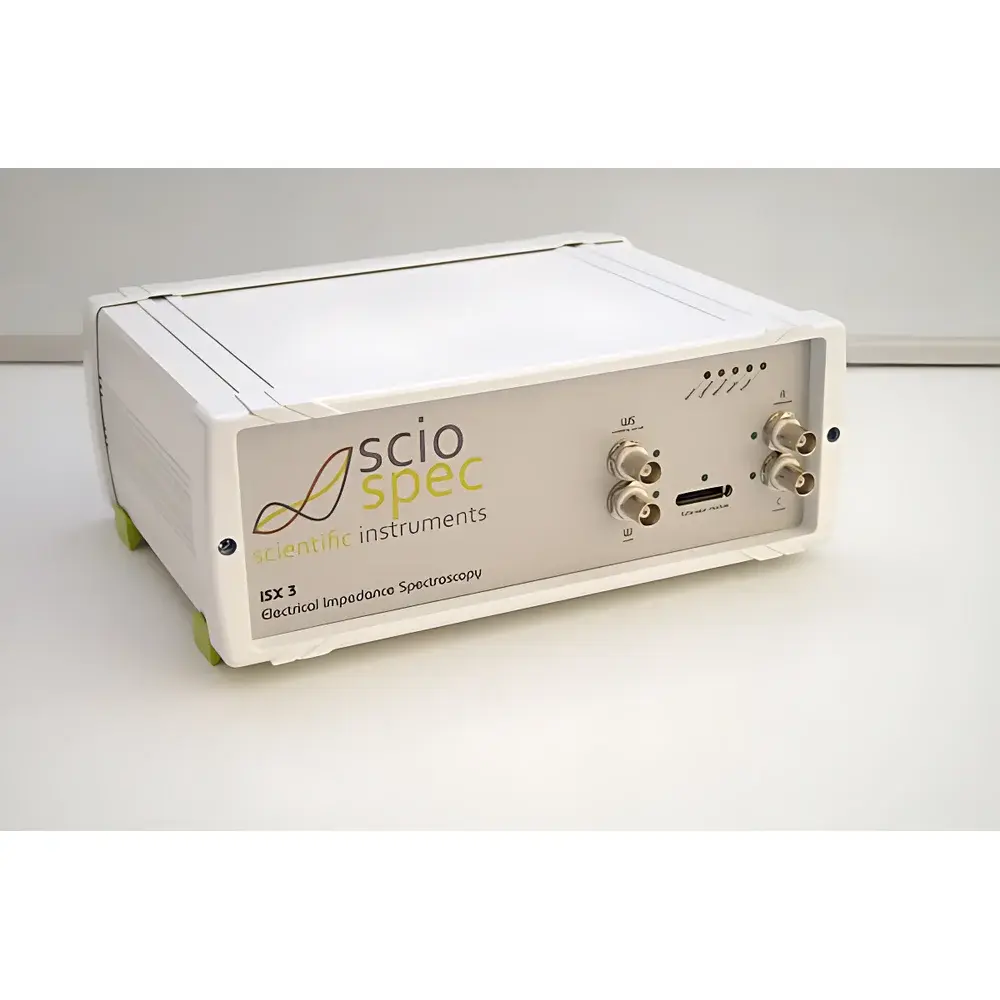
Sciospec ISX-3 Bio-Impedance Analyzer
| Brand | Sciospec |
|---|---|
| Model | ISX-3 |
| Type | Single-Channel Broadband Impedance Analyzer |
| Frequency Range | 100 mHz – 10 MHz (extendable to 40 MHz or 100 MHz) |
| Basic Accuracy | ±0.01% |
| Dynamic Range | 180 dB (from mΩ to GΩ) |
| DC Bias | ±1 V |
| Electrode Configurations | 2-, 3-, and 4-terminal |
| Interface | USB 2.0 High-Speed, Ethernet, Optional Wi-Fi |
| Safety Certification | Medical-Grade Isolated Power Supply (IEC 60601-1 compliant) |
| Software API | Native COM interface for Python, MATLAB, LabVIEW, C, Java |
| Max Points per Sweep | 2048 |
| Input/Output Synchronization | Hardware-triggered I/O via Sync In/Out BNC |
| Expansion Options | MEArack, ECISadapter, SlideChipAdapter (50-channel), Temperature Monitoring (dual NTC), Multi-Channel Multiplexer (up to 64 analog channels) |
Overview
The Sciospec ISX-3 Bio-Impedance Analyzer is a high-precision, single-channel broadband impedance spectrometer engineered for rigorous biomedical and electrochemical research. It operates on the principle of frequency-domain AC impedance spectroscopy—applying a small-signal sinusoidal voltage across a biological sample and measuring the complex current response to determine magnitude and phase of impedance over a defined frequency spectrum. With a standard operating range from 100 mHz to 10 MHz—and optional hardware extensions enabling operation up to 100 MHz—the ISX-3 delivers exceptional resolution in both low-frequency cellular response regimes (e.g., membrane capacitance, tight junction integrity) and high-frequency bulk conductivity domains. Its 180 dB dynamic range supports measurements spanning milliohms to gigaohms, making it suitable for characterizing heterogeneous biological interfaces—from monolayer cell cultures on microelectrode arrays to hydrogel-embedded tissue constructs. The instrument integrates medical-grade galvanic isolation per IEC 60601-1, ensuring safe operation in live-cell and preclinical experimental environments where electrical safety and signal fidelity are non-negotiable.
Key Features
- High-fidelity impedance measurement with ±0.01% basic accuracy and 2048-point spectral resolution per sweep
- Flexible electrode configuration support: 2-, 3-, and 4-terminal setups for optimal compensation of contact and cable impedance
- Dual-mode excitation: AC-only mode and AC+DC bias (±1 V) for probing electrochemical double-layer behavior or voltage-gated cellular responses
- Hardware-synchronized I/O via BNC-triggered Sync In/Out ports—enabling precise temporal alignment with external stimuli (e.g., optical activation, microfluidic valve control)
- Modular expansion architecture via ExtensionPort interface—compatible with MEArack, ECISadapter, and SlideChipAdapter systems
- Medical-grade isolated power supply certified to IEC 60601-1, eliminating ground-loop artifacts and ensuring compliance with GLP/GMP lab infrastructure requirements
- Cross-platform software control via native COM interface—fully scriptable in Python, MATLAB, LabVIEW, C, and Java for automated assay development
Sample Compatibility & Compliance
The ISX-3 is validated for use with standardized bioelectrode platforms including commercial multi-electrode arrays (MEAs), ECIS Cultureware® 8-well plates (e.g., 8W1E, 8W10E+, 1F8x1E), and custom microfabricated chips. Its front-panel BNC, SMA, MCX, and DSUB connectors accommodate diverse sensor form factors, while bottom- and top-mounted optical windows permit concurrent impedance acquisition and high-resolution microscopy (phase contrast, fluorescence, confocal). All configurations meet ISO 13485 design control principles for in vitro diagnostic (IVD) development workflows. When deployed with temperature monitoring modules (dual NTC inputs), the system supports ASTM E2913-compliant thermal stability validation for long-duration barrier function assays. Data integrity adheres to FDA 21 CFR Part 11 requirements when used with Sciospec’s audit-trail-enabled software suite.
Software & Data Management
The included Sciospec Impedance Studio software provides a fully integrated GUI for real-time visualization, parameter fitting (e.g., Cole-Cole, Randles, distributed element models), and batch processing of time-series impedance datasets. Raw data is exported in HDF5 and CSV formats with embedded metadata (timestamp, frequency vector, calibration state, hardware configuration). The COM API enables direct integration into custom LIMS or ELN platforms, supporting structured experiment logging aligned with ISO/IEC 17025 documentation standards. Firmware updates and calibration certificate management are handled through a secure, version-controlled repository accessible via Ethernet or USB. All measurement sessions include automatic checksum generation and digital signature verification to satisfy GLP audit requirements.
Applications
- Real-time monitoring of epithelial/endothelial barrier integrity (TEER quantification) in transwell and chip-based models
- Label-free kinetic profiling of cell adhesion, spreading, migration, and wound-healing dynamics
- Characterization of extracellular matrix remodeling under pharmacological or mechanical stimulation
- Development and validation of point-of-care biosensors based on interdigitated electrode (IDE) or nanowire transducers
- Electrophysiological phenotyping of stem-cell-derived cardiomyocytes or neuronal networks on MEAs
- Quality control of conductive hydrogels and bioprinted constructs during maturation
- Correlation of impedance spectra with histological endpoints in preclinical toxicology studies
FAQ
What electrode configurations does the ISX-3 support?
The ISX-3 natively supports 2-terminal (simple impedance), 3-terminal (guarded measurement), and 4-terminal (Kelvin sensing) configurations to minimize lead resistance and parasitic capacitance effects.
Can the ISX-3 be used for FDA-regulated assay development?
Yes—when operated with audit-trail-enabled software, calibrated traceably to NIST standards, and deployed in an ISO 13485-certified environment, the ISX-3 meets foundational instrumentation requirements for IVD assay validation.
Is synchronization with external hardware possible?
Yes—via dedicated Sync In/Out BNC ports, the ISX-3 achieves sub-microsecond hardware-level timing alignment with microscopes, perfusion pumps, or optogenetic stimulators.
How many frequency points can be measured per sweep?
Up to 2048 logarithmically spaced points per sweep, configurable within the 100 mHz–10 MHz baseband or extended ranges.
Does the system support temperature monitoring during long-term assays?
Yes—two integrated NTC input channels allow simultaneous recording of local substrate temperature with 0.1 °C resolution, critical for kinetic modeling of biological processes.



