
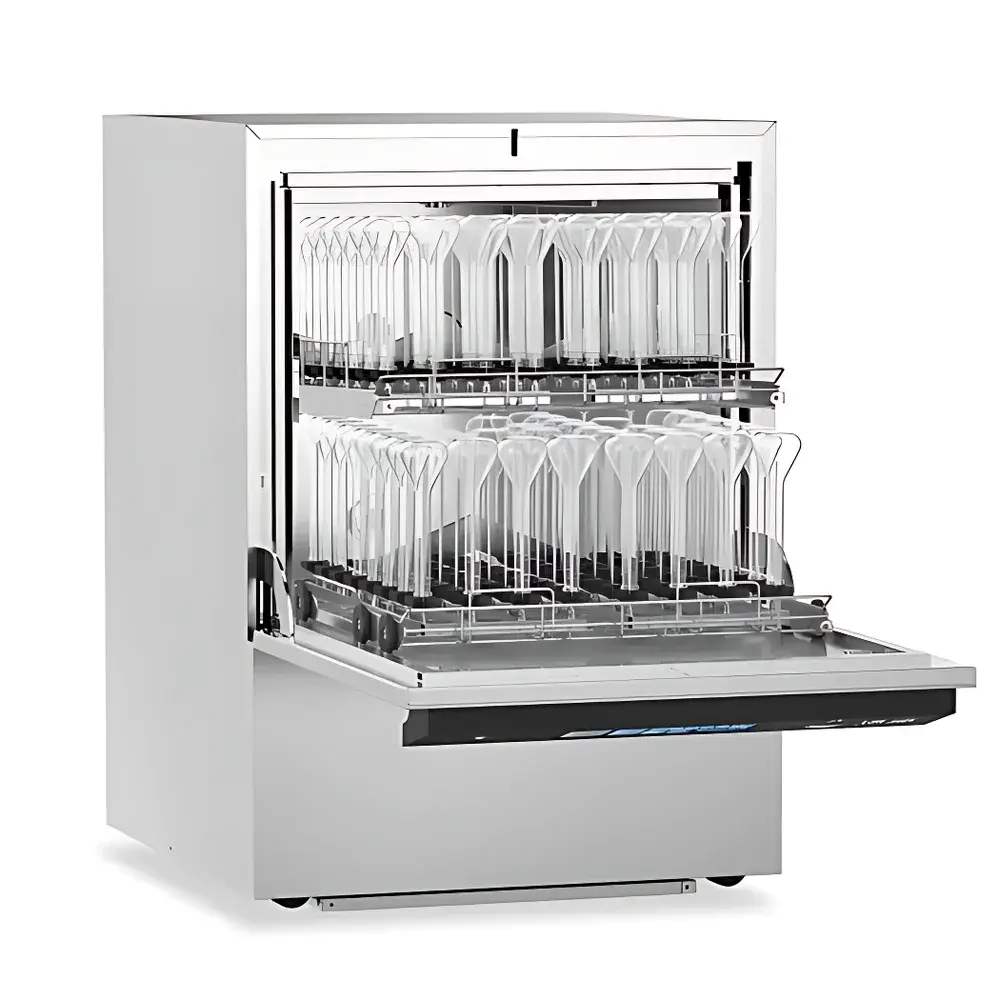
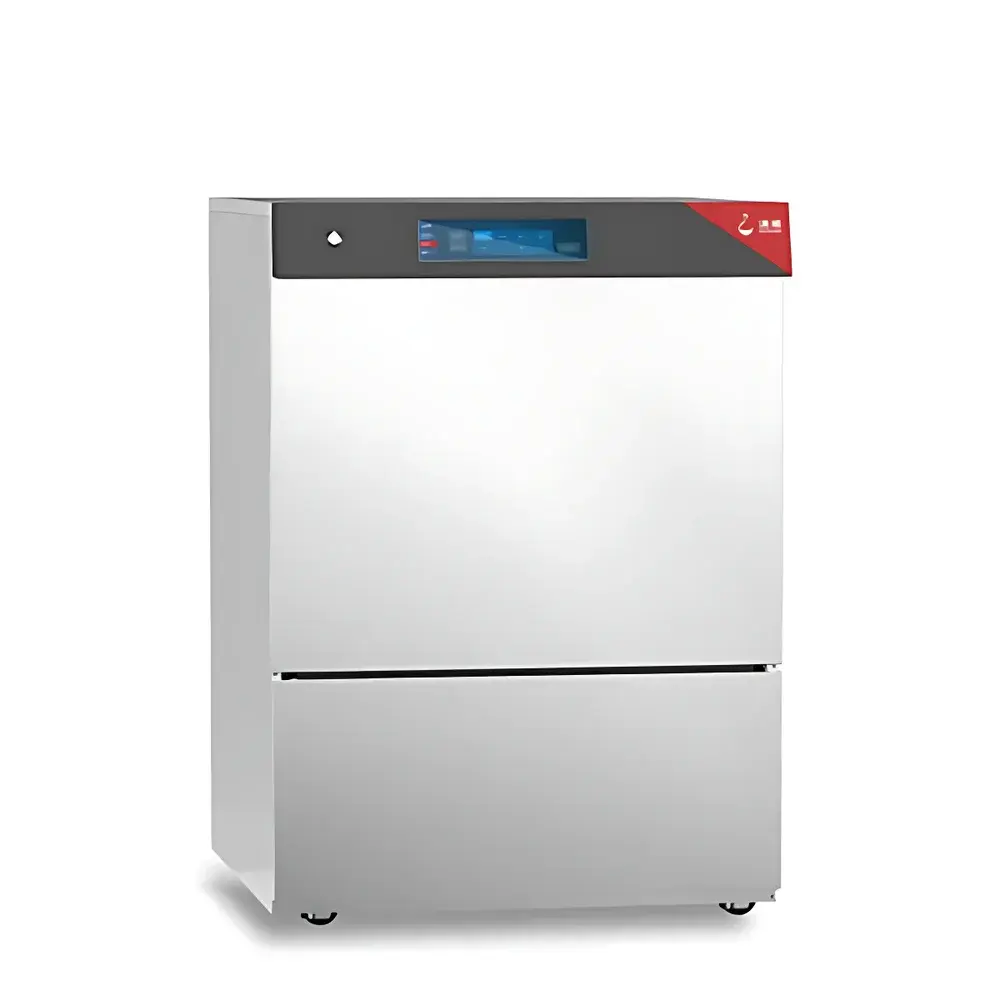
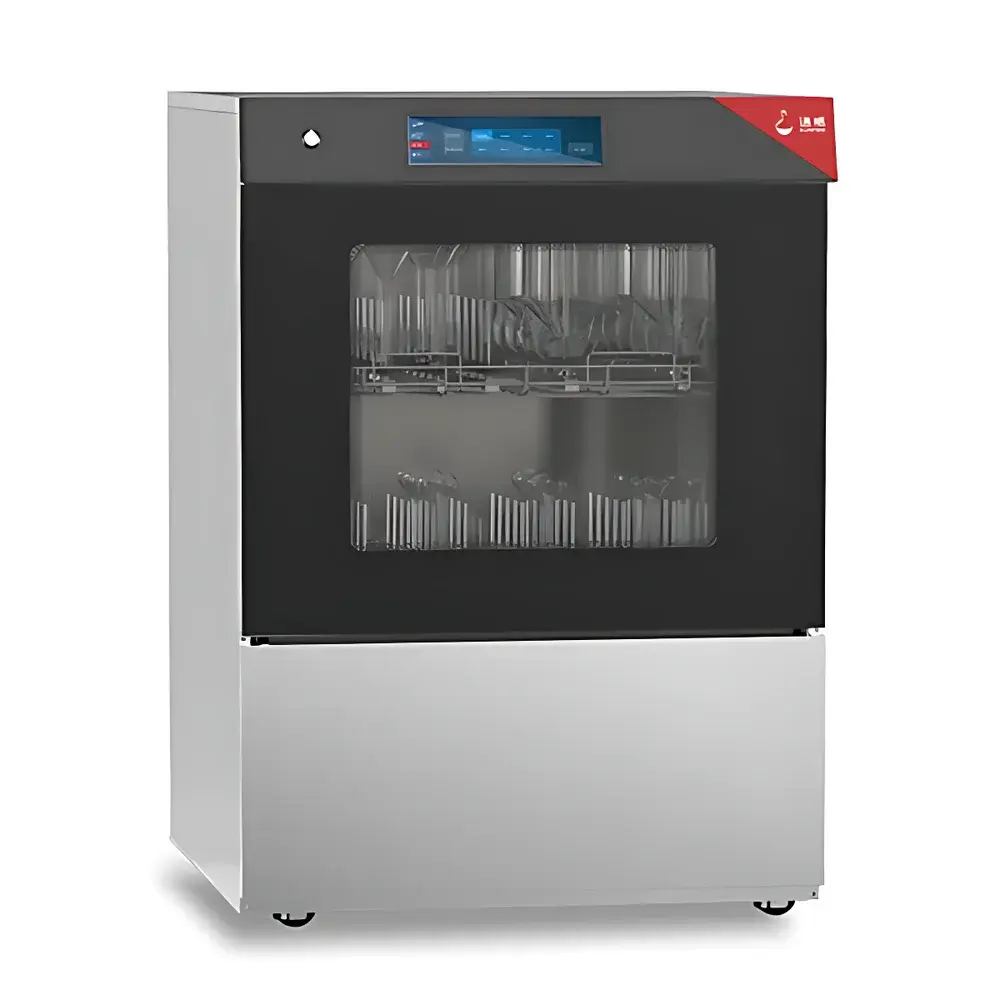
EURPING Q620D Laboratory Bottle Washer
| Brand | EURPING |
|---|---|
| Origin | Tianjin, China |
| Manufacturer Type | Direct Manufacturer |
| Product Category | Domestic (China-Made) |
| Model | Q620D |
| Chamber Volume | 185 L |
| Heating Power | 4000 W |
| Temperature Range | Ambient to 93 °C |
| Recirculation Pump Flow Rate | 0–500 L/min |
| Compatible Cleaning Agents | Alkaline & Acidic Detergents |
| External Dimensions (L×W×D) | 670 × 690 × 940 mm |
| Cabinet Material | 304 Stainless Steel |
| Interior Chamber Material | 316L Stainless Steel |
| Control Interface | 8.8-inch Touchscreen |
| Preloaded Programs | 30 Standard + 120 Customizable |
| Data Logging | SD Card Audit Trail + RS232 Print Output |
| Safety Features | Motorized EULA Door Lock, Overtemperature Protection, Leak Detection, Low-Fluid Alerts, Dual-Channel Detergent Dispensing, Multi-Stage Filtration System |
| Drying Method | Energy-Efficient Residual-Heat Drying |
Overview
The EURPING Q620D Laboratory Bottle Washer is an engineered solution for high-throughput, traceable, and validated cleaning of glassware and labware in regulated research, quality control, and pharmaceutical environments. Designed around a closed-loop recirculating washing system, it employs thermally stable stainless-steel fluid pathways and programmable multi-stage cycles—including pre-rinse, alkaline wash, acid rinse, final rinse, and residual-heat drying—to remove organic residues, particulates, and inorganic salts from volumetric flasks, pipettes, test tubes, Erlenmeyer flasks, beakers, graduated cylinders, wide-mouth and narrow-neck bottles, and other standard laboratory containers. Its architecture complies with core principles of Good Laboratory Practice (GLP) and supports alignment with ISO 15190:2020 (laboratory safety), ISO 13485 (medical device manufacturing), and FDA 21 CFR Part 11 requirements through comprehensive electronic audit trail functionality.
Key Features
- Robust chamber construction: 316L stainless steel interior (electropolished finish) and 304 stainless steel outer cabinet ensure corrosion resistance against aggressive alkaline and acidic detergents across repeated thermal cycles.
- Large-capacity processing: 185 L chamber volume accommodates dual-tier basket configurations—enabling simultaneous cleaning of ≥100 mL volumetric flasks or mixed-load arrangements via FL-EXCH modular rack system (1/2-module interchangeability).
- Intelligent fluid management: Variable-frequency recirculation pump (0–500 L/min) with real-time pressure sensing and backside manifold delivery ensures uniform spray coverage and minimizes dead zones.
- Dual-detergent dispensing: Independent metered delivery of alkaline and acidic solutions enables pH-controlled cleaning sequences optimized for specific residue profiles (e.g., protein vs. metal oxide removal).
- Full-cycle data integrity: Microprocessor-based controller logs timestamped operational states of all electromechanical components—including heater status, pump duty cycle, door lock engagement, detergent dosing events, temperature ramps, and pressure transients—stored on removable SD card with tamper-resistant audit trail formatting.
- Regulatory-grade access control: Three-tier user permission system (Operator / Supervisor / Administrator) enforces role-based workflow restrictions; touchscreen interface includes automatic sleep mode with manual wake-up and live display of flow rate, chamber temperature, elapsed time, and system pressure.
Sample Compatibility & Compliance
The Q620D accepts standard laboratory glassware up to 1000 mL in height and 120 mm in diameter, including Class A volumetric flasks, serological pipettes, culture tubes, conical flasks, and reusable sample vials. Its FL-EXCH rack recognition system detects basket presence and configuration in real time, preventing program execution if improperly loaded. All wetted surfaces meet USP material compatibility guidelines. The unit’s validation-ready design supports IQ/OQ documentation packages and conforms to EN 61000-6-3 (EMC emissions) and EN 61000-6-2 (immunity) standards. Optional calibration certificates for temperature sensors and pressure transducers are available upon request.
Software & Data Management
The embedded control firmware provides native support for electronic record retention per FDA 21 CFR Part 11 Annex 11 expectations. Each wash cycle generates a unique digital log file containing operator ID, start/stop timestamps, selected program ID, deviation flags (if any), and full parameter history. RS232 serial output enables direct integration with LIMS or MES platforms for automated report generation. Data export formats include CSV and PDF; no proprietary software installation is required for review or archival. Audit trail entries are immutable and include cryptographic hash verification to prevent post-hoc editing.
Applications
The Q620D serves laboratories requiring reproducible, auditable cleaning outcomes—including analytical chemistry labs performing HPLC/GC sample preparation; QC units in API and finished-dose pharmaceutical manufacturing; clinical diagnostic facilities adhering to CLIA and CAP requirements; and academic core facilities supporting grant-funded metabolomics or proteomics workflows. It eliminates manual scrubbing variability, reduces solvent consumption by up to 70% versus sink-based methods, and lowers long-term labor costs while improving personnel safety through reduced exposure to caustic chemicals and repetitive motion stress.
FAQ
Does the Q620D support validation protocols for GMP environments?
Yes—the system is designed for IQ/OQ execution and includes documented traceability of critical parameters (temperature, pressure, flow, timing), electronic signatures, and configurable alarm thresholds aligned with Annex 15 and WHO TRS 986 guidance.
Can I integrate the washer into our existing LIMS infrastructure?
Yes—via RS232 serial interface using standard ASCII command sets; optional Modbus TCP gateway modules are available for Ethernet-based SCADA integration.
What maintenance intervals are recommended for optimal performance?
Primary filter cartridges should be inspected weekly and replaced every 3–6 months depending on water hardness and load frequency; heat exchanger surfaces require quarterly descaling; annual calibration of temperature and pressure sensors is advised.
Is residual-heat drying sufficient for moisture-sensitive applications?
Residual-heat drying achieves ≤5% relative humidity inside chamber post-cycle; for hygroscopic or sterility-critical applications, optional forced-air drying module (Q620D-DA) is available as an add-on.
How does the FL-EXCH rack system improve workflow flexibility?
FL-EXCH enables rapid reconfiguration of basket layouts without tools—half-modules can be swapped between top/bottom tiers or across different rack types (e.g., pipette vs. flask orientation), reducing changeover time between batch types by >40%.



