
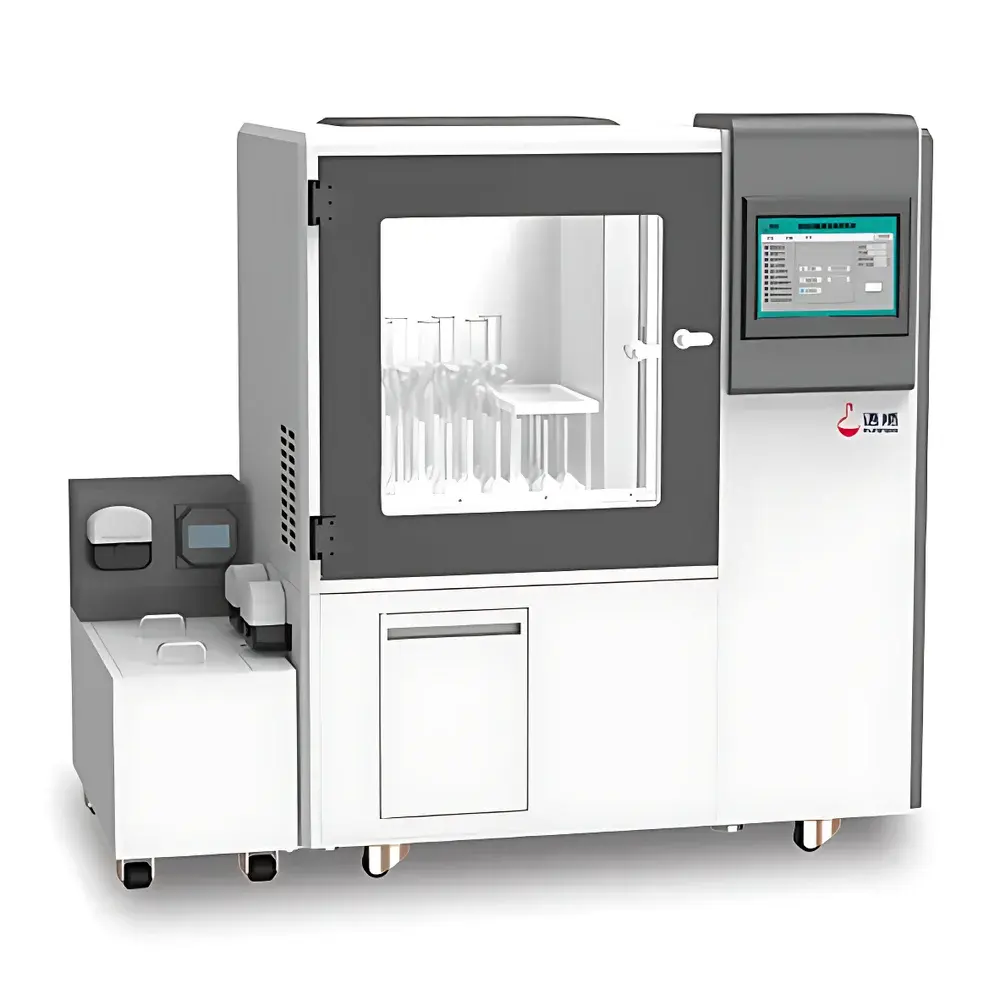
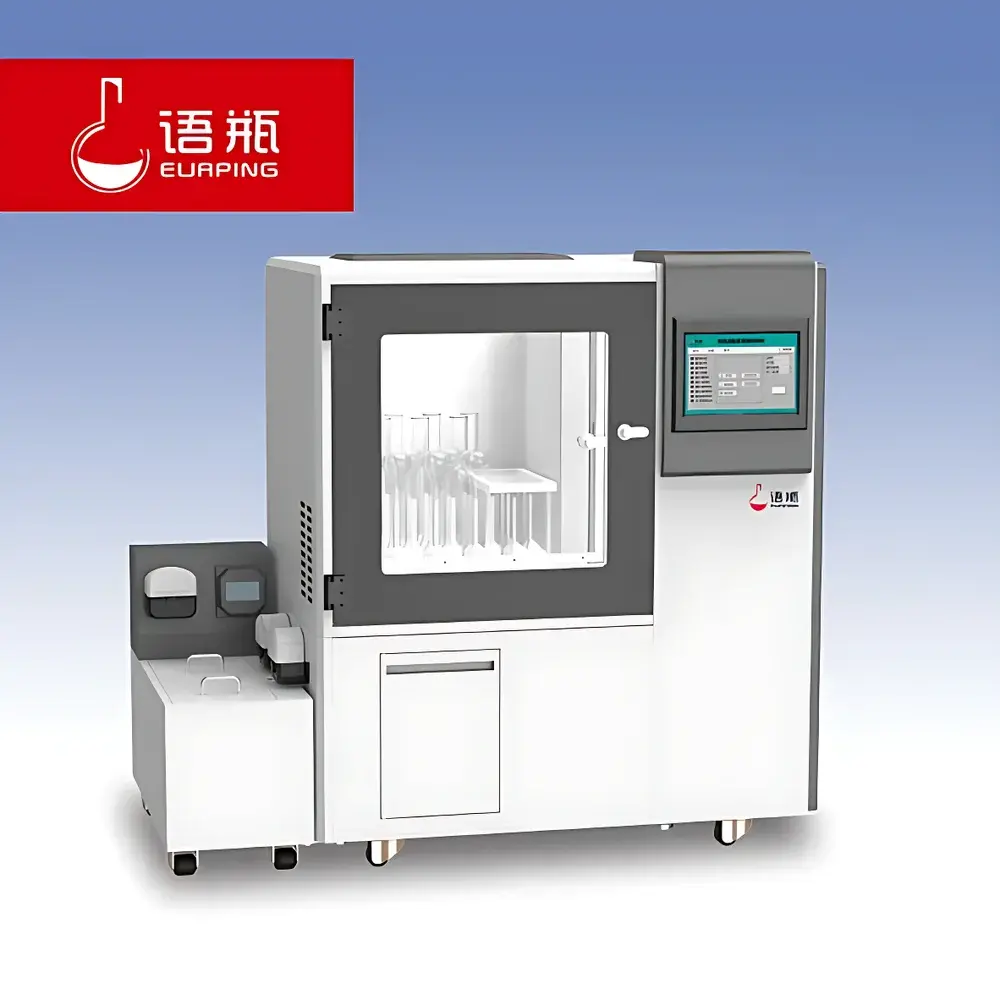
EURPING Acide 3300 Sub-Boiling Acid Vapor Ultra-Clean Laboratory Cleaner
| Brand | EURPING |
|---|---|
| Origin | Tianjin, China |
| Manufacturer Type | Direct Manufacturer |
| Model | Acide 3300 Sub-Boiling Acid Vapor Ultra-Clean Cleaner |
| Automation Level | Fully Automatic |
| Cleaning Efficiency | 99.99% |
| Total Cycle Time | 60–90 min |
| Acid Heating Profile | Ramp-to-90°C in ≤5 min |
| Rinse Duration | 3–6 sec (non-recirculating ultrapure water spray) |
| Exhaust System | Integrated EP acid gas absorption with active exhaust fan |
| Waste Effluent pH | Neutral (pH ≈ 7) |
| Door Design | Dual-layer transparent front-access door with enhanced sealing |
Overview
The EURPING Acide 3300 is a fully automated, sub-boiling acid vapor ultra-clean laboratory cleaner engineered for trace-level analytical laboratories requiring ultra-low elemental background in glassware, quartzware, and fluoropolymer labware (PFA, PTFE, TFM). It operates on the principle of controlled sub-boiling acid vapor condensation—where high-purity nitric or hydrochloric acid is heated below its boiling point to generate a saturated, unidirectional vapor phase that uniformly condenses on cooler vessel surfaces. This condensate dissolves and mobilizes adsorbed metal cations (e.g., Fe, Al, Cr, Ni, Pb), halides, and silicate residues without thermal decomposition or aerosol generation. Unlike conventional reflux or immersion methods, the Acide 3300 eliminates cross-contamination via non-recirculating vapor flow and single-pass ultrapure water (≥18.2 MΩ·cm) spray rinse—ensuring no carryover of residual acid or leached ions into subsequent analyses. The system is purpose-built for ICP-MS, HR-ICP-MS, GF-AAS, and low-background radiochemistry workflows where blank levels must remain below 0.1 pg/mL for key transition metals.
Key Features
- Sub-boiling acid vapor generation with programmable ramp-and-hold thermal profile: achieves 90°C in ≤5 minutes and stabilizes at 95°C within 10 minutes—maintaining optimal vapor saturation while preventing acid decomposition or over-pressurization.
- Non-recirculating, unidirectional acid vapor path combined with instantaneous, non-recirculating ultrapure water spray rinse (3–6 seconds duration), eliminating re-deposition risks and ensuring complete acid removal prior to drying.
- Integrated EP (Enhanced Protection) acid gas abatement system: features an active exhaust fan coupled with a chemically impregnated sorbent cartridge, neutralizing >99.5% of HNO₃/HCl vapors before atmospheric release—compliant with OSHA PEL and EU Directive 2004/101/EC workplace exposure limits.
- Fully automated acid dosing and drainage: includes real-time acid level sensing, auto-refill prompts, and full sump evacuation capability—reducing operator intervention and minimizing manual handling of concentrated acids.
- Dual-layer borosilicate viewing door with positive-seal gasket and front-access configuration: enables continuous visual monitoring of cleaning chamber dynamics while maintaining Class II containment integrity per ISO 15195:2018 for hazardous vapor environments.
- Neutralized effluent discharge: integrated pH stabilization module ensures waste output meets municipal sewer discharge standards (pH 6.5–7.5), eliminating need for secondary neutralization tanks.
Sample Compatibility & Compliance
The Acide 3300 accommodates a broad range of trace-metal-clean labware including borosilicate glass volumetric flasks (up to 2 L), quartz digestion tubes (QZ-100 series), PFA/PTFE/Teflon®-lined caps and liners, quartz ICP-MS sample introduction components (torch injectors, nebulizer housings, spray chambers), and fused silica capillary assemblies. All wetted materials—including vapor chamber walls, spray nozzles, and drain lines—are constructed from high-purity quartz or electropolished 316L stainless steel with passivated surfaces (ASTM A967). The system supports compliance with ISO/IEC 17025:2017 method validation requirements for cleaning efficacy verification, and its documented cleaning cycle parameters are suitable for inclusion in GLP/GMP audit trails per FDA 21 CFR Part 11 when paired with optional electronic log export.
Software & Data Management
The embedded control interface provides password-protected user roles (Operator, Supervisor, Administrator), timestamped cycle logging (start/end time, acid type, temperature profile, rinse duration, fault codes), and USB export of CSV-formatted audit logs. Optional Ethernet connectivity enables integration with LIMS platforms via Modbus TCP or OPC UA protocols. All critical process parameters—including acid reservoir level, chamber temperature, exhaust flow rate, and rinse conductivity (<0.055 µS/cm)—are continuously monitored and graphically displayed in real time. Cycle reports include pass/fail status against pre-defined acceptance criteria (e.g., post-rinse resistivity ≥18.0 MΩ·cm, chamber residual acidity <10 ppb H⁺), supporting ISO 15189:2022 clause 5.5.2 traceability requirements.
Applications
- Preparation of ultra-clean vessels for EPA Method 1638, 200.8, and 6020B trace metal analysis.
- Decontamination of ICP-MS sample introduction systems to reduce polyatomic interferences (e.g., 40Ar16O⁺ on 56Fe⁺).
- Routine cleaning of cleanroom-grade quartz ware used in semiconductor metrology (SEMI F57-0218).
- Reconditioning of PFA vials and caps after high-acid microwave digestion (CEM MARS 6, Anton Paar Multiwave PRO).
- Blank minimization in radiometric assays involving 238U, 232Th, and 40K isotopic measurements (ASTM D3613-15).
FAQ
What acid types are compatible with the Acide 3300?
Nitric acid (HNO₃, 69–70%), hydrochloric acid (HCl, 37%), and aqua regia (3:1 HCl:HNO₃) are validated; HF and perchloric acid are strictly prohibited due to material compatibility and safety constraints.
How is cleaning efficacy verified?
Users perform periodic blank testing using certified reference materials (e.g., NIST SRM 3100 series) or conduct in-house spike-recovery studies; recommended verification frequency is every 50 cycles or weekly, whichever occurs first.
Does the system require external ventilation ducting?
No—integrated EP acid gas absorption allows standalone operation in standard laboratory fume hood–free environments, though connection to building exhaust is permissible for additional redundancy.
Can the Acide 3300 be validated per GMP Annex 15 guidelines?
Yes—the system supports IQ/OQ documentation packages, including temperature mapping, acid vapor distribution uniformity testing, and rinse water conductivity validation protocols aligned with EU GMP Annex 15 Section 4.3.
What maintenance intervals are recommended?
Acid reservoir and drain line inspection every 100 cycles; EP sorbent cartridge replacement every 6 months or after 500 cycles; quartz chamber visual inspection for etching or residue buildup quarterly.



