
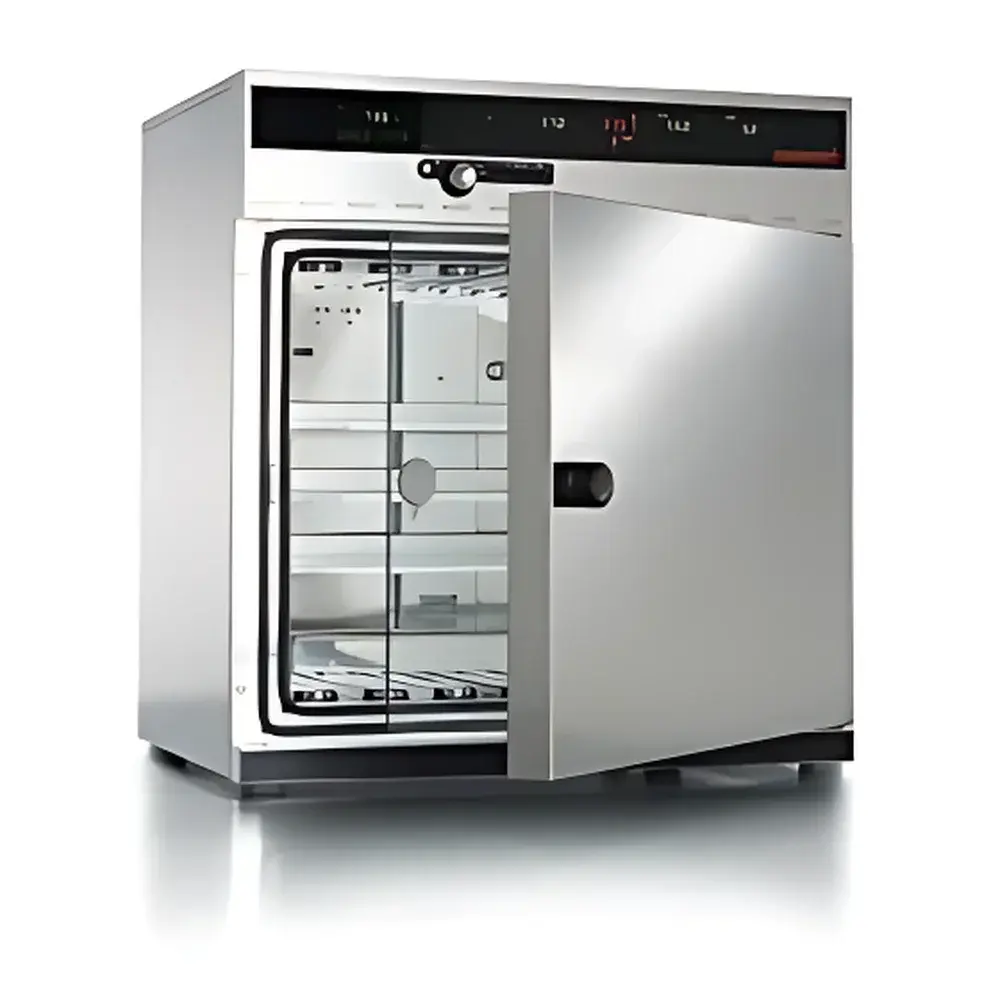
MEMMERT INC108 / INC153 / INC246 Carbon Dioxide Incubator
| Brand | MEMMERT |
|---|---|
| Origin | Germany |
| Model | INC108 / INC153 / INC246 |
| Temperature Range | +20 °C to +50 °C (min. +8 K above ambient) |
| Humidity Range (standard) | 88–97 % RH |
| Humidity Range (with optional Dynamic Humidity Module) | 40–97 % RH |
| CO₂ Range (standard) | 0–10 % vol. |
| CO₂ Range (with CO₂ Module) | 0–20 % vol. |
| O₂ Range (with O₂ Module) | 1–20 % vol. |
| Sterilization | Dry-heat at +160 °C for 4 h (full chamber, including CO₂ sensor) |
| Temperature Uniformity (DIN 12880 | 2007-05, 37 °C): ≤ ±0.3 °C |
| Temperature Stability (DIN 12880 | 2007-05): ≤ ±0.13 °C |
| Sensor Type | 4-wire Pt100 (redundant), NDIR CO₂ sensor with auto-zero calibration every 24 h |
| Compliance | Certified as Class IIa medical device per MDR (EU 2017/745), GLP/GMP-ready architecture |
Overview
The MEMMERT INC108, INC153, and INC246 are precision-engineered carbon dioxide incubators designed for demanding life science applications—including mammalian cell culture, stem cell expansion, in vitro fertilization (IVF), and primary tissue maintenance—where physiological fidelity and long-term operational reliability are non-negotiable. These instruments operate on a dual-control principle: independent regulation of CO₂ concentration (via non-dispersive infrared, or NDIR, sensing), temperature (via high-stability 4-wire Pt100 probes), and humidity (via capacitive sensors validated for repeated +160 °C sterilization cycles). Unlike conventional incubators relying on single-point sensing or passive humidification, the MEMMERT platform integrates active gas mixing, laminar airflow distribution, and full-chamber thermal validation to ensure spatial uniformity and temporal stability across all operating conditions. Each unit is certified as a Class IIa medical device under EU Regulation 2017/745 (MDR), reflecting its design compliance with essential safety and performance requirements for clinical and regulated research environments.
Key Features
- Full-chamber dry-heat sterilization at +160 °C for 4 hours—validated for all internal components including the NDIR CO₂ sensor, stainless-steel chamber, and humidity probe—eliminating microbial carryover without chemical residues.
- Dual-redundant 4-wire Pt100 temperature sensing with real-time self-diagnosis: if one probe fails, the system maintains operation while triggering an audible and visual alert.
- NDIR-based CO₂ control with automatic zero-point calibration every 24 hours and user-accessible 3-point calibration (at 5%, 7%, and 10% CO₂) without external hardware or software.
- Modular architecture supporting up to seven optional functional modules: Comfort (dual CO₂ cylinder auto-switching), Clean (electropolished, laser-welded interior), Communication (USB + Celsius software integration, printer interface, cycle logging), CO₂ Expansion (0–20% range), O₂ Control (N₂-mediated, 1–20% O₂), Advanced (bundle of Comfort/Clean/Communication/CO₂), and Dynamic Humidity (active humidification/dehumidification, 40–97% RH).
- Laminar, turbulence-free air circulation ensures homogeneous temperature distribution (≤ ±0.3 °C at 37 °C per DIN 12880:2007-05) and rapid recovery (<3 min to re-establish set humidity after door opening when equipped with Dynamic Humidity Module).
- Comprehensive safety architecture: independent overtemperature cut-off (mechanical TB limiter + digital ASF controller), door-open alarm, low-water detection, CO₂ high/low deviation alerts, and fail-safe heating shutdown on critical fault detection.
Sample Compatibility & Compliance
The INC series accommodates standard SBS-format multiwell plates, T-flasks (up to T225), roller bottles, and Petri dishes across three working volumes (108 L, 153 L, 246 L), with adjustable stainless-steel shelving configurations. All internal surfaces are constructed from electropolished 1.4404 (AISI 316L) stainless steel—welded using orbital laser technology to eliminate crevices and ensure cleanability. The incubators comply with ISO 13485:2016 for medical device quality management systems and support audit readiness for GLP (OECD Principles) and GMP (ICH Q5D, USP ) workflows. The integrated Celsius software enables electronic record keeping compliant with FDA 21 CFR Part 11 when configured with user access controls, audit trails, and electronic signatures. Humidity and CO₂ sensors are traceably calibrated per ISO/IEC 17025 requirements; factory-issued calibration certificates (performed at chamber center, 37 °C) are included with each unit.
Software & Data Management
The “Celsius” control software—supplied with the Communication Module—provides full remote configuration, real-time monitoring, and automated data logging (temperature, CO₂, humidity, O₂, alarms, door events) at user-defined intervals. It supports weekly scheduling (e.g., weekend-only operation), multi-level password protection (administrator/operator/user), and export of CSV or PDF reports with time stamps and operator IDs. All parameter changes, calibration actions, and alarm events are recorded in an immutable audit trail with date/time stamping. The USB interface allows offline firmware updates and secure backup of program sequences. For laboratory information management system (LIMS) integration, Celsius supports Modbus TCP protocol via optional Ethernet gateway—enabling bidirectional communication with enterprise platforms while maintaining data integrity and version control.
Applications
These incubators serve as critical infrastructure in academic core facilities, biopharmaceutical QC labs, IVF clinics, and contract development and manufacturing organizations (CDMOs). Typical use cases include: long-term maintenance of adherent and suspension cell lines (e.g., CHO, HEK293, iPSCs); co-culture experiments requiring precise O₂ modulation (e.g., hypoxia studies in cancer biology); embryo culture under strict pH-buffering conditions (5% CO₂, 37 °C, >95% RH); and qualification of media formulations where humidity drift directly impacts osmolality and metabolite accumulation. The O₂ module enables physiologically relevant oxygen tension modeling (e.g., 2–5% O₂ for stem cell niches), while the Dynamic Humidity Module supports protocols involving frequent sampling or microinjection—where rapid environmental recovery prevents desiccation-induced apoptosis.
FAQ
Is the entire incubator chamber—including sensors—capable of +160 °C dry-heat sterilization?
Yes. The chamber, inner glass door, Pt100 probes, NDIR CO₂ sensor, and capacitive humidity sensor are all rated for uninterrupted exposure to +160 °C for 4 hours. This eliminates biofilm formation and meets EN ISO 14644-1 Class 5 cleanroom maintenance standards.
Can the CO₂ and O₂ modules be used simultaneously?
No. Due to gas mixing constraints and safety interlocks, the O₂ module is mutually exclusive with both the Comfort Module and Advanced Module. Dual-gas control requires custom engineering consultation.
What is the validation support provided for IQ/OQ/PQ protocols?
Each unit ships with a Factory Acceptance Test (FAT) report, 37 °C calibration certificate (center-point), and a complete set of blank IQ/OQ templates aligned with ASTM E2500 and Annex 15 (EU GMP). MEMMERT also offers on-site PQ execution services with documented uncertainty budgets.
Does the Dynamic Humidity Module require additional plumbing or external water supply?
No. It operates autonomously using an integrated Peltier-driven condensation/dehumidification system and recirculated reservoir water—no external connections or drain lines are needed.
How does the system handle CO₂ supply interruption during operation?
Upon cylinder depletion or line disconnection, the controller triggers an audible/visual alarm and logs the event. The chamber maintains temperature and humidity stability for ≥15 minutes while retaining residual CO₂; users may manually switch to the secondary cylinder (if Comfort Module is installed) or initiate emergency protocol without system reset.
Related Products



