
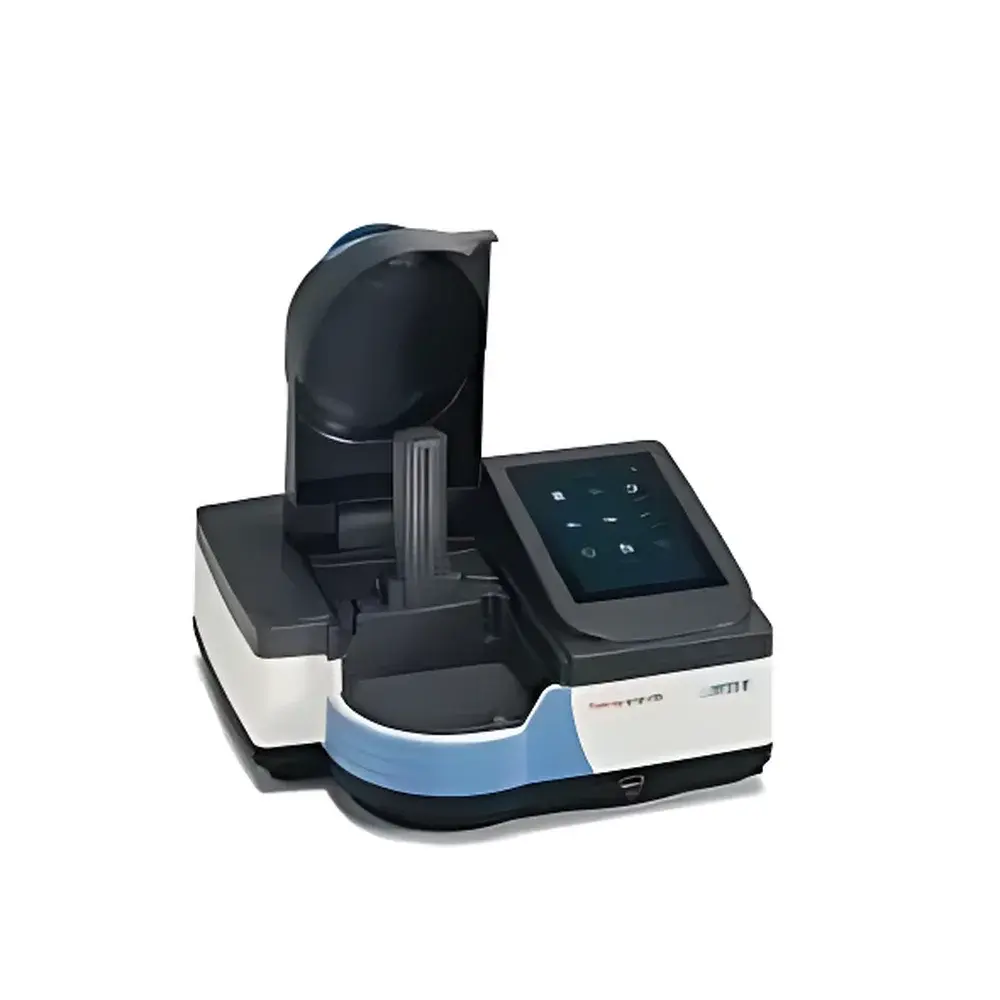
HunterLab Genesys 40 UV-Vis Spectrophotometer
| Brand | HunterLab |
|---|---|
| Origin | USA |
| Manufacturer Type | Authorized Distributor |
| Origin Category | Imported |
| Model | Genesys 40 |
| Optical Design | Dual-Beam |
| Detector | Photodiode Array |
| Wavelength Range | 325–1100 nm |
| Wavelength Accuracy | ±0.5 nm |
| Spectral Bandwidth | 5 nm |
| Stray Light | <0.05% T |
| Control Interface | Android-based Embedded System with 7" HD Touchscreen |
| Connectivity | Integrated Wi-Fi Module |
| Sample Compartment | Front-access, Removable & Washable Liner |
| Compatible Accessories | Cuvettes, 150 mm Test Tubes (≤25 mm Ø), Smart Pipetting Accessory, Peltier Single-Cell Holder, Fiber Optic Probes, Micro-volume Cuvette Adapters |
Overview
The HunterLab Genesys 40 UV-Vis Spectrophotometer is a dual-beam, benchtop spectrophotometric instrument engineered for precision absorbance and transmittance measurements across the ultraviolet and visible spectrum (325–1100 nm). Utilizing a stable xenon flash lamp as its broadband light source and a high-fidelity photodiode array detector, the Genesys 40 delivers consistent photometric performance without thermal drift or lamp warm-up delays. Its dual-beam optical architecture continuously references the sample beam against a matched reference beam—minimizing errors from source intensity fluctuations, environmental temperature shifts, or electronic noise. Designed for robustness in teaching laboratories, QC environments, and applied research settings, the instrument meets foundational requirements for method validation, routine calibration verification, and compliance-driven workflows under ISO/IEC 17025, ASTM E275, and USP guidelines.
Key Features
- 7-inch high-definition capacitive touchscreen interface—fully operable with standard laboratory gloves and optimized for intuitive navigation under ambient lab lighting
- Dual-beam optical path with real-time background correction, enabling high reproducibility (<0.001 AU repeatability at 1.0 AU) across extended measurement sessions
- Xenon flash lamp with >10⁹ flashes lifetime—eliminates routine lamp replacement downtime and ensures spectral stability across the full wavelength range
- Embedded Android operating system supporting on-instrument execution of preloaded methods including kinetic assays, multi-point quantitative analysis, peak identification, and spectral overlay
- Front-access sample compartment with removable, autoclavable polymer liner—facilitates rapid decontamination and accommodates oversized or irregularly shaped samples
- Integrated Wi-Fi module compliant with IEEE 802.11 b/g/n standards—enables secure transfer of spectra, methods, and reports to networked storage, LIMS, or cloud-based repositories
- Magnetic accessory mounting system—allows tool-free attachment/detachment of Peltier-controlled cell holders, fiber optic probes, smart pipetting modules, and micro-volume cuvette adapters
Sample Compatibility & Compliance
The Genesys 40 accepts standard 10 mm square cuvettes, round test tubes up to 150 mm in length and 25 mm in diameter, and micro-volume cells down to 50 µL capacity via optional adapters. Its large, unobstructed sample chamber permits integration of third-party accessories—including flow cells, temperature-controlled stages, and solid-sample reflectance holders—without compromising optical alignment. The instrument supports GLP/GMP-compliant operation through audit-trail-enabled software logging (user actions, method parameters, timestamped results), electronic signature readiness, and configurable data export formats (CSV, XML, PDF) aligned with FDA 21 CFR Part 11 requirements. All firmware and method libraries are version-controlled and traceable per ISO 9001 quality management protocols.
Software & Data Management
The embedded Android platform hosts a purpose-built spectrophotometry application with no external PC dependency. Methods—including custom kinetics protocols, multi-wavelength quantitation, and spectral derivative analysis—are stored locally and accessible via Smart Start—a context-aware launcher that surfaces frequently used assays based on time-of-day, user role, or recent sample type. Data files include embedded metadata (instrument ID, calibration date, operator ID, environmental conditions), ensuring full traceability. Wi-Fi connectivity enables scheduled backups to enterprise NAS systems or secure SFTP servers; print jobs route directly to networked printers without intermediate file handling. Software updates are delivered over-the-air and validated via cryptographic checksums prior to installation.
Applications
The Genesys 40 serves validated applications in pharmaceutical raw material identification (USP ), enzyme kinetics monitoring (e.g., NADH/NADPH oxidation at 340 nm), colorimetric assay development (e.g., Bradford, Lowry, BCA), water quality testing (nitrate, phosphate, COD), nanoparticle characterization (plasmon resonance profiling), and food ingredient quantification (carotenoids, anthocyanins, chlorophyll). Its 5 nm spectral bandwidth and <0.05% T stray light specification ensure accurate resolution of closely spaced absorption maxima in complex matrices. In academic settings, it supports curriculum-aligned experiments in analytical chemistry, biochemistry, and materials science—while industrial users deploy it for incoming inspection, in-process control, and stability-indicating assays.
FAQ
Does the Genesys 40 support regulatory compliance for pharmaceutical QC?
Yes—it provides electronic audit trails, user access controls, method versioning, and data integrity features aligned with FDA 21 CFR Part 11 and EU Annex 11 expectations.
Can I perform temperature-controlled measurements?
Yes—via optional Peltier single-cell holder (±0.1 °C stability) compatible with standard 10 mm cuvettes and integrated into the instrument’s method scheduler.
Is fiber optic probe measurement supported?
Yes—the front-access design and magnetic mounting system allow direct coupling of industry-standard SMA-905 fiber probes for remote or hazardous environment sampling.
What is the warranty and service coverage?
HunterLab provides a standard 2-year parts-and-labor warranty; extended service plans include preventive maintenance, performance verification, and on-site calibration traceable to NIST standards.
How is spectral calibration verified?
The instrument includes automated self-check routines using internal holmium oxide and neutral density filters; external verification follows ASTM E275 and ISO 6223 protocols using certified reference materials.




